Planned Maintenance: Some services may turn out to be unavailable from 15th January, 2026 to 16th January, 2026. We apologize for the inconvenience!

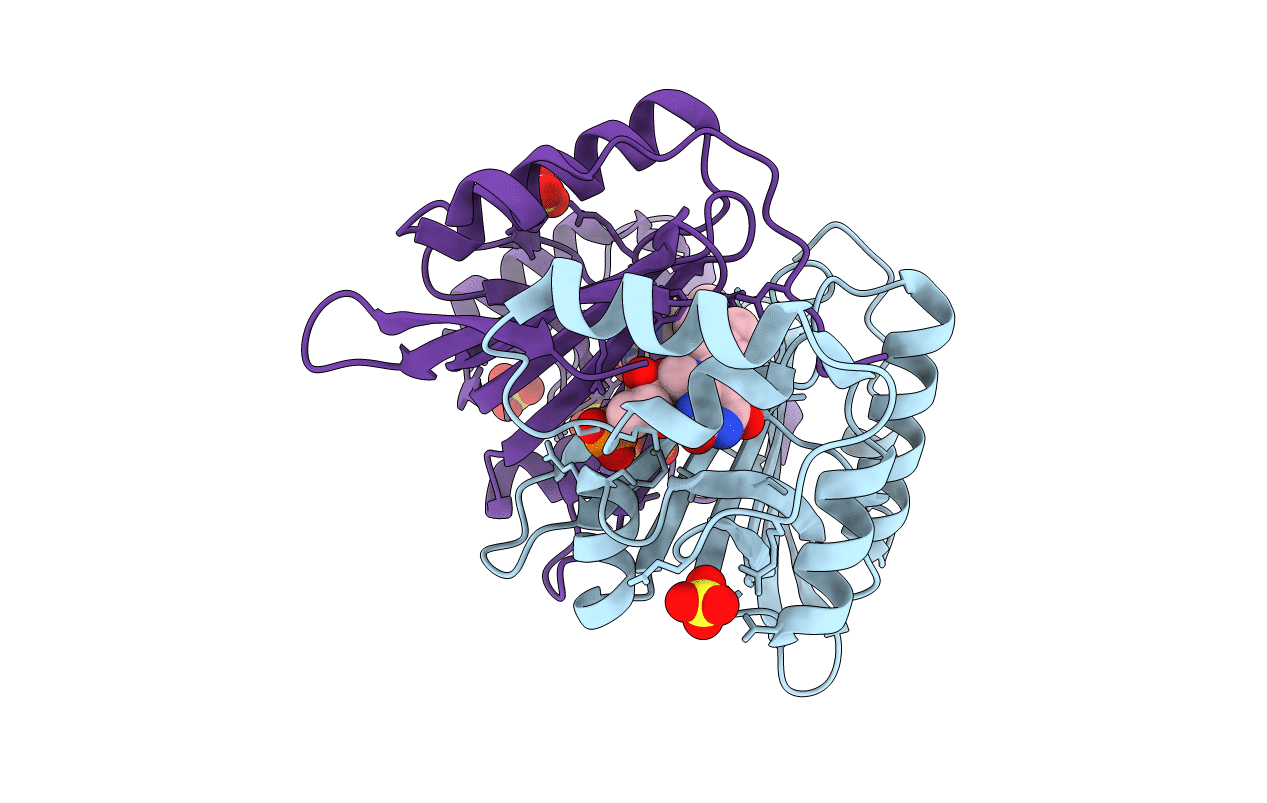
1TY9 image
Deposition Date 2004-07-07
Release Date 2004-11-23
Last Version Date 2023-08-23
Entry Detail
PDB ID:
1TY9
Keywords:
Title:
X-RAY CRYSTAL STRUCTURE OF PHZG FROM PSEUDOMONAS FLUORESCENS
Biological Source:
Source Organism(s):
Expression System(s):
Method Details:
Experimental Method:
Resolution:
1.80 Å
R-Value Free:
0.24
R-Value Work:
0.19
R-Value Observed:
0.19
Space Group:
P 21 21 21
Macromolecular Entities
Structures with similar UniProt ID
Protein Blast
Polymer Type:polypeptide(L)
Molecule:Phenazine biosynthesis protein phzG
Gene (Uniprot):phzG
Chain IDs:A, B
Chain Length:222
Number of Molecules:2
Biological Source:Pseudomonas fluorescens
Primary Citation
Structure of the phenazine biosynthesis enzyme PhzG.
Acta Crystallogr.,Sect.D 60 2110 2113 (2004)
PMID: 15502343 DOI: 10.1107/S0907444904022474

Abstact

PhzG is a flavin-dependent oxidase that is believed to play a role in phenazine antibiotic synthesis in various bacteria, including Pseudomonas. Phenazines are chorismic acid derivatives that provide the producing organisms, including the opportunistic pathogen P. aeruginosa, with a competitive growth advantage. Here, the crystal structures of PhzG from both P. aeruginosa and P. fluorescens solved in an unliganded state at 1.9 and 1.8 A resolution, respectively, are described. Although the specific reaction in phenazine biosynthesis catalyzed by PhzG is unknown, the structural data indicates that PhzG is closely related to pyridoxine-5'-phosphate oxidase, the Escherichia coli pdxH gene product, which catalyzes the final step in pyridoxal-5'-phosphate (PLP) biosynthesis. A previous proposal suggested that the physiological substrate of PhzG to be 2,3-dihydro-3-hydroxyanthranilic acid (DHHA), a phenazine precursor produced by the sequential actions of the PhzE and PhzD enzymes on chorismate, and that two DHHA molecules dimerized in another enzyme-catalyzed reaction to yield phenazine-1-carboxylate. However, it was not possible to demonstrate any in vitro activity upon incubation of PhzG and DHHA. Interestingly, analysis of the in vitro activities of PhzG in combination with PhzF suggests that PhzF acts on DHHA and that PhzG then reacts with a non-aromatic tricyclic phenazine precusor to catalyze an oxidation/aromatization reaction that yields phenazine-1-carboxylate. It is proposed that phzG arose by duplication of pdxH and that the subtle differences seen between the structures of PhzG and PdxH correlate with the loss of the ability of PhzG to catalyze PLP formation. Sequence alignments and superimpositions of the active sites of PhzG and PdxH reveal that the residues that form a positively charged pocket around the phosphate of PLP in the PdxH-PLP complex are not conserved in PhzG, consistent with the inability of phosphorylated compounds to serve as substrates for PhzG.

Legend

Protein

Chemical

Disease

Primary Citation of related structures
Feedback Form
Name
Email
Institute
Feedback