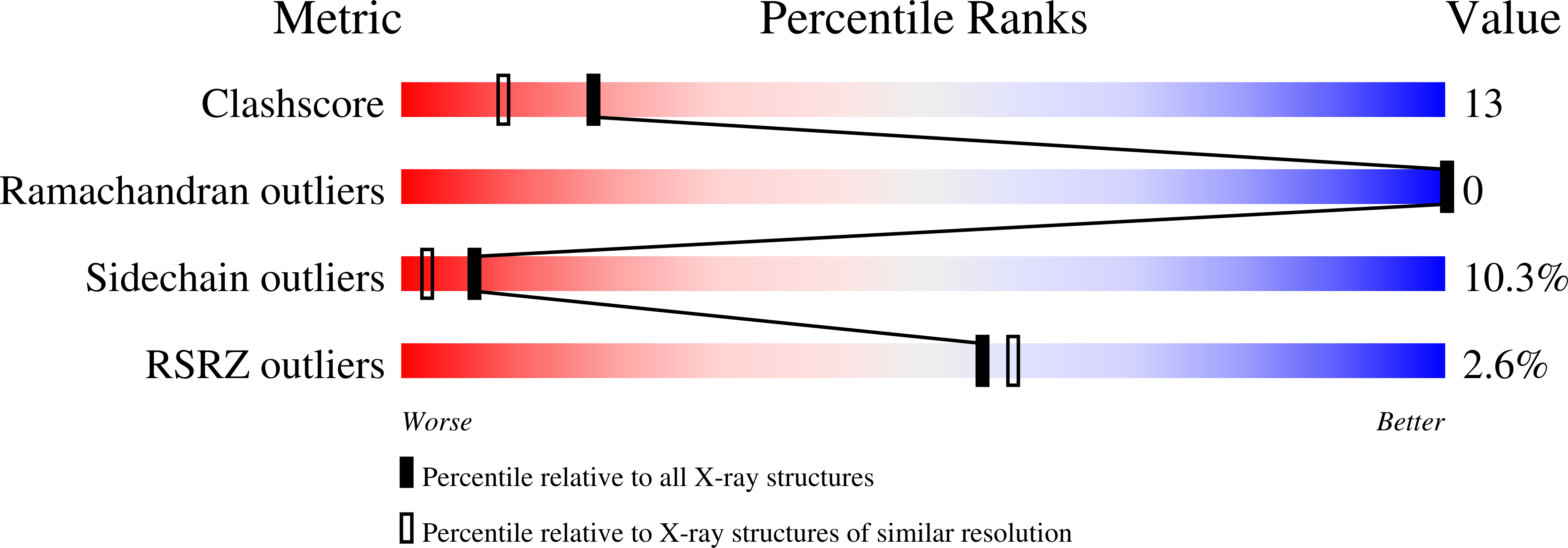
1TTR image
Deposition Date 1996-04-11
Release Date 1996-10-14
Last Version Date 2024-04-03
Entry Detail
PDB ID:
1TTR
Title:
TRANSTHYRETIN-V/122/I CARDIOMYOPATHIC MUTANT
Biological Source:
Source Organism:
Homo sapiens (Taxon ID: 9606)
Host Organism:
Method Details:
Experimental Method:
Resolution:
1.90 Å
R-Value Work:
0.15
Space Group:
P 21 21 2
Macromolecular Entities
Structures with similar UniProt ID
Protein Blast
Polymer Type:polypeptide(L)
Molecule:TRANSTHYRETIN
Gene (Uniprot):TTR
Mutagens:V122I
Chain IDs:A, B
Chain Length:127
Number of Molecules:2
Biological Source:Homo sapiens
Primary Citation
Structure of the Val122Ile variant transthyretin - a cardiomyopathic mutant.
Acta Crystallogr.,Sect.D 52 966 972 (1996)
PMID: 15299606 DOI: 10.1107/S0907444996003307

Abstact

The Val122Ile mutant transthyretin (TTR Ile122) is an amyloidogenic protein which has been described as the major protein component of amyloid fibrils isolated from patients with familial amyloidotic cardiomyopathy (FAC), a disease characterized by cardiac failure and amyloid deposits in the heart. The reasons for the deposition of TTR are still unknown and it is conceivable that a conformational alteration, resulting from the mutation, is fundamental for amyloid formation. The three-dimensional structure of TTR Ile122 was determined and refined to a crystallographic R factor of 15.8% at 1.9 A resolution. The r.m.s. deviation from ideality in bond distances is 0.019 A and in angle-bonded distances is 0.027 A. The presence of two crystallographically independent monomers in the asymmetric unit allowed additional means of estimation of atomic coordinate error. The structure of the mutant is essentially identical to that of the wild-type transthyretin (TTR). The largest deviations occur in surface loops and in the region of the substitution. The protein is a tetramer composed of identical subunits; each monomer has two four-stranded beta-sheets which are extended to eight-stranded beta-sheets when two monomers associate through hydrogen bonds forming a dimer, which is the crystallographic asymmetric unit. The replacement of valine for isoleucine introduces very small alterations in relation to the wild-type protein; nevertheless they seem to confirm a tendency for a less stable tetrameric structure. This would support the idea that the tetrameric structure might be disrupted in amyloid fibrils.

Legend

Protein

Chemical

Disease

Primary Citation of related structures
Feedback Form
Name
Email
Institute
Feedback