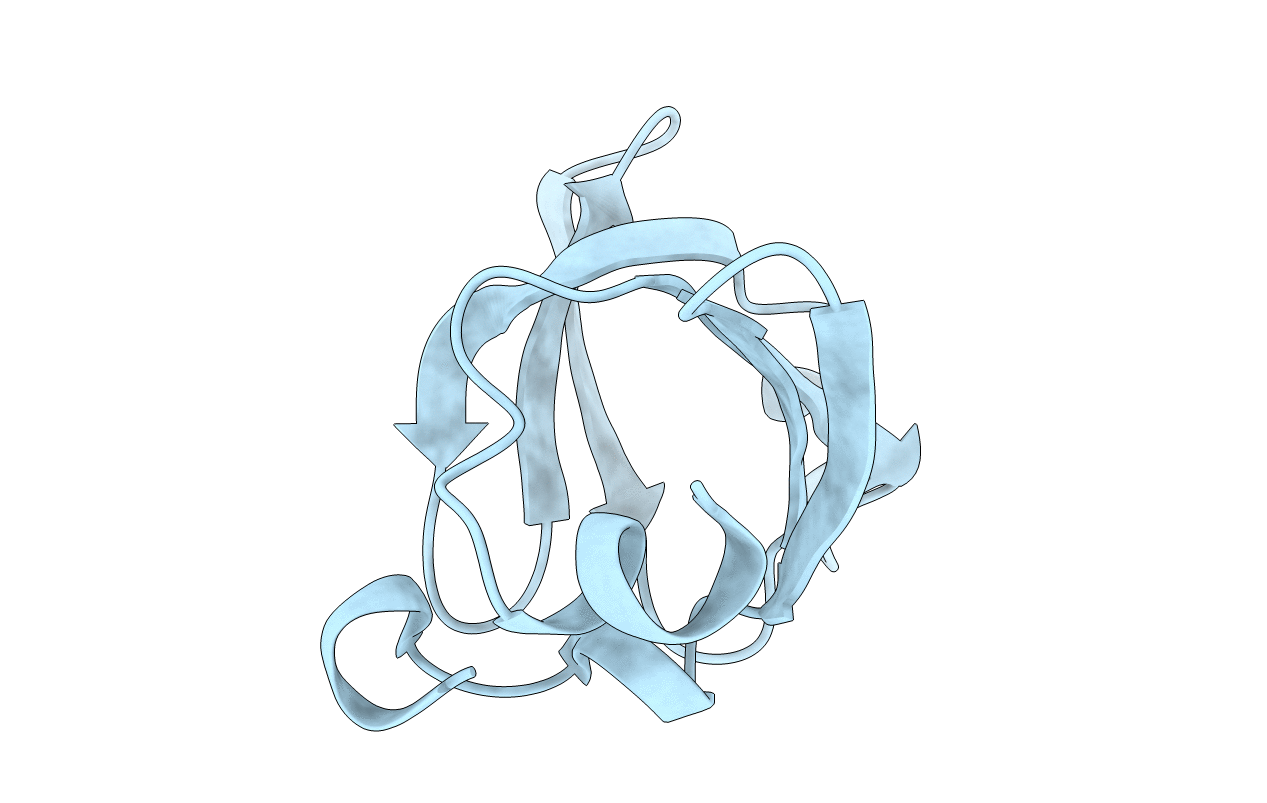
1TSF image
Deposition Date 2004-06-21
Release Date 2004-10-12
Last Version Date 2023-08-23
Entry Detail
PDB ID:
1TSF
Keywords:
Title:
Crystal Structure of the Archaeal homolog of Human RNase P Protein Rpp29 from Archaeoglobus fulgidus
Biological Source:
Source Organism:
Method Details:
Experimental Method:
Resolution:
1.70 Å
R-Value Free:
0.28
R-Value Work:
0.25
R-Value Observed:
0.25
Space Group:
P 21 21 21
Macromolecular Entities
Structures with similar UniProt ID
Protein Blast
Polymer Type:polypeptide(L)
Molecule:Ribonuclease P protein component 1
Gene (Uniprot):rnp1
Chain IDs:A
Chain Length:102
Number of Molecules:1
Biological Source:Archaeoglobus fulgidus
Primary Citation
Crystal structure of archaeal ribonuclease P protein aRpp29 from Archaeoglobus fulgidus.
Biochemistry 43 14128 14138 (2004)
PMID: 15518563 DOI: 10.1021/bi048578z

Abstact

The crystal structure of ribonuclease P protein aRpp29 from the sulfate-reducing hyperthermophile Archaeoglobus fulgidus was determined at 1.7 A resolution using X-ray diffraction methods. The central feature of this archaeal protein is a sheet of six antiparallel beta-strands twisted around a conserved hydrophobic core. Residues near the N- and C-termini form helical structures that are oriented in an antiparallel manner. A comparison of conserved amino acids indicates that archaeal aRpp29 is homologous to human ribonuclease P protein Rpp29. The aRpp29 protein is structurally similar to bacterial transcription factors Hfq and NusG, as well as the Sm and Sm-like RNA-associated proteins from eukarya. The crystal structure of A. fulgidus aRpp29 differs from the previously reported solution structure, where NMR data did not detect the helices and indicated that approximately 40% of the residues are relatively flexible or disordered. Circular dichroism data indicate that the protein has less helical content than the amount observed in the crystal, suggesting that in solution the helical regions are unfolded or in equilibrium between folded and unfolded forms; this hypothesis is consistent with amide proton exchange rate data. Surface residues that are conserved from archaea to humans and are likely to interact with the ribonuclease P RNA or other protein subunits are identified in the structure. The model of the aRpp29 protein defined by this work provides an essential step toward eventually understanding the overall architecture of ribonuclease P.

Legend

Protein

Chemical

Disease

Primary Citation of related structures
Feedback Form
Name
Email
Institute
Feedback