1TI7 image
Deposition Date 2004-06-02
Release Date 2004-06-08
Last Version Date 2023-08-23
Entry Detail
PDB ID:
1TI7
Keywords:
Title:
CRYSTAL STRUCTURE OF NMRA, A NEGATIVE TRANSCRIPTIONAL REGULATOR, IN COMPLEX WITH NADP AT 1.7A RESOLUTION
Biological Source:
Source Organism:
Host Organism:
Method Details:
Experimental Method:
Resolution:
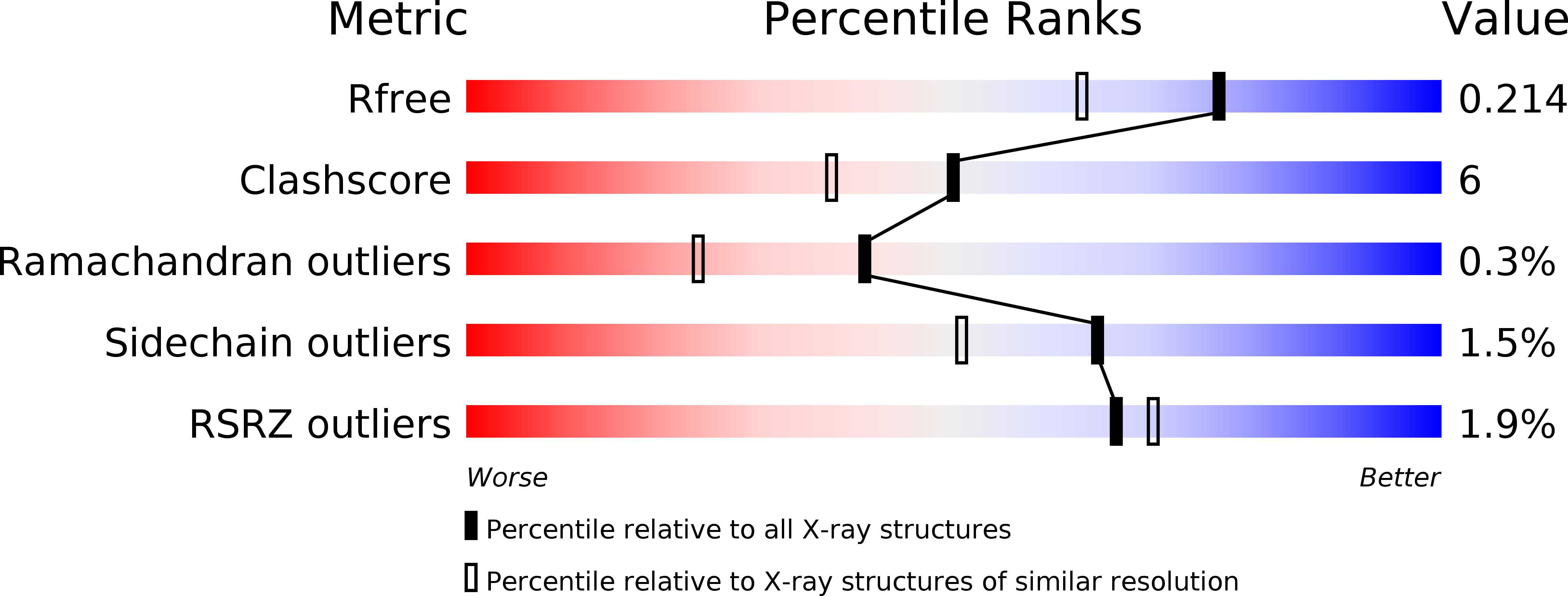
1.70 Å
R-Value Free:
0.21
R-Value Work:
0.17
R-Value Observed:
0.17
Space Group:
P 32 2 1
Macromolecular Entities
Structures with similar UniProt ID
Protein Blast
Polymer Type:polypeptide(L)
Molecule:nitrogen metabolite repression regulator NmrA
Chain IDs:A
Chain Length:352
Number of Molecules:1
Biological Source:Emericella nidulans
Primary Citation
The negative transcriptional regulator NmrA discriminates between oxidized and reduced dinucleotides.
J.Biol.Chem. 278 32107 32114 (2003)
PMID: 12764138 DOI: 10.1074/jbc.M304104200

Abstact

NmrA, a transcription repressor involved in the regulation of nitrogen metabolism in Aspergillus nidulans,is a member of the short-chain dehydrogenase reductase superfamily. Isothermal titration calorimetry and differential scanning calorimetry have been used to show NmrA binds NAD+ and NADP+ with similar affinity (average KD 65 microM) but has a greatly reduced affinity for NADH and NADPH (average KD 6.0 mM). The structure of NmrA in a complex with NADP+ reveals how repositioning a His-37 side chain allows the different conformations of NAD+ and NADP+ to be accommodated. Modeling NAD(P)H into NmrA indicated that steric clashes, attenuation of electrostatic interactions, and loss of aromatic ring stacking can explain the differing affinities of NAD(P)+/NAD(P)H. The ability of NmrA to discriminate between the oxidized and reduced forms of the dinucleotides may be linked to a possible role in redox sensing. Isothermal titration calorimetry demonstrated that NmrA and a C-terminal fragment of the GATA transcription factor AreA interacted with a 1:1 stoichiometry and an apparent KD of 0.26 microM. NmrA was unable to bind the nitrogen metabolite repression signaling molecules ammonium or glutamine.

Legend

Protein

Chemical

Disease

Primary Citation of related structures
Feedback Form
Name
Email
Institute
Feedback