1TH1 image
Deposition Date 2004-05-31
Release Date 2004-09-07
Last Version Date 2024-10-30
Entry Detail
PDB ID:
1TH1
Title:
Beta-catenin in complex with a phosphorylated APC 20aa repeat fragment
Biological Source:
Source Organism:
Homo sapiens (Taxon ID: 9606)
Method Details:
Experimental Method:
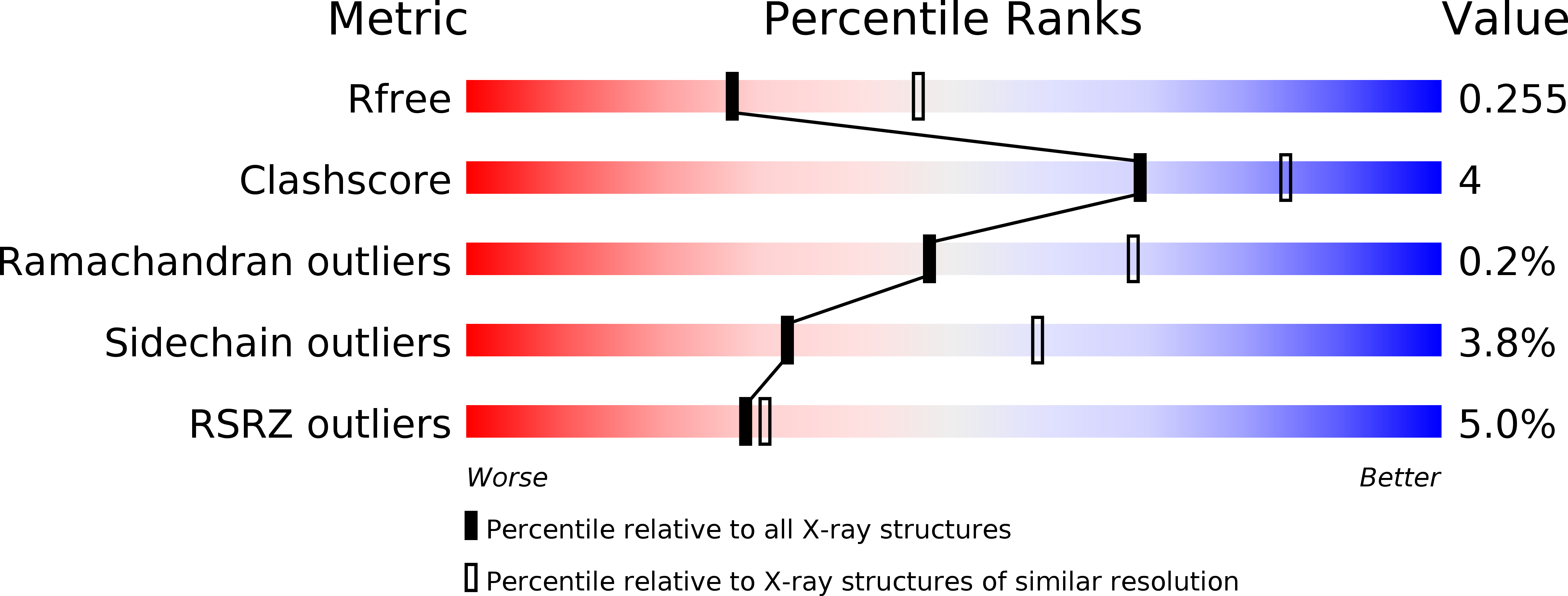
Resolution:
2.50 Å
R-Value Free:
0.25
R-Value Work:
0.22
Space Group:
P 1 21 1
Macromolecular Entities
Structures with similar UniProt ID
Protein Blast
Polymer Type:polypeptide(L)
Molecule:Beta-catenin
Gene (Uniprot):CTNNB1
Chain IDs:A, B
Chain Length:532
Number of Molecules:2
Biological Source:Homo sapiens
Structures with similar UniProt ID
Protein Blast
Polymer Type:polypeptide(L)
Molecule:Adenomatous polyposis coli protein
Gene (Uniprot):APC
Chain IDs:C, D
Chain Length:179
Number of Molecules:2
Biological Source:Homo sapiens
Modified Residue
Compound ID Chain ID Parent Comp ID Details 2D Image
SEP C SER PHOSPHOSERINE
TPO C THR PHOSPHOTHREONINE
Primary Citation
Crystal Structure of a beta-Catenin/APC Complex Reveals a Critical Role for APC Phosphorylation in APC Function.
Mol.Cell 15 523 533 (2004)
PMID: 15327769 DOI: 10.1016/j.molcel.2004.08.001

Abstact

The tumor suppressor adenomatous polyposis coli (APC) plays a critical role in the turnover of cytosolic beta-catenin, the key effector of the canonical Wnt signaling pathway. APC contains seven 20 amino acid (20 aa) beta-catenin binding repeats that are required for beta-catenin turnover. We have determined the crystal structure of beta-catenin in complex with a phosphorylated APC fragment containing two 20 aa repeats. Surprisingly, one single phosphorylated 20 aa repeat, together with its flanking regions, covers the entire structural groove of beta-catenin and may thus compete for beta-catenin binding with all other beta-catenin armadillo repeat partners. Our biochemical studies show that phosphorylation of the APC 20 aa repeats increases the affinity of the repeats for beta-catenin by 300- to 500-fold and the phosphorylated 20 aa repeats prevent beta-catenin binding to Tcf. Our work suggests that the phosphorylation of the APC 20 aa repeats could be a critical switch for APC function.

Legend

Protein

Chemical

Disease

Primary Citation of related structures
Feedback Form
Name
Email
Institute
Feedback