1T0F image
Deposition Date 2004-04-08
Release Date 2004-11-09
Last Version Date 2023-08-23
Entry Detail
PDB ID:
1T0F
Title:
Crystal Structure of the TnsA/TnsC(504-555) complex
Biological Source:
Source Organism:
Escherichia coli (Taxon ID: 562)
Method Details:
Experimental Method:
Resolution:
1.85 Å
R-Value Free:
0.23
R-Value Work:
0.21
R-Value Observed:
0.21
Space Group:
C 1 2 1
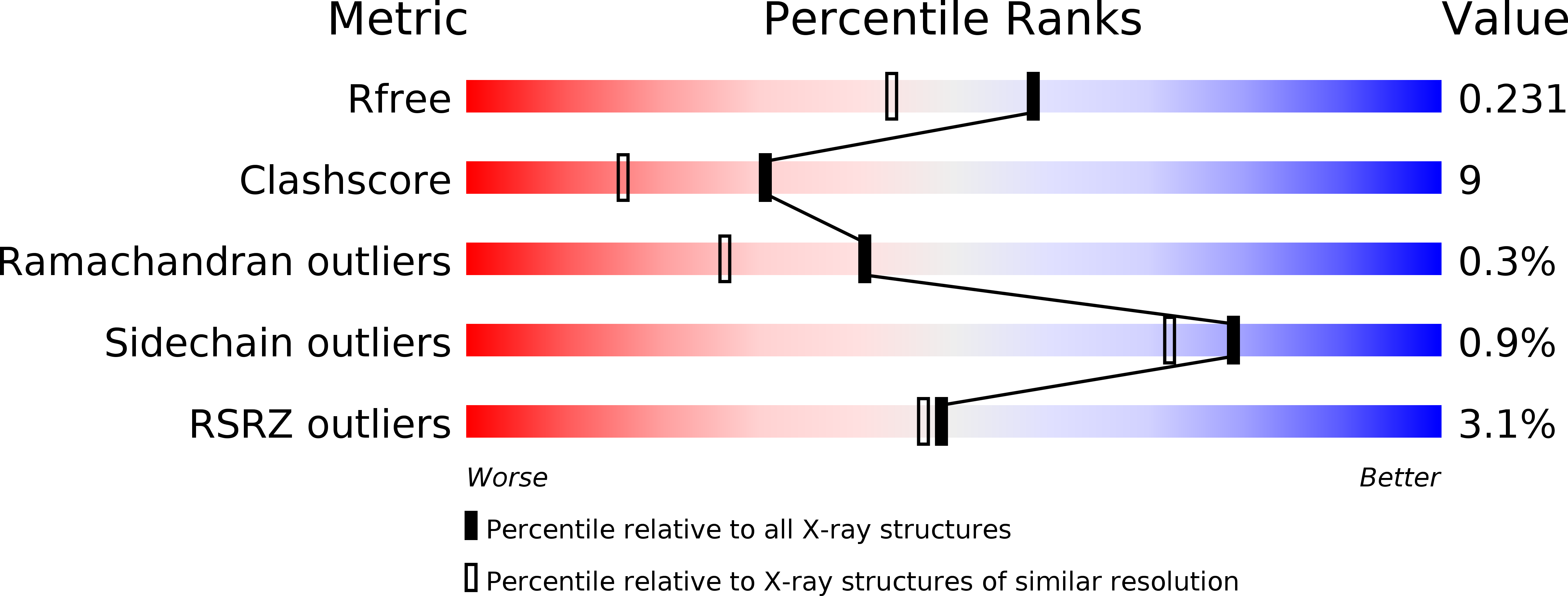
Macromolecular Entities
Structures with similar UniProt ID
Protein Blast
Polymer Type:polypeptide(L)
Molecule:Transposon Tn7 transposition protein tnsA
Gene (Uniprot):tnsA
Chain IDs:A, B
Chain Length:276
Number of Molecules:2
Biological Source:Escherichia coli
Structures with similar UniProt ID
Protein Blast
Polymer Type:polypeptide(L)
Molecule:Transposon Tn7 transposition protein tnsC
Gene (Uniprot):tnsC
Chain IDs:C, D
Chain Length:54
Number of Molecules:2
Biological Source:Escherichia coli
Primary Citation
The carboxy-terminal portion of TnsC activates the Tn7 transposase through a specific interaction with TnsA.
Embo J. 23 2972 2981 (2004)
PMID: 15257292 DOI: 10.1038/sj.emboj.7600311

Abstact

Tn7 transposition requires the assembly of a nucleoprotein complex containing four self-encoded proteins, transposon ends, and target DNA. Within this complex, TnsC, the molecular switch that regulates transposition, and TnsA, one part of the transposase, interact directly. Here, we demonstrate that residues 504-555 of TnsC are responsible for TnsA/TnsC interaction. The crystal structure of the TnsA/TnsC(504-555) complex, resolved to 1.85 A, illustrates the burial of a large hydrophobic patch on the surface of TnsA. One consequence of sequestering this patch is a marked increase in the thermal stability of TnsA as shown by differential scanning calorimetry. A model based on the complex structure suggested that TnsA and a slightly longer version of the cocrystallized TnsC fragment (residues 495-555) might cooperate to bind DNA, a prediction confirmed using gel mobility shift assays. Donor DNA binding by the TnsA/TnsC(495-555) complex is correlated with the activation of the TnsAB transposase, as measured by double-stranded DNA cleavage assays, demonstrating the importance of the TnsA/TnsC interaction in affecting Tn7 transposition.

Legend

Protein

Chemical

Disease

Primary Citation of related structures
Feedback Form
Name
Email
Institute
Feedback