1SZB image
Deposition Date 2004-04-05
Release Date 2004-06-22
Last Version Date 2024-10-16
Entry Detail
PDB ID:
1SZB
Keywords:
Title:
Crystal structure of the human MBL-associated protein 19 (MAp19)
Biological Source:
Source Organism:
Homo sapiens (Taxon ID: 9606)
Host Organism:
Method Details:
Experimental Method:
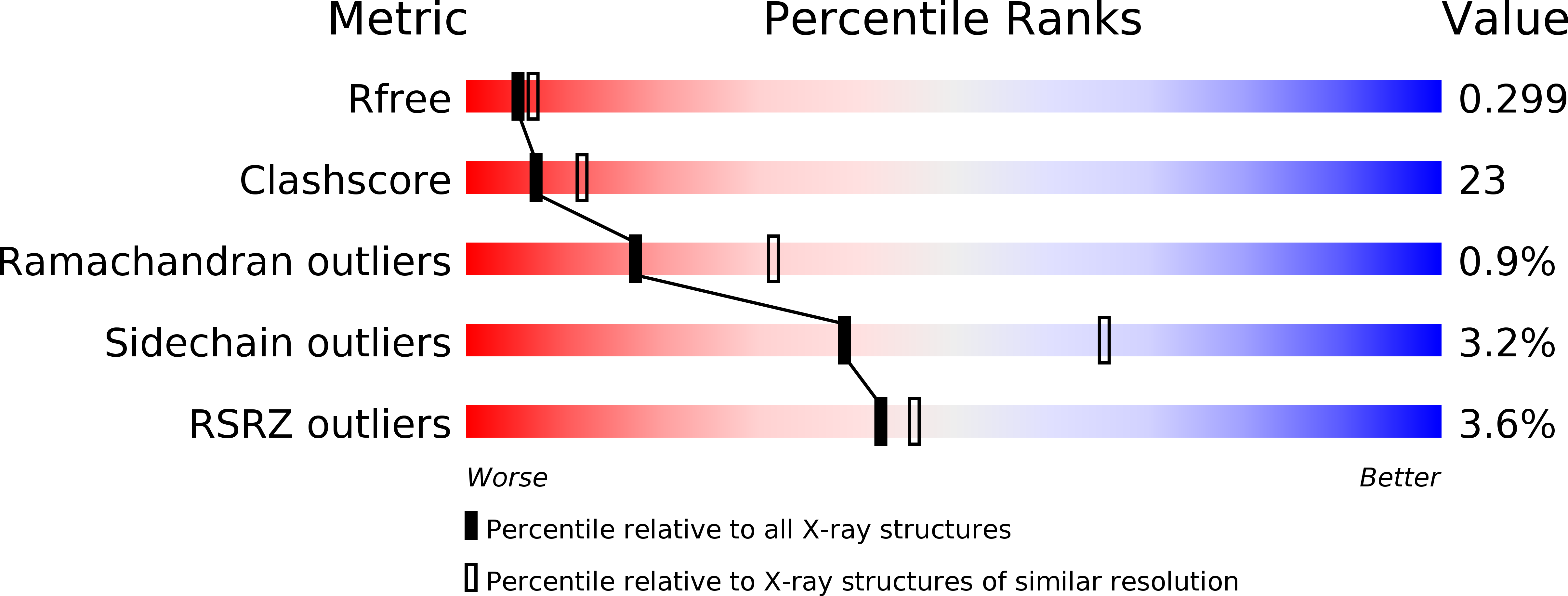
Resolution:
2.50 Å
R-Value Free:
0.31
R-Value Work:
0.26
R-Value Observed:
0.26
Space Group:
P 43 21 2
Macromolecular Entities
Structures with similar UniProt ID
Protein Blast
Polymer Type:polypeptide(L)
Molecule:mannose binding lectin-associated serine protease-2 related protein, MAp19 (19kDa)
Gene (Uniprot):MASP2
Chain IDs:A, B
Chain Length:170
Number of Molecules:2
Biological Source:Homo sapiens
Ligand Molecules
Primary Citation
The X-ray structure of human MBL-associated protein 19 (MAp19) and its interaction site with mannan-binding lectin and L-ficolin
J.Biol.Chem. 279 29391 29397 (2004)
PMID: 15117939 DOI: 10.1074/jbc.M402687200

Abstact

MAp19 is an alternative splicing product of the MASP-2 gene comprising the N-terminal CUB1-epidermal growth factor (EGF) segment of MASP-2, plus four additional residues at its C-terminal end. Like full-length MASP-2, it forms Ca(2+)-dependent complexes with mannan-binding lectin (MBL) and L-ficolin. The x-ray structure of human MAp19 was solved to a resolution of 2.5 A. It shows a head to tail homodimer held together by interactions between the CUB1 module of one monomer and the EGF module of its counterpart. A Ca(2+) ion bound to each EGF module stabilizes the dimer interfaces. A second Ca(2+) ion is bound to the distal end of each CUB1 module, through six ligands contributed by Glu(52), Asp(60), Asp(105), Ser(107), Asn(108), and a water molecule. Compared with its counterpart in human C1s, the N-terminal end of the MAp19 CUB1 module contains a 7-residue extension that forms additional inter-monomer contacts. To identify the residues involved in the interaction of MAp19 with MBL and L-ficolin, point mutants were generated and their binding ability was determined using surface plasmon resonance spectroscopy. Six mutations at Tyr(59), Asp(60), Glu(83), Asp(105), Tyr(106), and Glu(109) either strongly decreased or abolished interaction with both MBL and L-ficolin. These mutations map a common binding site for these proteins located at the distal end of each CUB1 module and stabilized by the Ca(2+) ion.

Legend

Protein

Chemical

Disease

Primary Citation of related structures
Feedback Form
Name
Email
Institute
Feedback