1SMY image
Deposition Date 2004-03-10
Release Date 2004-05-18
Last Version Date 2023-10-25
Entry Detail
PDB ID:
1SMY
Keywords:
Title:
Structural basis for transcription regulation by alarmone ppGpp
Biological Source:
Source Organism:
Method Details:
Experimental Method:
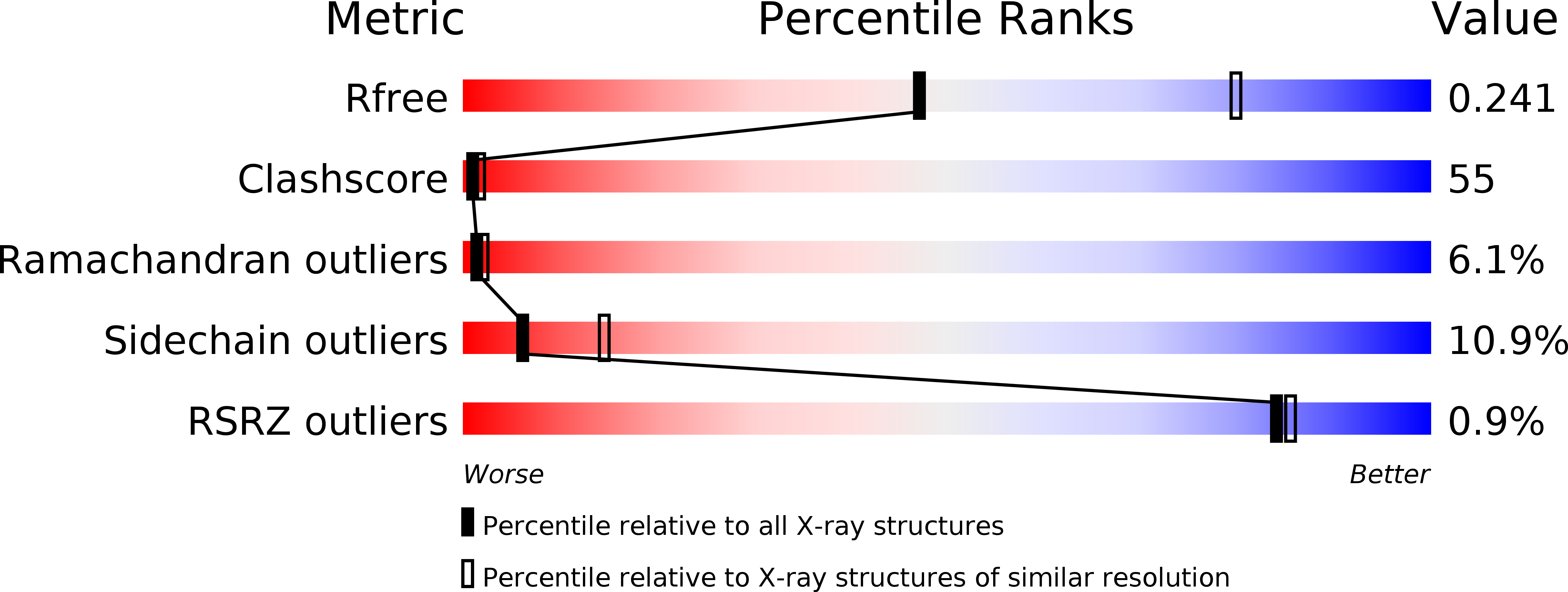
Resolution:
2.70 Å
R-Value Free:
0.26
R-Value Work:
0.18
R-Value Observed:
0.26
Space Group:
P 32
Macromolecular Entities
Structures with similar UniProt ID
Protein Blast
Polymer Type:polypeptide(L)
Molecule:DNA-directed RNA polymerase alpha chain
Gene (Uniprot):rpoA
Chain IDs:A, B, G (auth: K), H (auth: L)
Chain Length:315
Number of Molecules:4
Biological Source:Thermus thermophilus
Structures with similar UniProt ID
Protein Blast
Polymer Type:polypeptide(L)
Molecule:DNA-directed RNA polymerase beta chain
Gene (Uniprot):rpoB
Chain IDs:C, I (auth: M)
Chain Length:1119
Number of Molecules:2
Biological Source:Thermus thermophilus
Structures with similar UniProt ID
Protein Blast
Polymer Type:polypeptide(L)
Molecule:DNA-directed RNA polymerase beta' chain
Gene (Uniprot):rpoC
Chain IDs:D, J (auth: N)
Chain Length:1524
Number of Molecules:2
Biological Source:Thermus thermophilus
Structures with similar UniProt ID
Protein Blast
Polymer Type:polypeptide(L)
Molecule:RNA POLYMERASE OMEGA SUBUNIT
Chain IDs:E, K (auth: O)
Chain Length:99
Number of Molecules:2
Biological Source:Thermus thermophilus
Structures with similar UniProt ID
Protein Blast
Polymer Type:polypeptide(L)
Molecule:principal sigma factor
Chain IDs:F, L (auth: P)
Chain Length:423
Number of Molecules:2
Biological Source:Thermus thermophilus
Primary Citation
Structural basis for transcription regulation by alarmone ppGpp
Cell(Cambridge,Mass.) 117 299 310 (2004)
PMID: 15109491 DOI: 10.1016/S0092-8674(04)00401-5

Abstact

Guanosine-tetraphosphate (ppGpp) is a major regulator of stringent control, an adaptive response of bacteria to amino acid starvation. The 2.7 A resolution structure of the Thermus thermophilus RNA polymerase (RNAP) holoenzyme in complex with ppGpp reveals that ppGpp binds to the same site near the active center in both independent RNAP molecules in the crystal but in strikingly distinct orientations. Binding is symmetrical with respect to the two diphosphates of ppGpp and is relaxed with respect to the orientation of the nucleotide base. Different modes of ppGpp binding are coupled with asymmetry of the active site configurations. The results suggest that base pairing of ppGpp with cytosines in the nontemplate DNA strand might be an essential component of transcription control by ppGpp. We present experimental evidence highlighting the importance of base-specific contacts between ppGpp and specific cytosine residues during both transcription initiation and elongation.

Legend

Protein

Chemical

Disease

Primary Citation of related structures
Feedback Form
Name
Email
Institute
Feedback