1SLY image
Deposition Date 1995-08-02
Release Date 1996-08-17
Last Version Date 2024-10-30
Entry Detail
PDB ID:
1SLY
Title:
COMPLEX OF THE 70-KDA SOLUBLE LYTIC TRANSGLYCOSYLASE WITH BULGECIN A
Biological Source:
Source Organism:
Escherichia coli (Taxon ID: 562)
Method Details:
Experimental Method:
Resolution:
2.80 Å
R-Value Free:
0.26
R-Value Work:
0.18
R-Value Observed:
0.18
Space Group:
P 21 21 21
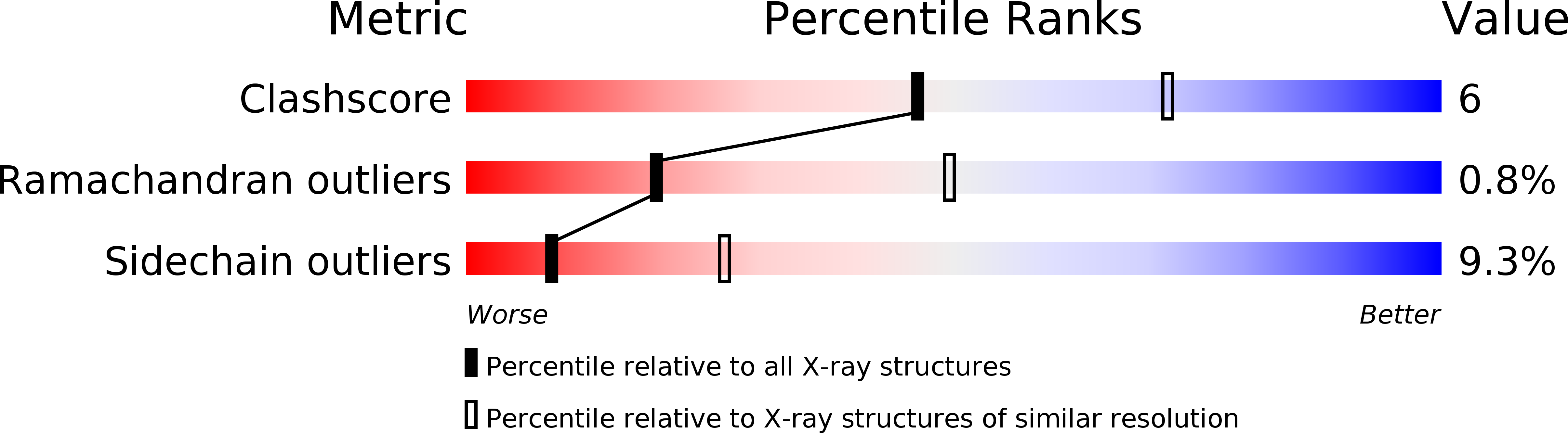
Macromolecular Entities
Structures with similar UniProt ID
Protein Blast
Polymer Type:polypeptide(L)
Molecule:70-KDA SOLUBLE LYTIC TRANSGLYCOSYLASE
Chain IDs:A
Chain Length:618
Number of Molecules:1
Biological Source:Escherichia coli
Ligand Molecules
Primary Citation
Structure of the 70-kDa soluble lytic transglycosylase complexed with bulgecin A. Implications for the enzymatic mechanism.
Biochemistry 34 12729 12737 (1995)
PMID: 7548026 DOI: 10.1021/bi00039a032

Abstact

Bulgecins are O-sulfonated glycopeptides that are able to enhance the antibacterial activity of beta-lactam antibiotics. The 70-kDa soluble lytic transglycosylase (SLT70) from Escherichia coli forms a specific target of these compounds. Using X-ray crystallography, the three-dimensional structure of a complex of SLT70 with bulgecin A has been determined to 2.8-A resolution and refined to an R factor of 19.5%. The model contains all 618 amino acids of SLT70 and a single molecule of bound bulgecin, located in the active site of the enzyme. The glycopeptide inhibitor is bound in an extended conformation occupying sites analogous to the B, C, and D subsites of lysozyme. Upon binding of bulgecin, the three-stranded antiparallel beta-sheet in the C domain shows a pronounced shift toward the inhibitor. In subsite D, the proposed catalytic residue Glu478 forms a hydrogen bond to the hydroxymethyl oxygen of the proline part of bulgecin and interacts electrostatically with the proline NH2+ group. These interactions, in addition to the interactions observed for the 2-acetamido group of the N-acetylglucosamine residue bound in subsite C, may explain the strong inhibition of SLT70 activity by bulgecin, suggesting that bulgecin acts as an analogue of an oxocarbonium ion intermediate in the reaction catalyzed by SLT70. The structure of the SLT70--bulgecin A complex may be of assistance in the rational design of novel antibiotics.

Legend

Protein

Chemical

Disease

Primary Citation of related structures
Feedback Form
Name
Email
Institute
Feedback