Planned Maintenance: Some services may turn out to be unavailable from 15th January, 2026 to 16th January, 2026. We apologize for the inconvenience!

1SKV image
Deposition Date 2004-03-05
Release Date 2004-07-13
Last Version Date 2024-11-13
Entry Detail
PDB ID:
1SKV
Keywords:
Title:
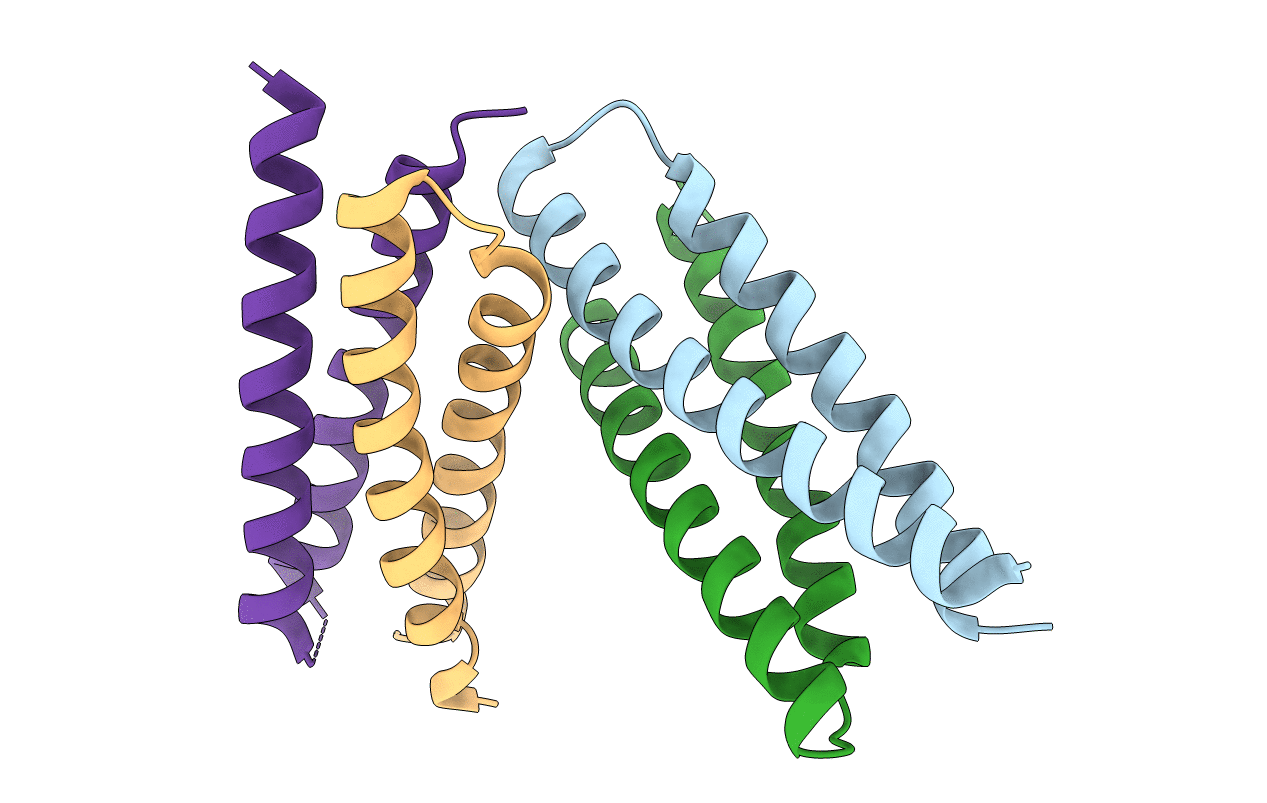
Crystal Structure of D-63 from Sulfolobus Spindle Virus 1
Biological Source:
Source Organism(s):
Expression System(s):
Method Details:
Experimental Method:
Resolution:
2.60 Å
R-Value Free:
0.26
R-Value Work:
0.22
R-Value Observed:
0.22
Space Group:
P 62
Macromolecular Entities
Structures with similar UniProt ID
Protein Blast
Polymer Type:polypeptide(L)
Molecule:Hypothetical 7.5 kDa protein
Gene (Uniprot):d63
Chain IDs:A, B, C, D
Chain Length:69
Number of Molecules:4
Biological Source:Sulfolobus virus 1
Modified Residue
Compound ID Chain ID Parent Comp ID Details 2D Image
MSE A MET SELENOMETHIONINE
Primary Citation
Structure of d-63 from sulfolobus spindle-shaped virus 1: surface properties of the dimeric four-helix bundle suggest an adaptor protein function
J.Virol. 78 7438 7442 (2004)
PMID: 15220417 DOI: 10.1128/JVI.78.14.7438-7442.2004

Abstact

Sulfolobus spindle-shaped virus 1 (SSV1) and its fusellovirus homologues can be found in many acidic (pH <or= 4.0) hot springs (>or=70 degrees C) around the world. SSV1 contains a 15.5-kb double-stranded DNA genome that encodes 34 proteins with greater than 50 amino acids. A site-specific integrase and a DnaA-like protein have been previously identified by sequence homology, and three structural proteins have been isolated from purified virus and identified by N-terminal sequencing (VP1, VP2, and VP3). The functions of the remaining 29 proteins are currently unknown. To assign functions to these proteins, we have initiated biochemical and structural studies on the SSV1 proteome. Here we report the structure of SSV1 D-63. The structure reveals a helix-turn-helix motif that dimerizes to form an antiparallel four-helix bundle. Mapping residues conserved among three fusellovirus isolates onto the structure shows that one face of the rod-shaped molecule is highly conserved. This conserved surface spans the dimer axis and thus exhibits 2-fold symmetry. Two smaller conserved patches, also related by 2-fold symmetry, are found on the opposite face of the molecule. All of these conserved surfaces are devoid of clefts or pockets typically used to bind small molecules, suggesting that D-63 may function as an adaptor protein in macromolecular assembly.

Legend

Protein

Chemical

Disease

Primary Citation of related structures
Feedback Form
Name
Email
Institute
Feedback