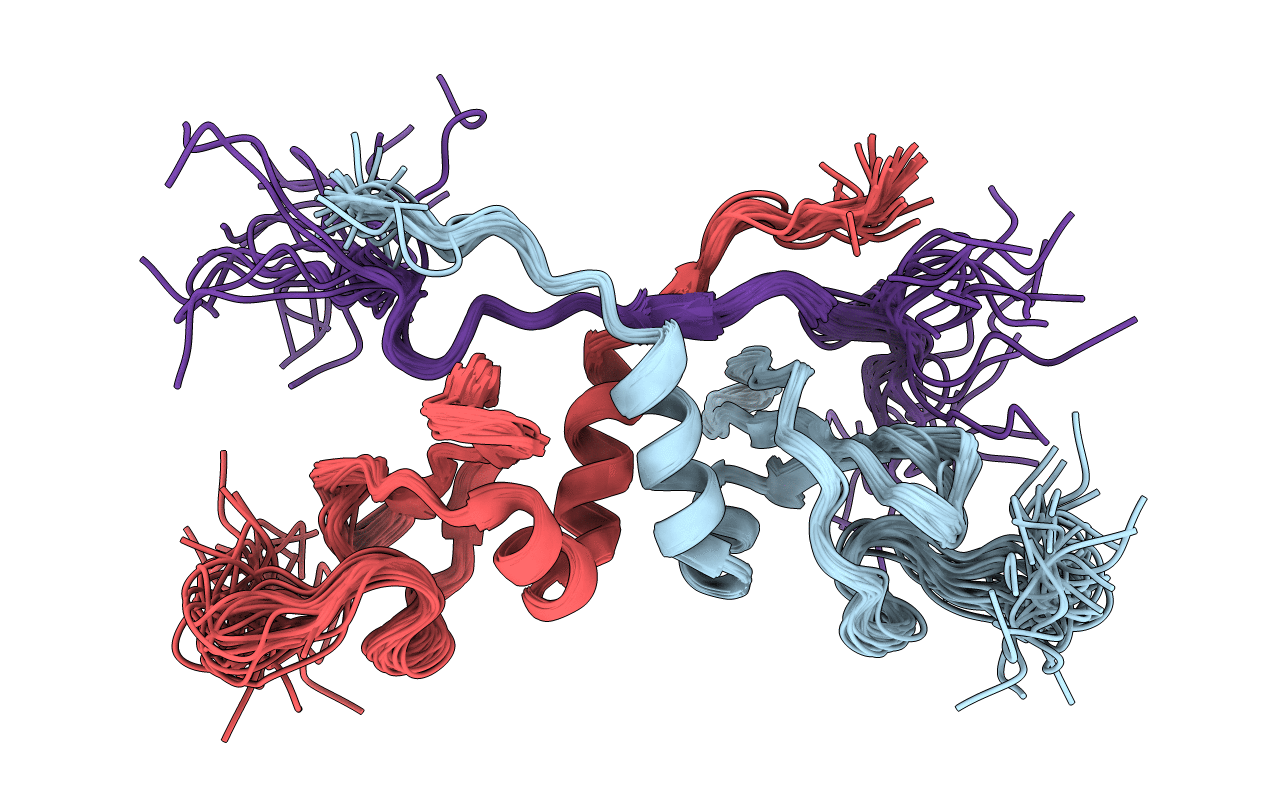
1S4Z image
Deposition Date 2004-01-19
Release Date 2004-03-23
Last Version Date 2024-05-22
Entry Detail
PDB ID:
1S4Z
Keywords:
Title:
HP1 chromo shadow domain in complex with PXVXL motif of CAF-1
Biological Source:
Source Organism:
Mus musculus (Taxon ID: 10090)
Host Organism:
Method Details:
Experimental Method:
Conformers Calculated:
100
Conformers Submitted:
25
Selection Criteria:
structures with the lowest energy
Macromolecular Entities
Structures with similar UniProt ID
Protein Blast
Polymer Type:polypeptide(L)
Molecule:Chromobox protein homolog 1
Chain IDs:A, B
Chain Length:75
Number of Molecules:2
Biological Source:Mus musculus
Structures with similar UniProt ID
Protein Blast
Polymer Type:polypeptide(L)
Molecule:Chromatin assembly factor 1 subunit A
Gene (Uniprot):Chaf1a
Chain IDs:C
Chain Length:30
Number of Molecules:1
Biological Source:Mus musculus
Ligand Molecules
Primary Citation
Structural basis of HP1/PXVXL motif peptide interactions and HP1 localisation to heterochromatin.
Embo J. 23 489 499 (2004)
PMID: 14765118 DOI: 10.1038/sj.emboj.7600088

Abstact

HP1 family proteins are adaptor molecules, containing two related chromo domains that are required for chromatin packaging and gene silencing. Here we present the structure of the chromo shadow domain from mouse HP1beta bound to a peptide containing a consensus PXVXL motif found in many HP1 binding partners. The shadow domain exhibits a novel mode of peptide recognition, where the peptide binds across the dimer interface, sandwiched in a beta-sheet between strands from each monomer. The structure allows us to predict which other shadow domains bind similar PXVXL motif-containing peptides and provides a framework for predicting the sequence specificity of the others. We show that targeting of HP1beta to heterochromatin requires shadow domain interactions with PXVXL-containing proteins in addition to chromo domain recognition of Lys-9-methylated histone H3. Interestingly, it also appears to require the simultaneous recognition of two Lys-9-methylated histone H3 molecules. This finding implies a further complexity to the histone code for regulation of chromatin structure and suggests how binding of HP1 family proteins may lead to its condensation.

Legend

Protein

Chemical

Disease

Primary Citation of related structures
Feedback Form
Name
Email
Institute
Feedback