1S3R image
Deposition Date 2004-01-14
Release Date 2005-01-25
Last Version Date 2024-03-13
Entry Detail
PDB ID:
1S3R
Keywords:
Title:
Crystal structure of the human-specific toxin intermedilysin
Biological Source:
Source Organism:
Host Organism:
Method Details:
Experimental Method:
Resolution:
2.60 Å
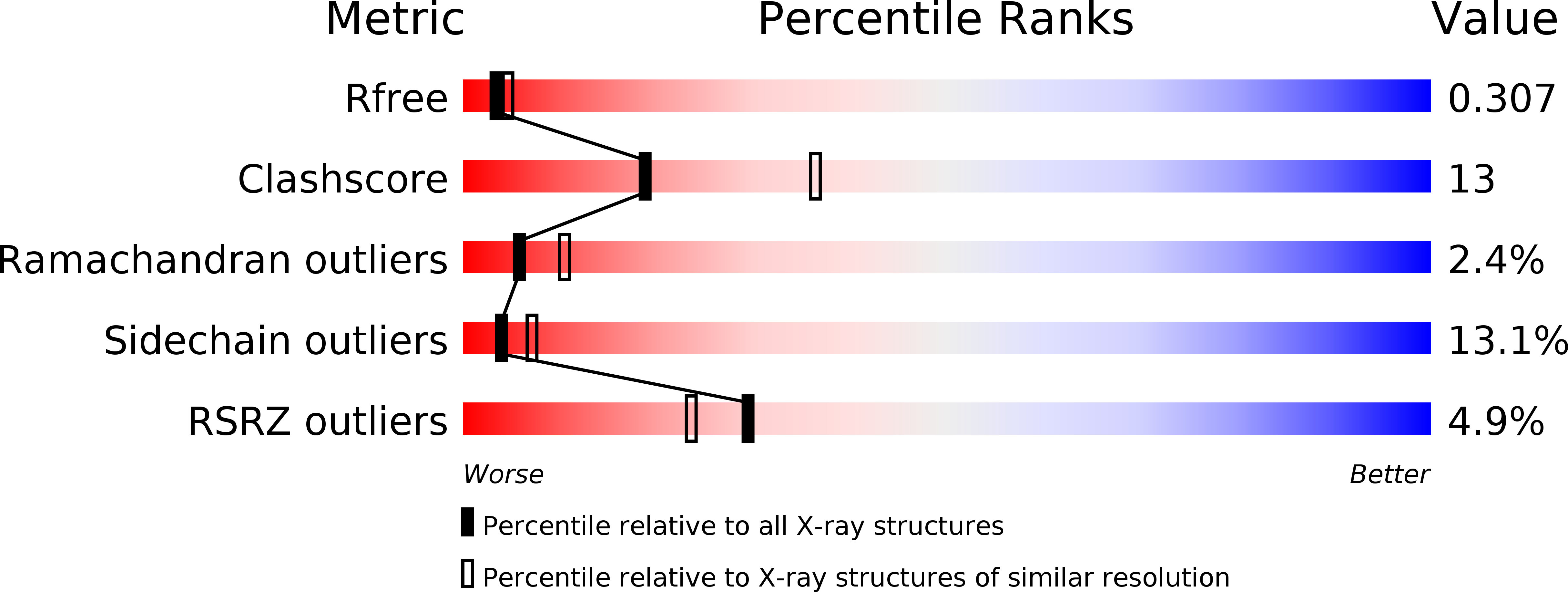
R-Value Free:
0.29
R-Value Work:
0.22
R-Value Observed:
0.23
Space Group:
P 21 21 2
Macromolecular Entities
Structures with similar UniProt ID
Protein Blast
Polymer Type:polypeptide(L)
Molecule:intermedilysin
Gene (Uniprot):ily
Chain IDs:A, B
Chain Length:535
Number of Molecules:2
Biological Source:Streptococcus intermedius
Ligand Molecules
Primary Citation
Insights into the action of the superfamily of cholesterol-dependent cytolysins from studies of intermedilysin
Proc.Natl.Acad.Sci.Usa 102 600 605 (2005)
PMID: 15637162 DOI: 10.1073/pnas.0403229101

Abstact

The cholesterol-dependent cytolysins (CDCs), a superfamily of pore-forming toxins, are characterized by a conserved undecapeptide motif that is believed to be critical for membrane recognition by means of cholesterol. Intermedilysin (ILY), an unusual member of the CDCs, exhibits specificity for human cells and contains nonconservative substitutions in the motif. We show that the cellular specificity of ILY is based on its ability to specifically bind to human cells and does not involve some other feature of the CDC mechanism. Furthermore, cellular recognition by ILY appears to be encoded in domain 4 alone but does not involve the variant undecapeptide of ILY. We show that the undecapeptide is involved in the prepore-to-pore conversion of ILY and so demonstrate a direct connection between the structure of the undecapeptide and the prepore-to-pore transition. We have determined the crystal structure of ILY, which, when compared to the known structure of a prototypical CDC, suggests that the basic aspects of its 3D structure are likely to be conserved in all CDCs.

Legend

Protein

Chemical

Disease

Primary Citation of related structures
Feedback Form
Name
Email
Institute
Feedback