1S1G image
Deposition Date 2004-01-06
Release Date 2004-03-23
Last Version Date 2023-08-23
Entry Detail
PDB ID:
1S1G
Title:
Crystal Structure of Kv4.3 T1 Domain
Biological Source:
Source Organism(s):
Homo sapiens (Taxon ID: 9606)
Expression System(s):
Method Details:
Experimental Method:
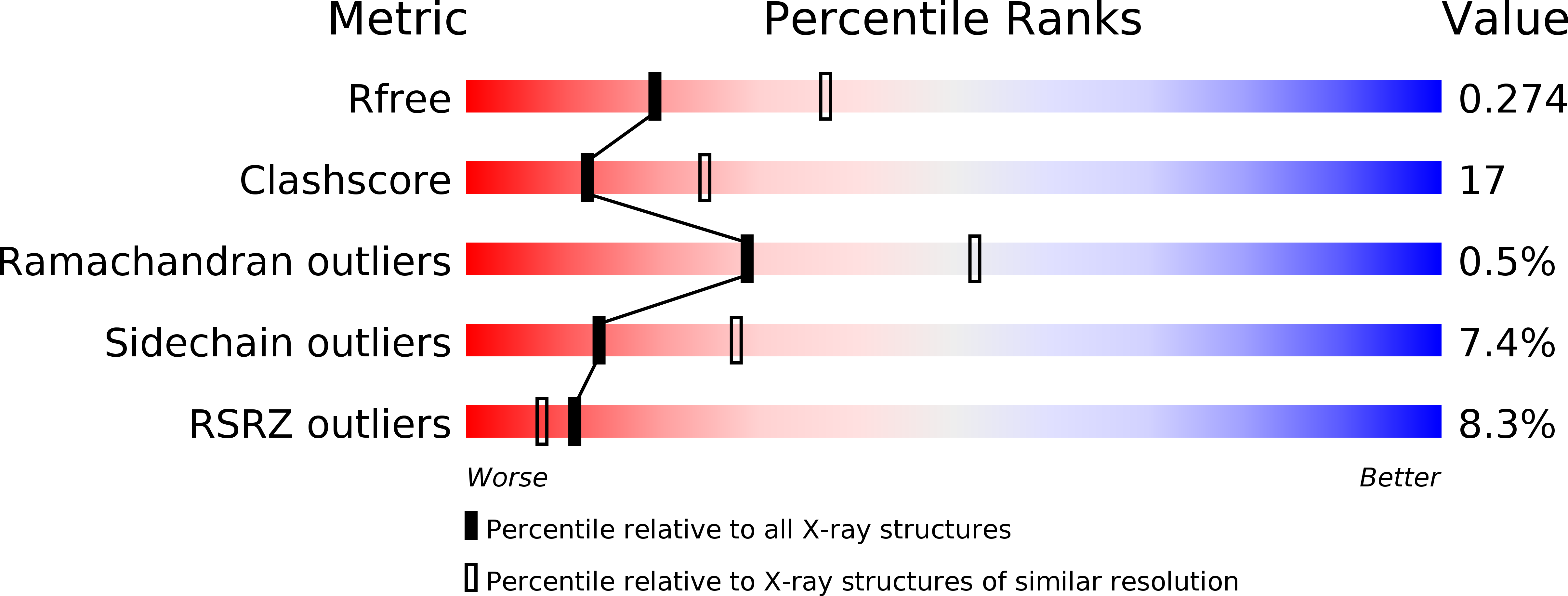
Resolution:
2.60 Å
R-Value Free:
0.27
R-Value Work:
0.22
R-Value Observed:
0.22
Space Group:
P 41 21 2
Macromolecular Entities
Structures with similar UniProt ID
Protein Blast
Polymer Type:polypeptide(L)
Molecule:Potassium voltage-gated channel subfamily D member 3
Gene (Uniprot):KCND3
Chain IDs:A, B
Chain Length:124
Number of Molecules:2
Biological Source:Homo sapiens
Ligand Molecules
Primary Citation
Two N-terminal domains of Kv4 K(+) channels regulate binding to and modulation by KChIP1.
Neuron 41 587 598 (2004)
PMID: 14980207 DOI: 10.1016/S0896-6273(04)00049-2

Abstact

The family of calcium binding proteins called KChIPs associates with Kv4 family K(+) channels and modulates their biophysical properties. Here, using mutagenesis and X-ray crystallography, we explore the interaction between Kv4 subunits and KChIP1. Two regions in the Kv4.2 N terminus, residues 7-11 and 71-90, are necessary for KChIP1 modulation and interaction with Kv4.2. When inserted into the Kv1.2 N terminus, residues 71-90 of Kv4.2 are also sufficient to confer association with KChIP1. To provide a structural framework for these data, we solved the crystal structures of Kv4.3N and KChIP1 individually. Taken together with the mutagenesis data, the individual structures suggest that that the Kv4 N terminus is required for stable association with KChIP1, perhaps through a hydrophobic surface interaction, and that residues 71-90 in Kv4 subunits form a contact loop that mediates the specific association of KChIPs with Kv4 subunits.

Legend

Protein

Chemical

Disease

Primary Citation of related structures
Feedback Form
Name
Email
Institute
Feedback