1RP3 image
Deposition Date 2003-12-02
Release Date 2004-04-06
Last Version Date 2024-02-14
Entry Detail
PDB ID:
1RP3
Keywords:
Title:
Cocrystal structure of the flagellar sigma/anti-sigma complex, Sigma-28/FlgM
Biological Source:
Source Organism:
Host Organism:
Method Details:
Experimental Method:
Resolution:
2.30 Å
R-Value Free:
0.26
R-Value Work:
0.24
R-Value Observed:
0.24
Space Group:
P 1 21 1
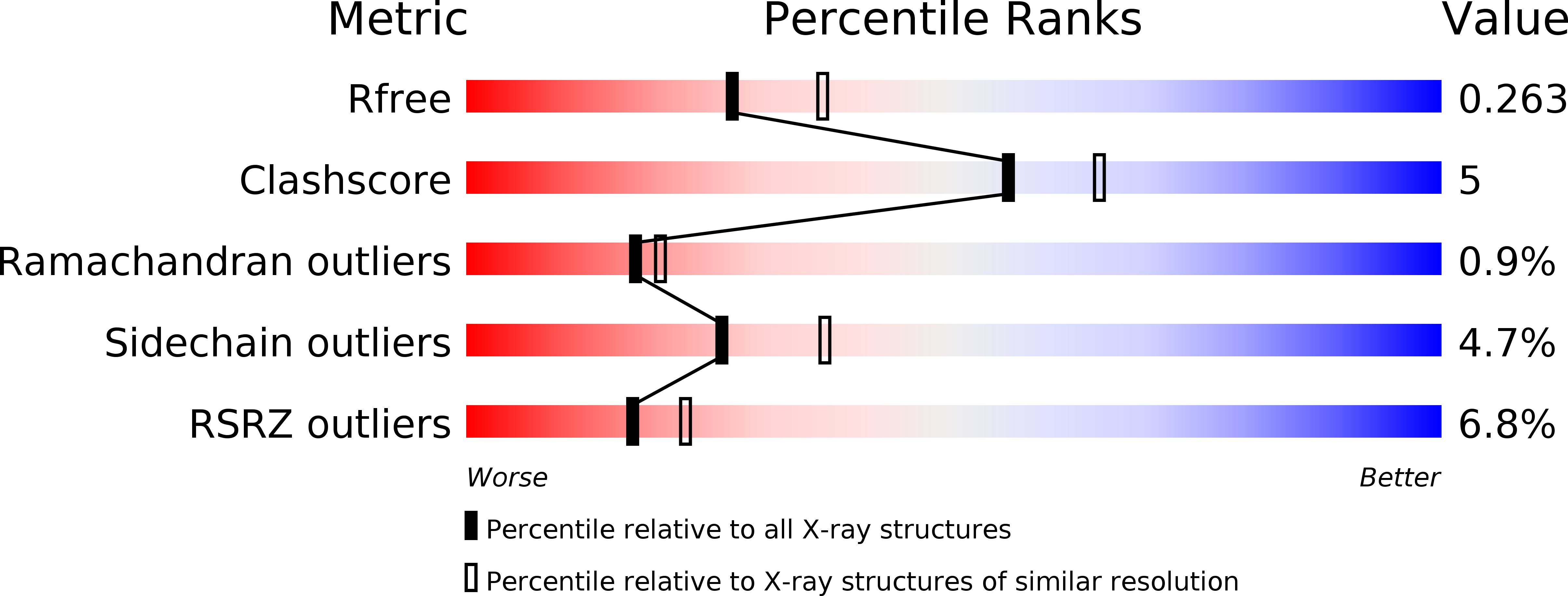
Macromolecular Entities
Structures with similar UniProt ID
Protein Blast
Polymer Type:polypeptide(L)
Molecule:RNA polymerase sigma factor SIGMA-28 (FliA)
Gene (Uniprot):fliA
Chain IDs:A, C, E, G
Chain Length:239
Number of Molecules:4
Biological Source:Aquifex aeolicus
Structures with similar UniProt ID
Protein Blast
Polymer Type:polypeptide(L)
Molecule:anti sigma factor FlgM
Gene (Uniprot):fliA
Chain IDs:B, D, F, H
Chain Length:88
Number of Molecules:4
Biological Source:Aquifex aeolicus
Primary Citation
Crystal Structure of the Flagellar Sigma/Anti-Sigma Complex Sigma(28)/FlgM Reveals an Intact Sigma Factor in an Inactive Conformation
Mol.Cell 14 127 138 (2004)
PMID: 15068809 DOI: 10.1016/S1097-2765(04)00150-9

Abstact

The key regulators of bacterial transcription initiation are the sigma factors, which direct promoter recognition and melting but only after binding to the core RNA polymerase to form the holoenzyme. X-ray crystal structures of the flagellar sigma, sigma(28), in complex with its anti-sigma, FlgM, explain the inhibition mechanism of FlgM, including its ability to attack and destabilize the sigma(28)-holoenzyme. The sigma domains (sigma(2), sigma(3), and sigma(4)) pack together in a compact unit with extensive interdomain interfaces that bury the promoter binding determinants, including the -35 element recognition helix of sigma(4), which fits in an acidic groove on the surface of sigma(3). The structure illustrates the large rearrangements that sigma(28) must undergo to form the holoenzyme and provides insights into the regulation of sigma(28) promoter binding activity that may extend, at least in principle, to other sigmas.

Legend

Protein

Chemical

Disease

Primary Citation of related structures
Feedback Form
Name
Email
Institute
Feedback