1ROD image
Deposition Date 1995-11-24
Release Date 1996-06-10
Last Version Date 2024-10-23
Entry Detail
PDB ID:
1ROD
Keywords:
Title:
CHIMERIC PROTEIN OF INTERLEUKIN 8 AND HUMAN MELANOMA GROWTH STIMULATING ACTIVITY PROTEIN, NMR
Biological Source:
Source Organism:
Homo sapiens (Taxon ID: 9606)
Host Organism:
Method Details:
Experimental Method:
Conformers Submitted:
8
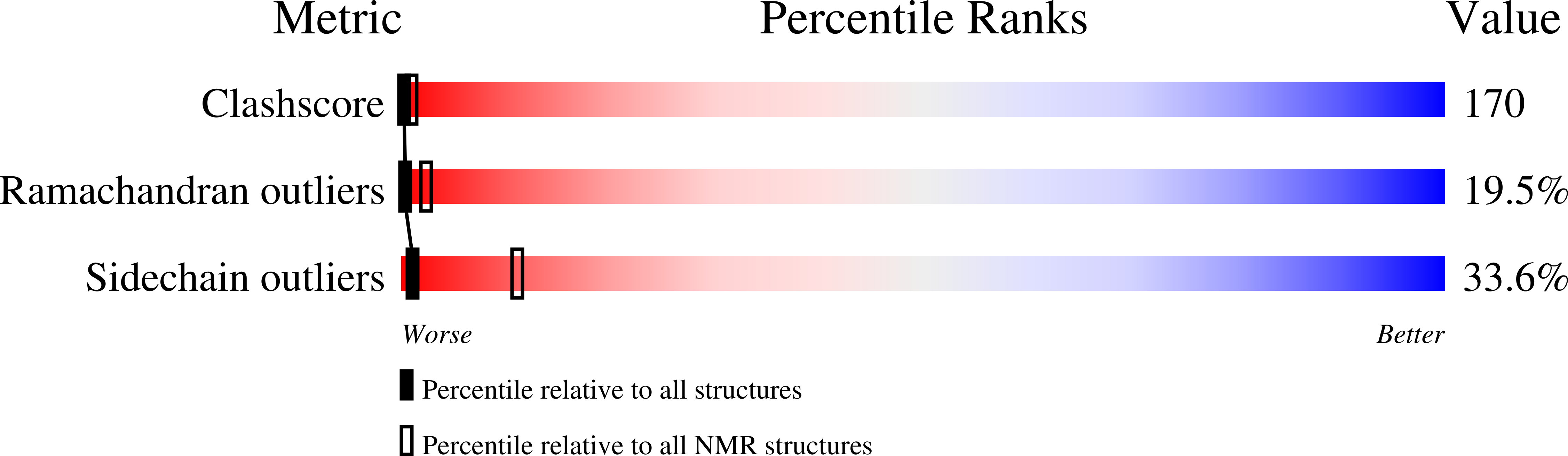
Macromolecular Entities
Structures with similar UniProt ID
Protein Blast
Polymer Type:polypeptide(L)
Molecule:CHIMERIC PROTEIN OF INTERLEUKIN 8 AND HUMAN MELANOMA GROWTH STIMULATING ACTIVITY PROTEIN
Gene (Uniprot):CXCL8
Chain IDs:A, B
Chain Length:72
Number of Molecules:2
Biological Source:Homo sapiens
Ligand Molecules
Primary Citation
Structure and activity of a chimeric interleukin-8-melanoma-growth-stimulatory-activity protein.
Eur.J.Biochem. 235 26 35 (1996)
PMID: 8631339 DOI: 10.1111/j.1432-1033.1996.00026.x

Abstact

A 72-amino-acid chimeric protein, Chi1, was constructed from the N-terminal part of interleukin 8, IL-8-(1-53), and the C-terminal part of melanoma growth stimulatory activity, MGSA-(54-72). Chi1 protein showed receptor-binding specificity and biological activity similar, but not identical to IL-8 and decidedly different from MGSA. The structure of Chi1 was determined in solution by two-dimensional NMR and molecular-dynamics calculations. The structure resembled the structures of MGSA and IL-8 closely, containing a triple-stranded beta-sheet in the IL-8 part and an amphipathic alpha-helix in the MGSA part. Chi1 formed dimers at millimolar concentrations via the first strand from the N-terminus, analogous to IL-8 and MGSA. In contrast to the latter molecules, however, the alpha-helix of Chi1 did not pack against the beta-sheet part, but was an independent structural element. This structural difference could be explained mainly by the modulation of hydrophobic interactions between the helix and the rest of the protein in Chi1 as compared to IL-8 and MGSA. It is concluded that tight helix packing is not required for receptor binding and biological activity of Chi1.

Legend

Protein

Chemical

Disease

Primary Citation of related structures
Feedback Form
Name
Email
Institute
Feedback