1RK8 image
Deposition Date 2003-11-21
Release Date 2004-04-13
Last Version Date 2024-02-14
Entry Detail
PDB ID:
1RK8
Keywords:
Title:
Structure of the cytosolic protein PYM bound to the Mago-Y14 core of the exon junction complex
Biological Source:
Source Organism(s):
Expression System(s):
Method Details:
Experimental Method:
Resolution:
1.90 Å
R-Value Free:
0.24
R-Value Work:
0.23
R-Value Observed:
0.23
Space Group:
P 43 21 2
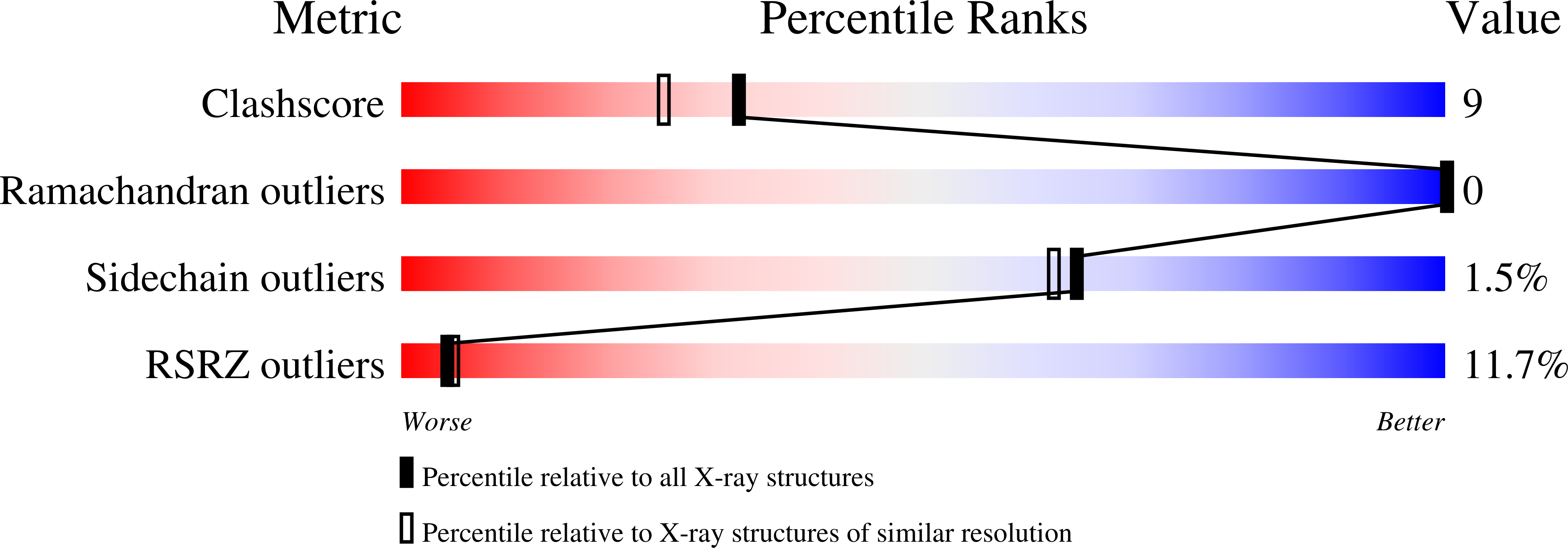
Macromolecular Entities
Structures with similar UniProt ID
Protein Blast
Polymer Type:polypeptide(L)
Molecule:CG8781-PA protein
Gene (Uniprot):tsu
Chain IDs:A
Chain Length:165
Number of Molecules:1
Biological Source:Drosophila melanogaster
Structures with similar UniProt ID
Protein Blast
Polymer Type:polypeptide(L)
Molecule:Mago nashi protein
Gene (Uniprot):mago
Chain IDs:B
Chain Length:147
Number of Molecules:1
Biological Source:Drosophila melanogaster
Structures with similar UniProt ID
Protein Blast
Polymer Type:polypeptide(L)
Molecule:Within the bgcn gene intron protein
Gene (Uniprot):Pym
Chain IDs:C
Chain Length:58
Number of Molecules:1
Biological Source:Drosophila melanogaster
Ligand Molecules
Primary Citation
Molecular insights into the interaction of PYM with the Mago-Y14 core of the exon junction complex
EMBO Rep. 5 304 310 (2004)
PMID: 14968132 DOI: 10.1038/sj.embor.7400091

Abstact

The exon junction complex (EJC) is deposited on mRNAs as a consequence of splicing and influences postsplicing mRNA metabolism. The Mago-Y14 heterodimer is a core component of the EJC. Recently, the protein PYM has been identified as an interacting partner of Mago-Y14. Here we show that PYM is a cytoplasmic RNA-binding protein that is excluded from the nucleus by Crm1. PYM interacts directly with Mago-Y14 by means of its N-terminal domain. The crystal structure of the Drosophila ternary complex at 1.9 A resolution reveals that PYM binds Mago and Y14 simultaneously, capping their heterodimerization interface at conserved surface residues. Formation of this ternary complex is also observed with the human proteins. Mago residues involved in the interaction with PYM have been implicated in nonsense-mediated mRNA decay (NMD). Consistently, human PYM is active in NMD tethering assays. Together, these data suggest a role for PYM in NMD.

Legend

Protein

Chemical

Disease

Primary Citation of related structures
Feedback Form
Name
Email
Institute
Feedback