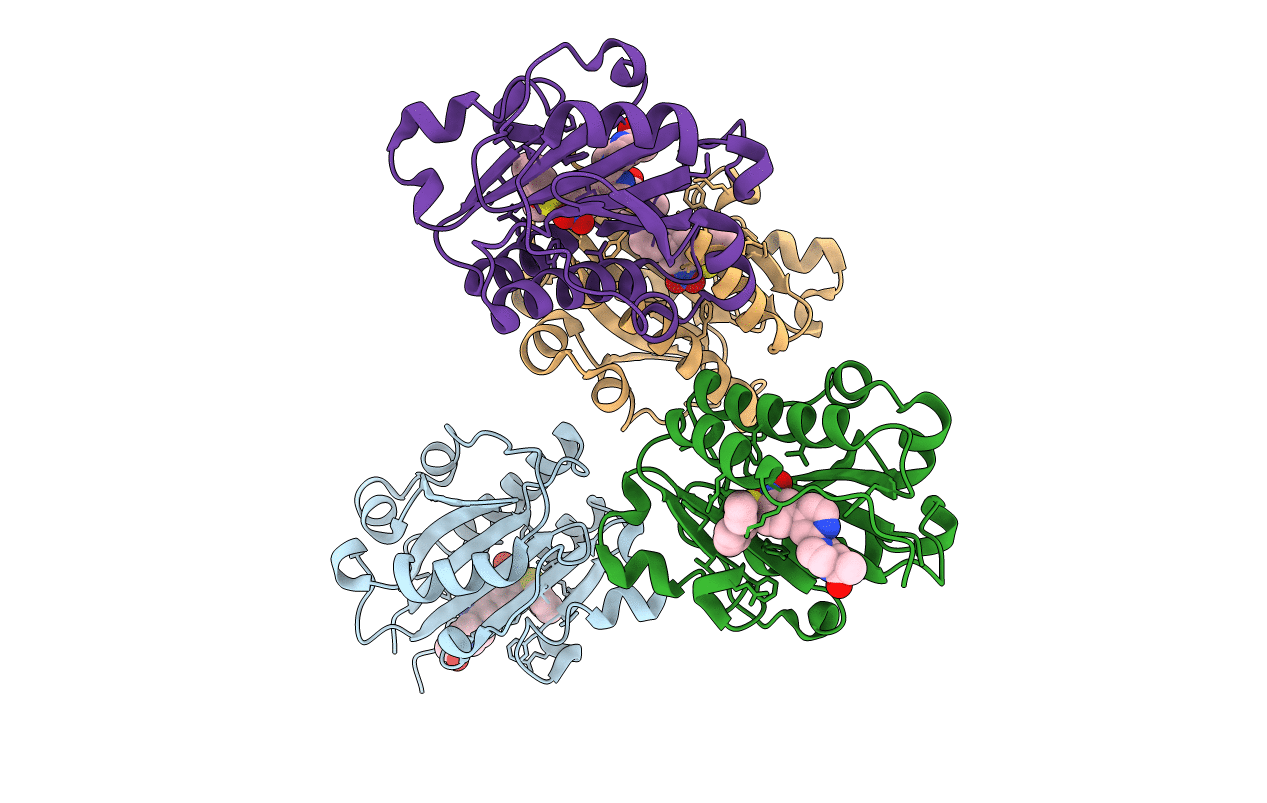
1RD4 image
Deposition Date 2003-11-05
Release Date 2004-03-30
Last Version Date 2023-08-23
Entry Detail
PDB ID:
1RD4
Keywords:
Title:
An allosteric inhibitor of LFA-1 bound to its I-domain
Biological Source:
Source Organism(s):
Homo sapiens (Taxon ID: 9606)
Expression System(s):
Method Details:
Experimental Method:
Resolution:
2.40 Å
R-Value Free:
0.29
R-Value Work:
0.23
R-Value Observed:
0.24
Space Group:
P 1
Macromolecular Entities
Structures with similar UniProt ID
Protein Blast
Polymer Type:polypeptide(L)
Molecule:Integrin alpha-L
Gene (Uniprot):ITGAL
Chain IDs:A, B, C, D
Chain Length:191
Number of Molecules:4
Biological Source:Homo sapiens
Ligand Molecules
Primary Citation
Structure of an allosteric inhibitor of LFA-1 bound to the I-domain studied by crystallography, NMR, and calorimetry
Biochemistry 43 2394 2404 (2004)
PMID: 14992576 DOI: 10.1021/bi035422a

Abstact

LFA-1 (lymphocyte function-associated antigen-1) plays a role in intercellular adhesion and lymphocyte trafficking and activation and is an attractive anti-inflammatory drug target. The alpha-subunit of LFA-1, in common with several other integrins, has an N-terminally inserted domain (I-domain) of approximately 200 amino acids that plays a central role in regulating ligand binding to LFA-1. An additional region, termed the I-domain allosteric site (IDAS), has been identified exclusively within the LFA-1 I-domain and shown to regulate the function of this protein. The IDAS is occupied by small molecule LFA-1 inhibitors when cocrystallized or analyzed by (15)N-(1)H HSQC (heteronuclear single-quantum coherence) NMR (nuclear magnetic resonance) titration experiments. We report here a novel arylthio inhibitor that binds the I-domain with a K(d) of 18.3 nM as determined by isothermal titration calorimetry (ITC). This value is in close agreement with the IC(50) (10.9 nM) derived from a biochemical competition assay (DELFIA) that measures the level of inhibition of binding of whole LFA-1 to its ligand, ICAM-1. Having established the strong affinity of the arylthio inhibitor for the isolated I-domain, we have used a range of techniques to further characterize the binding, including ITC, NMR, and X-ray crystallography. We have first developed an effective ITC binding assay for use with low-solubility inhibitors that avoids the need for ELISA-based assays. In addition, we utilized a fast NMR-based assay for the generation of I-domain-inhibitor models. This is based around the collection of HCCH-TOCSY spectra of LFA-1 in the bound form and the identification of a subset of side chain methyl groups that give chemical shift changes upon binding of LFA-1 inhibitors. This subset was used in two-dimensional (13)C-(15)N and (15)N-filtered and -edited two-dimensional NMR experiments to identify a minimal set of intraligand and ligand-protein NOEs, respectively (nuclear Overhauser enhancements). Models from the NMR data were assessed by comparison to an X-ray crystallographic structure of the complex, confirming that the method correctly predicted the essential features of the bound ligand.

Legend

Protein

Chemical

Disease

Primary Citation of related structures
Feedback Form
Name
Email
Institute
Feedback