1R3H image
Deposition Date 2003-10-02
Release Date 2004-03-30
Last Version Date 2024-11-13
Entry Detail
PDB ID:
1R3H
Keywords:
Title:
Crystal Structure of T10
Biological Source:
Source Organism:
Mus musculus (Taxon ID: 10090)
Homo sapiens (Taxon ID: 9606)
Host Organism:
Method Details:
Experimental Method:
Resolution:
2.50 Å
R-Value Free:
0.27
R-Value Work:
0.23
Space Group:
P 1 21 1
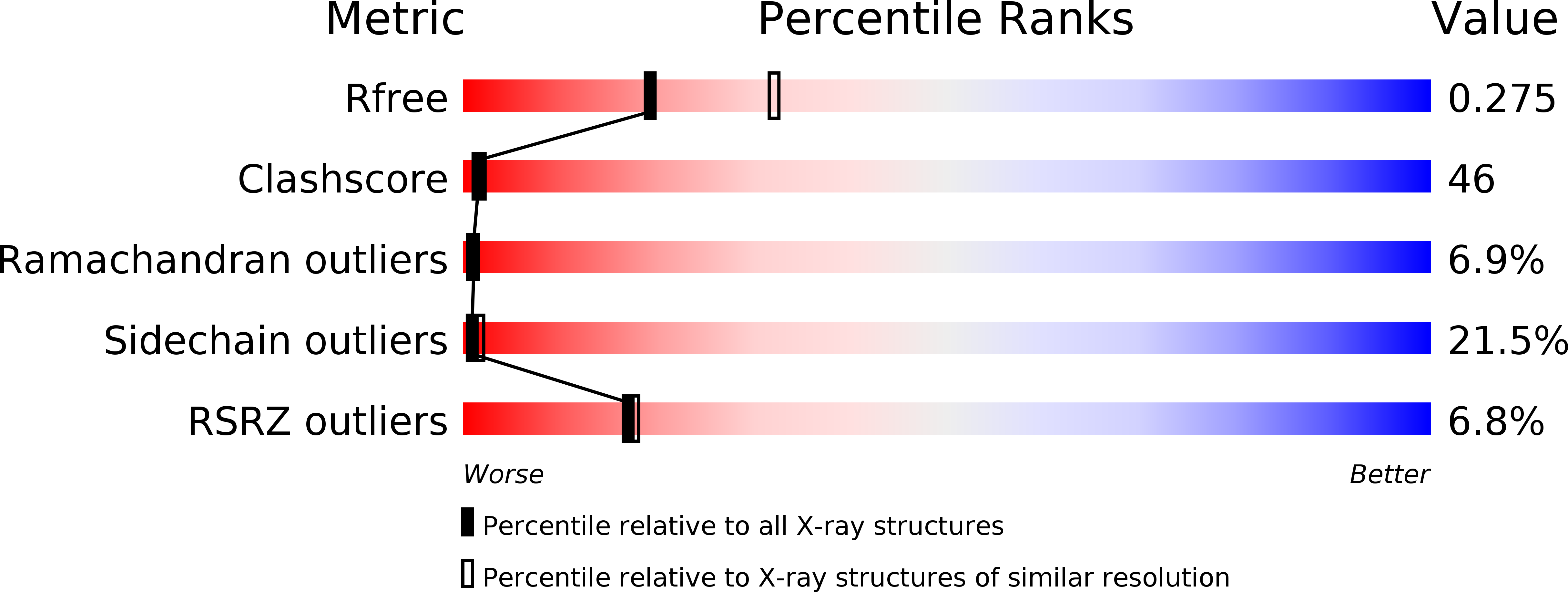
Macromolecular Entities
Structures with similar UniProt ID
Protein Blast
Polymer Type:polypeptide(L)
Molecule:MHC H2-TL-T10-129
Gene (Uniprot):H2-T10
Chain IDs:A, C, E, G
Chain Length:260
Number of Molecules:4
Biological Source:Mus musculus
Structures with similar UniProt ID
Protein Blast
Polymer Type:polypeptide(L)
Molecule:Beta-2-microglobulin
Gene (Uniprot):B2M
Chain IDs:B, D, F, H
Chain Length:99
Number of Molecules:4
Biological Source:Homo sapiens
Ligand Molecules
Primary Citation
Combined pseudo-merohedral twinning, non-crystallographic symmetry and pseudo-translation in a monoclinic crystal form of the gammadelta T-cell ligand T10.
Acta Crystallogr.,Sect.D 60 656 664 (2004)
PMID: 15039553 DOI: 10.1107/S0907444904002239

Abstact

T10 is a non-classical class Ib-like major histocompatibility complex (MHC) cell-surface antigen which binds directly to certain gammadelta T-cell receptors in the absence of any exogenous and endogenous ligands, such as peculiar lipids or glycolipids. The crystal structure at 2.5 A resolution of murine T10 was determined by molecular replacement using data from an almost perfectly twinned monoclinic crystal. The space group is P2(1), with unit-cell parameters a = 78.2, b = 70.0, c = 139.2 A, beta = 106.8 degrees. Self-rotation function analysis and various intensity statistics revealed the presence of pseudo-merohedral twinning, but these tests underestimated the true twin fraction of alpha approximately 0.46. Native Patterson analyses pointed to the presence of pseudo-translation among the four molecules present in the asymmetric unit. Data analysis, structure determination and model refinement are discussed.

Legend

Protein

Chemical

Disease

Primary Citation of related structures
Feedback Form
Name
Email
Institute
Feedback