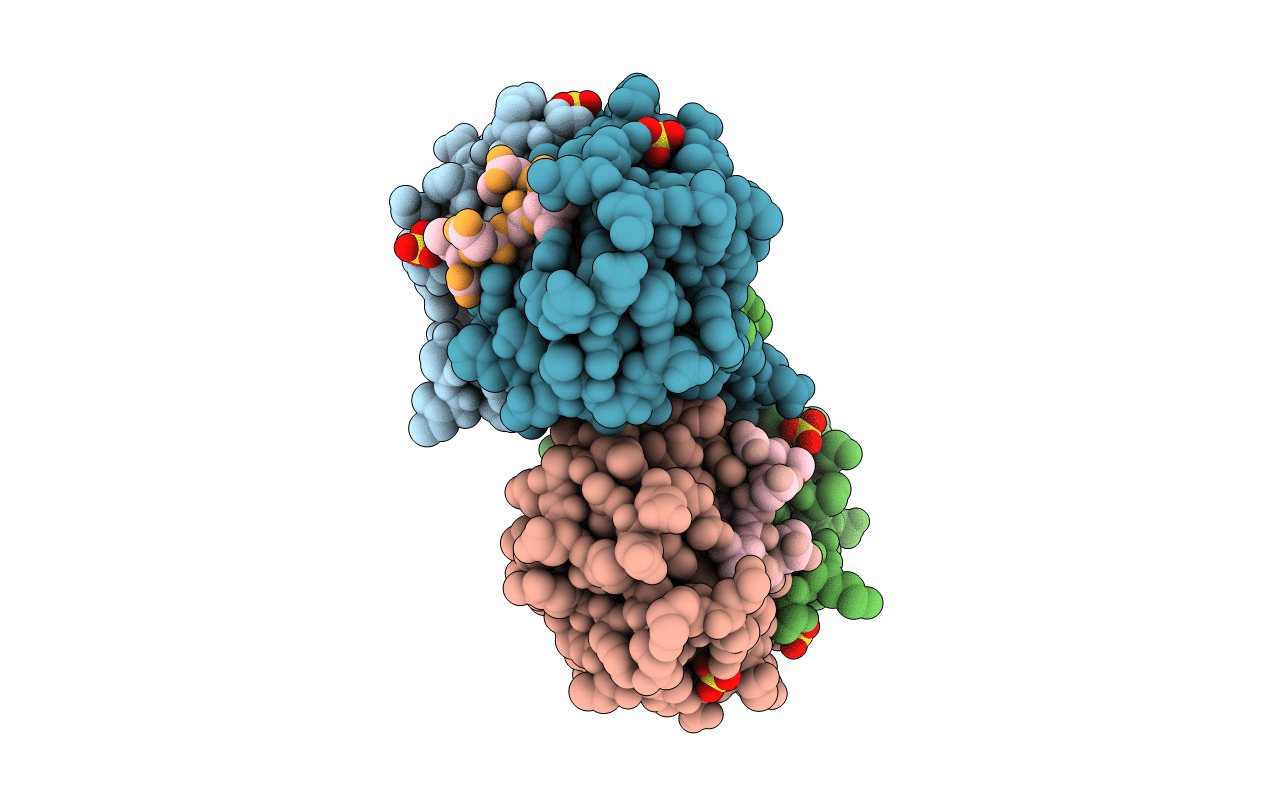
1R1P image
Deposition Date 2003-09-24
Release Date 2004-09-28
Last Version Date 2024-10-09
Entry Detail
PDB ID:
1R1P
Title:
Structural Basis for Differential Recognition of Tyrosine Phosphorylated Sites in the Linker for Activation of T cells (LAT) by the Adaptor Protein Gads
Biological Source:
Source Organism:
Mus musculus (Taxon ID: 10090)
Host Organism:
Method Details:
Experimental Method:
Resolution:
1.80 Å
R-Value Free:
0.24
R-Value Work:
0.19
R-Value Observed:
0.19
Space Group:
P 41 21 2

Macromolecular Entities
Structures with similar UniProt ID
Protein Blast
Polymer Type:polypeptide(L)
Molecule:GRB2-related adaptor protein 2
Gene (Uniprot):Grap2
Chain IDs:A, B, C, D
Chain Length:100
Number of Molecules:4
Biological Source:Mus musculus
Polymer Type:polypeptide(L)
Molecule:LAT pY171 peptide
Chain IDs:E, F, G, H
Chain Length:7
Number of Molecules:4
Biological Source:
Modified Residue
Compound ID Chain ID Parent Comp ID Details 2D Image
PTR E TYR O-PHOSPHOTYROSINE
Ligand Molecules
Primary Citation
Structural basis for differential recognition of tyrosine-phosphorylated sites in the linker for activation of T cells (LAT) by the adaptor Gads.
Embo J. 23 1441 1451 (2004)
PMID: 15029250 DOI: 10.1038/sj.emboj.7600168

Abstact

The transmembrane protein, linker for activation of T cells (LAT), is essential for T-cell activation and development. Phosphorylation of LAT at multiple tyrosines creates binding sites for the adaptors Gads and Grb2, leading to nucleation of multiprotein signaling complexes. Human LAT contains five potential binding sites for Gads, of which only those at Tyr171 and Tyr191 appear necessary for T-cell function. We asked whether Gads binds preferentially to these sites, as differential recognition could assist in assembling defined LAT-based complexes. Measured calorimetrically, Gads-SH2 binds LAT tyrosine phosphorylation sites 171 and 191 with higher affinities than the other sites, with the differences ranging from only several fold weaker binding to no detectable interaction. Crystal structures of Gads-SH2 complexed with phosphopeptides representing sites 171, 191 and 226 were determined to 1.8-1.9 A resolutions. The structures reveal the basis for preferential recognition of specific LAT sites by Gads, as well as for the relatively greater promiscuity of the related adaptor Grb2, whose binding also requires asparagine at position +2 C-terminal to the phosphorylated tyrosine.

Legend

Protein

Chemical

Disease

Primary Citation of related structures
Feedback Form
Name
Email
Institute
Feedback