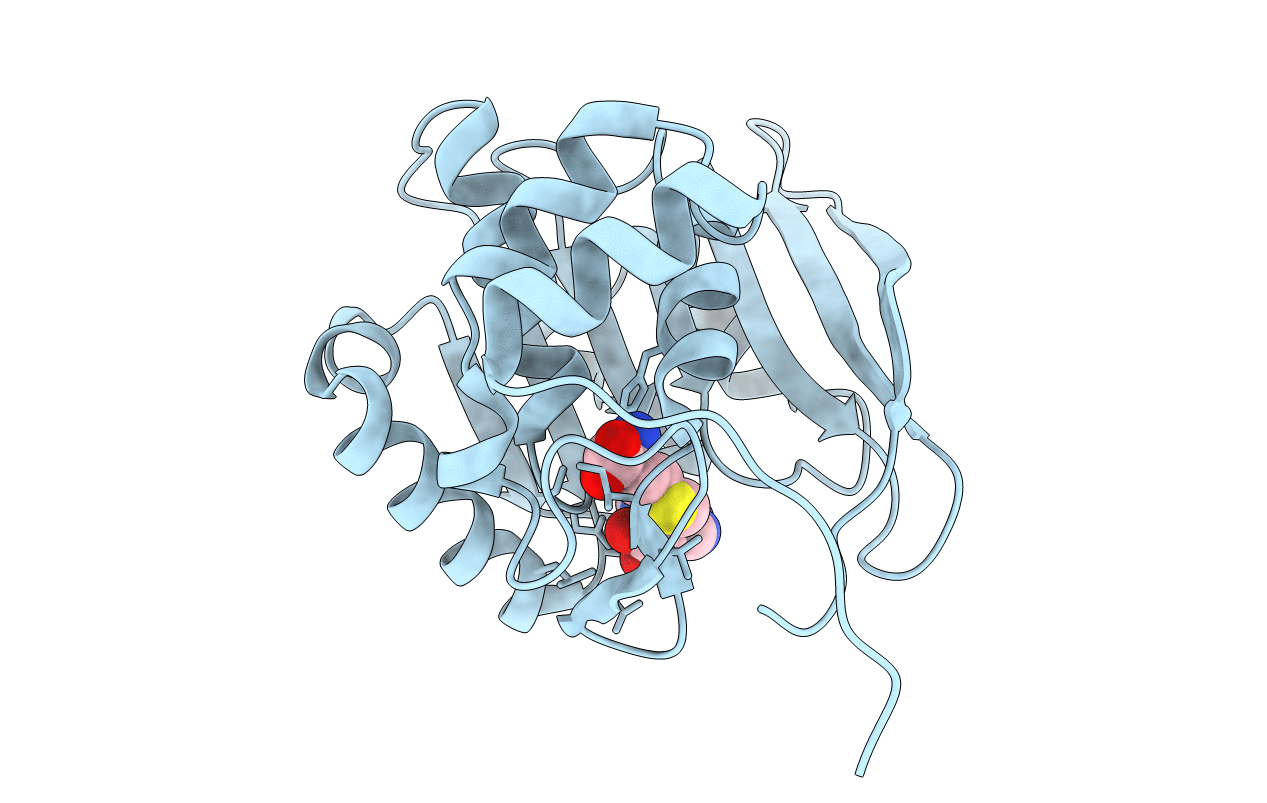
1R18 image
Deposition Date 2003-09-23
Release Date 2003-12-09
Last Version Date 2023-08-23
Entry Detail
PDB ID:
1R18
Keywords:
Title:
Drosophila protein isoaspartyl methyltransferase with S-adenosyl-L-homocysteine
Biological Source:
Source Organism:
Method Details:
Experimental Method:
Resolution:
2.20 Å
R-Value Free:
0.23
R-Value Work:
0.19
R-Value Observed:
0.19
Space Group:
C 1 2 1

Macromolecular Entities
Structures with similar UniProt ID
Protein Blast
Polymer Type:polypeptide(L)
Molecule:Protein-L-isoaspartate(D-aspartate)-O-methyltransferase
Gene (Uniprot):Pcmt
Chain IDs:A
Chain Length:227
Number of Molecules:1
Biological Source:Drosophila melanogaster
Ligand Molecules
Primary Citation
Catalytic implications from the Drosophila protein L-isoaspartyl methyltransferase structure and site-directed mutagenesis.
Biochemistry 42 12844 12853 (2003)
PMID: 14596598 DOI: 10.1021/bi034891+

Abstact

Protein L-isoaspartyl methyltransferases (PIMT; EC 2.1.1.77) catalyze the S-adenosylmethionine-dependent methylation of L-isoaspartyl residues that arise spontaneously in proteins with age, thereby initiating a repair process that restores the normal backbone configuration to the damaged polypeptide. In Drosophila melanogaster, overexpression of PIMT in transgenic flies extends the normal life span, suggesting that protein damage can be a limiting factor in longevity. To understand structural features of the Drosophila PIMT (dPIMT) important for catalysis, the crystal structure of dPIMT was determined at a resolution of 2.2 A, and site-directed mutagenesis was used to identify the role of Ser-60 in catalysis. The core structure of dPIMT is similar to the modified nucleotide-binding fold observed in PIMTs from extreme thermophiles and humans. A striking difference of the dPIMT structure is the rotation of the C-terminal residues by 90 degrees relative to the homologous structures. Effectively, this displacement generates a more open conformation that allows greater solvent access to S-adenosylhomocysteine, which is almost completely buried in other PIMT structures. The enzyme may alternate between the open conformation found for dPIMT and the more closed conformations described for other PIMTs during its catalytic cycle, thereby allowing the exchange of substrates and products. Catalysis by dPIMT requires the side chain of the conserved, active site residue Ser-60, since substitution of this residue with Thr, Gln, or Ala reduces or abolishes the methylation of both protein and isoaspartyl peptide substrates.

Legend

Protein

Chemical

Disease

Primary Citation of related structures
Feedback Form
Name
Email
Institute
Feedback