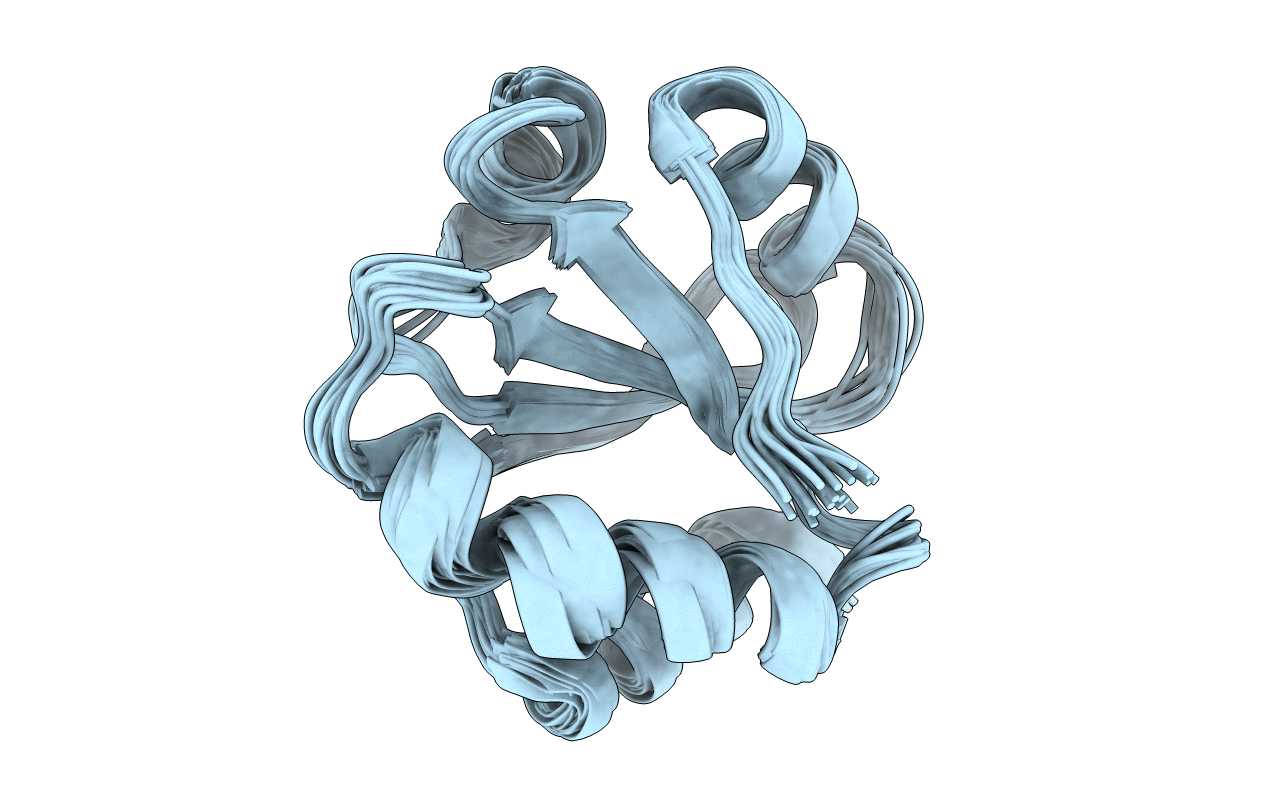
1QUW image
Deposition Date 1999-07-02
Release Date 2000-01-26
Last Version Date 2024-10-30
Entry Detail
PDB ID:
1QUW
Title:
SOLUTION STRUCTURE OF THE THIOREDOXIN FROM BACILLUS ACIDOCALDARIUS
Biological Source:
Source Organism:
Host Organism:
Method Details:
Experimental Method:
Conformers Calculated:
50
Conformers Submitted:
20
Selection Criteria:
STRUCTURES WITH ACCEPTABLE COVALENT GEOMETRY,STRUCTURES WITH THE LEAST RESTRAINT VIOLATIONS
Macromolecular Entities
Structures with similar UniProt ID
Protein Blast
Polymer Type:polypeptide(L)
Molecule:THIOREDOXIN
Gene (Uniprot):trxA
Chain IDs:A
Chain Length:105
Number of Molecules:1
Biological Source:Alicyclobacillus acidocaldarius
Ligand Molecules
Primary Citation
NMR solution structure of a novel thioredoxin from Bacillus acidocaldarius possible determinants of protein stability.
Eur.J.Biochem. 267 403 413 (2000)
PMID: 10632710 DOI: 10.1046/j.1432-1327.2000.01015.x

Abstact

The thioredoxin (Trx) from Bacillus acidocaldarius (BacTrx), an eubacterium growing optimally at 333 K, is the first Trx described to date from a moderate thermophilic source. To understand the molecular basis of its thermostability, the three-dimensional structure in the oxidized form was determined by NMR methods. A total of 2276 1H-NMR derived distance constraints along with 23 hydrogen-bonds, 72 phi and 27 chi1 torsion angle restraints, were used in a protocol employing simulated annealing followed by restrained molecular dynamics and restrained energy minimization. BacTrx consists of a well-defined core region of five strands of beta-sheet, surrounded by four exposed alpha-helices, features shared by other members of the thioredoxin family. The BacTrx 3D structure was compared with the Escherichia coli Trx (EcTrx) determined by X-ray crystallographic diffraction, and a number of structural differences were observed that may contribute to its thermostabilty. The results of structural analysis indicated that protein stability is due to cumulative effects, the main factor being an increased number of ionic interactions cross-linking different secondary structural elements and clamping the C-terminal alpha-helix to the core of the protein.

Legend

Protein

Chemical

Disease

Primary Citation of related structures
Feedback Form
Name
Email
Institute
Feedback