1QU1 image
Deposition Date 1999-07-05
Release Date 2000-01-05
Last Version Date 2024-10-16
Entry Detail
PDB ID:
1QU1
Keywords:
Title:
CRYSTAL STRUCTURE OF EHA2 (23-185)
Biological Source:
Source Organism(s):
Expression System(s):
Method Details:
Experimental Method:
Resolution:
1.90 Å
R-Value Free:
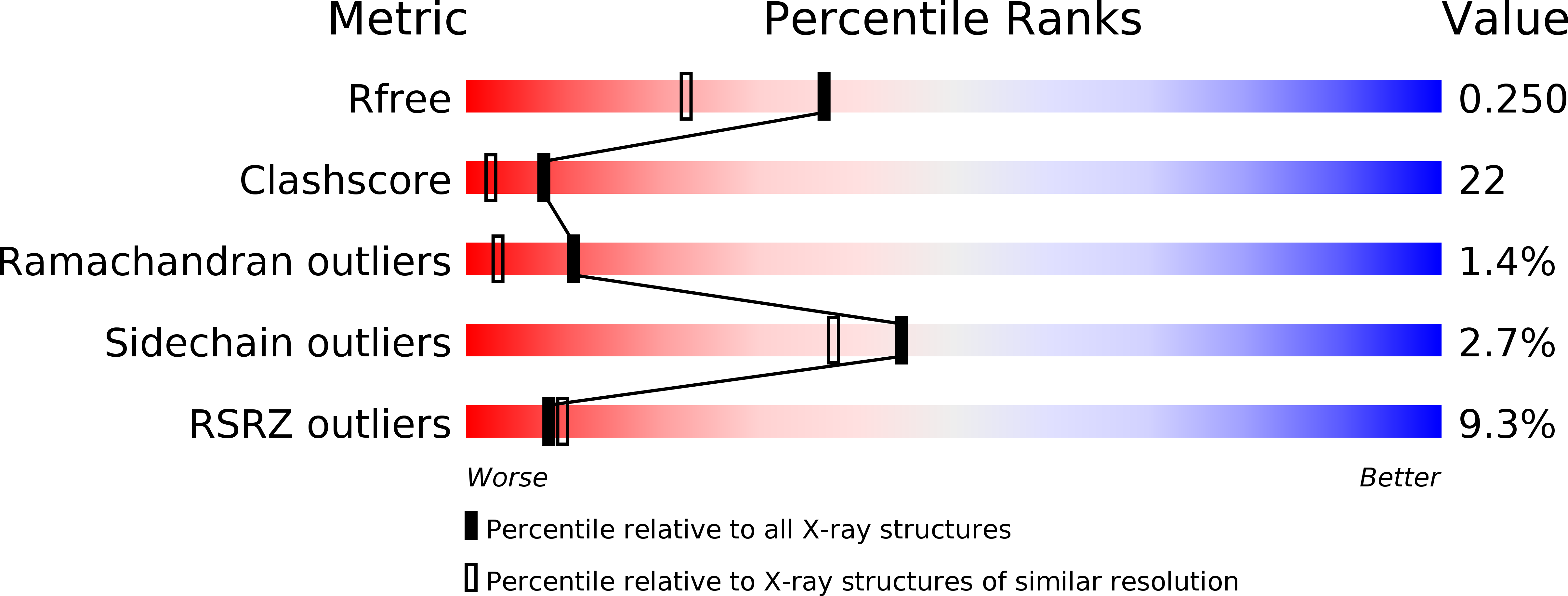
0.25
R-Value Work:
0.22
R-Value Observed:
0.22
Space Group:
C 1 2 1
Macromolecular Entities
Structures with similar UniProt ID
Protein Blast
Polymer Type:polypeptide(L)
Molecule:PROTEIN (INFLUENZA RECOMBINANT HA2 CHAIN)
Gene (Uniprot):HA
Chain IDs:A, B, C, D, E, F
Chain Length:155
Number of Molecules:6
Biological Source:Influenza A virus
Primary Citation
N- and C-terminal residues combine in the fusion-pH influenza hemagglutinin HA(2) subunit to form an N cap that terminates the triple-stranded coiled coil.
Proc.Natl.Acad.Sci.USA 96 8967 8972 (1999)
PMID: 10430879 DOI: 10.1073/pnas.96.16.8967

Abstact

The structure of a stable recombinant ectodomain of influenza hemagglutinin HA(2) subunit, EHA(2) (23-185), defined by proteolysis studies of the intact bacterial-expressed ectodomain, was determined to 1.9-A resolution by using x-ray crystallography. The structure reveals a domain composed of N- and C-terminal residues that form an N cap terminating both the N-terminal alpha-helix and the central coiled coil. The N cap is formed by a conserved sequence, and part of it is found in the neutral pH conformation of HA. The C-terminal 23 residues of the ectodomain form a 72-A long nonhelical structure ordered to within 7 residues of the transmembrane anchor. The structure implies that continuous alpha helices are not required for membrane fusion at either the N or C termini. The difference in stability between recombinant molecules with and without the N cap sequences suggests that additional free energy for membrane fusion may become available after the formation of the central triple-stranded coiled coil and insertion of the fusion peptide into the target membrane.

Legend

Protein

Chemical

Disease

Primary Citation of related structures
Feedback Form
Name
Email
Institute
Feedback