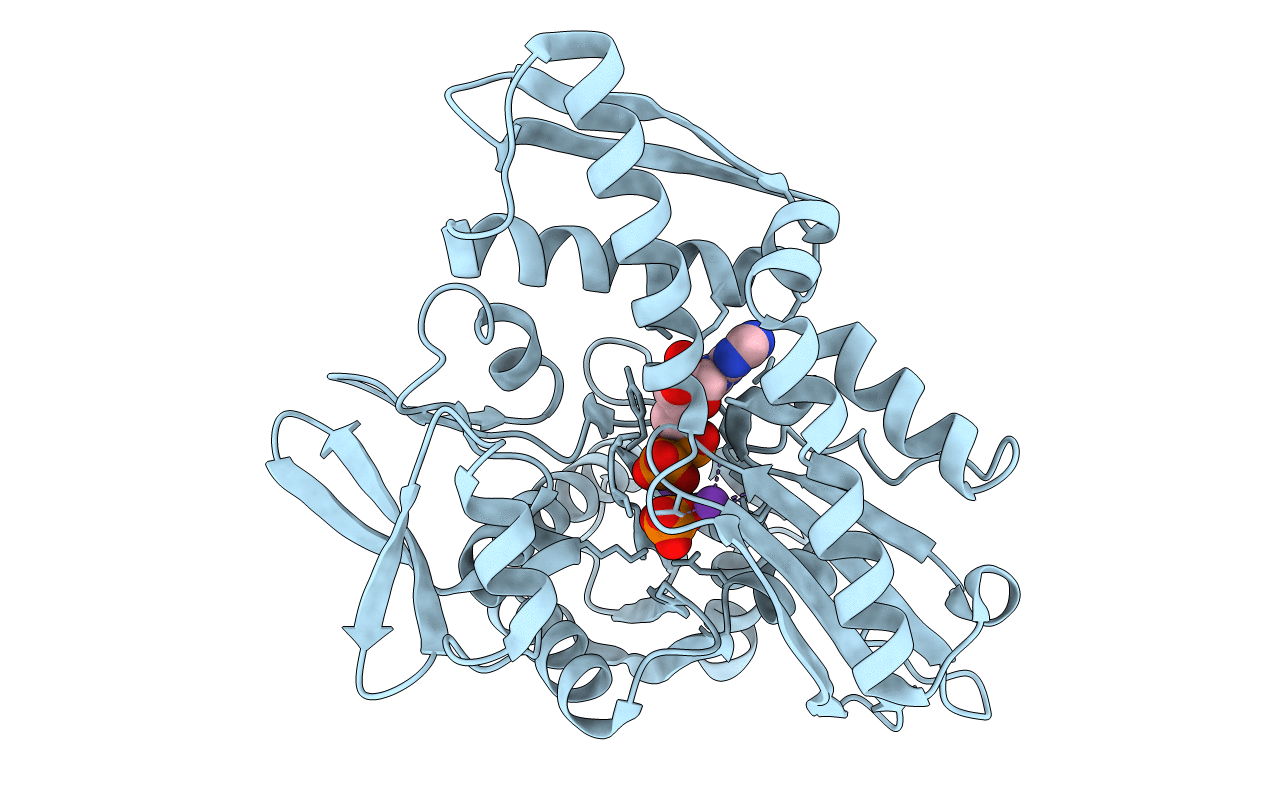
1QQN image
Deposition Date 1999-06-07
Release Date 1999-09-15
Last Version Date 2024-02-14
Entry Detail
PDB ID:
1QQN
Keywords:
Title:
D206S MUTANT OF BOVINE 70 KILODALTON HEAT SHOCK PROTEIN
Biological Source:
Source Organism:
Bos taurus (Taxon ID: 9913)
Method Details:
Experimental Method:
Resolution:
1.90 Å
R-Value Free:
0.22
R-Value Work:
0.19
R-Value Observed:
0.19
Space Group:
P 21 21 21

Macromolecular Entities
Structures with similar UniProt ID
Protein Blast
Polymer Type:polypeptide(L)
Molecule:D206S MUTANT OF BOVINE 70 KILODALTON HEAT SHOCK PROTEIN
Gene (Uniprot):HSPA8
Mutagens:D206S
Chain IDs:A
Chain Length:378
Number of Molecules:1
Biological Source:Bos taurus
Primary Citation
Mapping the role of active site residues for transducing an ATP-induced conformational change in the bovine 70-kDa heat shock cognate protein.
Biochemistry 38 10823 18830 (1999)
PMID: 10451379 DOI: 10.1021/bi990816g

Abstact

ATP binding induces a conformational change in 70-kDa heat shock proteins (Hsp70s) that facilitates release of bound polypeptides. Using the bovine heat shock cognate protein (Hsc70) as a representative of the Hsp70 family, we have characterized the effect of mutations on the coupling between ATP binding and the nucleotide-induced conformational change. Steady-state solution small-angle X-ray scattering and kinetic fluorescence measurements on a 60-kDa fragment of Hsc70 show that point mutations K71M, E175S, D199S, and D206S in the nucleotide binding cleft impair the ability of ATP to induce a conformational change. A secondary mutation in the peptide binding domain, E543K, "rescues" the ATP-induced transition for three of these mutations (E175S/E543K, D199S/E543K, and D206S/E543K) but not for K71M/E543K. Analysis of kinetics of the ATPase cycle confirm that these effects do not result from unexpectedly rapid ATP hydrolysis or slow ATP binding. Crystallographic structures of E175S, D199S, and D206S mutant ATPase fragment proteins show that the mutations do not perturb the tertiary structure of the protein but do significantly alter the protein-ligand interactions, due in part to an apparent charge compensation effect whereby mutating a (probably) negatively charged carboxyl group to a neutral serine displaces a K+ ion from the nucleotide binding cleft in two out of three cases (E175S and D199S but not D206S).

Legend

Protein

Chemical

Disease

Primary Citation of related structures
Feedback Form
Name
Email
Institute
Feedback