1QOZ image
Deposition Date 1999-11-25
Release Date 2000-11-24
Last Version Date 2024-10-09
Entry Detail
PDB ID:
1QOZ
Keywords:
Title:
Catalytic core domain of acetyl xylan esterase from Trichoderma reesei
Biological Source:
Source Organism:
Method Details:
Experimental Method:
Resolution:
1.90 Å
R-Value Free:
0.24
R-Value Work:
0.18
R-Value Observed:
0.18
Space Group:
P 1
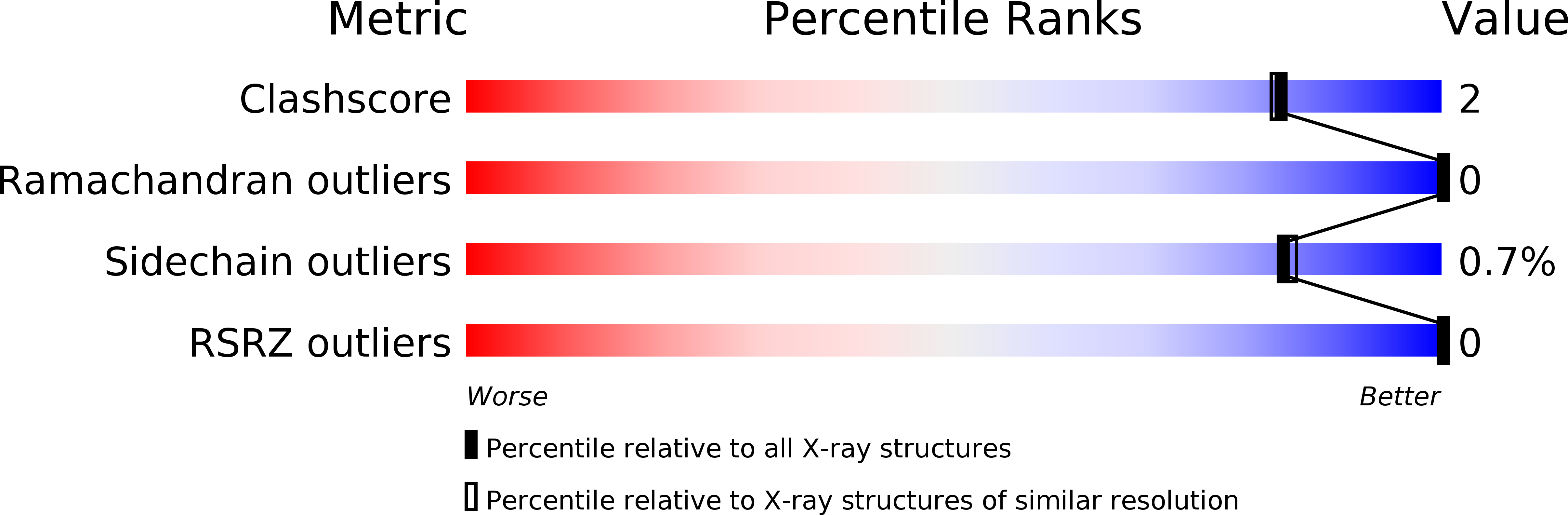
Macromolecular Entities
Structures with similar UniProt ID
Protein Blast
Polymer Type:polypeptide(L)
Molecule:ACETYL XYLAN ESTERASE
Gene (Uniprot):axe1
Chain IDs:A, B
Chain Length:207
Number of Molecules:2
Biological Source:TRICHODERMA REESEI
Modified Residue
Compound ID Chain ID Parent Comp ID Details 2D Image
ASN A ASN GLYCOSYLATION SITE
PCA A GLU PYROGLUTAMIC ACID
Ligand Molecules
Primary Citation
Three-Dimensional Structure of the Catalytic Core of Acetylxylan Esterase from Trichoderma Reesei: Insights Into the Deacetylation Mechanism
J.Struct.Biol. 132 180 ? (2000)
PMID: 11243887 DOI: 10.1006/JSBI.2000.4318

Abstact

Acetylxylan esterase from Trichoderma reesei removes acetyl side groups from xylan. The crystal structure of the catalytic core of the enzyme was solved at 1.9 A resolution. The core has an alpha/beta/alpha sandwich fold, similar to that of homologous acetylxylan esterase from Penicillium purpurogenum and cutinase from Fusarium solani. All three enzymes belong to family 5 of the carbohydrate esterases and the superfamily of the alpha/beta hydrolase fold. Evidently, the enzymes have diverged from a common ancestor and they share the same catalytic mechanism. The catalytic machinery of acetylxylan esterase from T. reesei was studied by comparison with cutinase, the catalytic site of which is well known. Acetylxylan esterase is a pure serine esterase having a catalytic triad (Ser90, His187, and Asp175) and an oxyanion hole (Thr13 N, and Thr13 O gamma). Although the catalytic triad of acetylxylan esterase has been reported previously, there has been no mention of the oxyanion hole. A model for the binding of substrates is presented on the basis of the docking of xylose. Acetylxylan esterase from T. reesei is able to deacetylate both mono- and double-acetylated residues, but it is not able to remove acetyl groups located close to large side groups such as 4-O-methylglucuronic acid. If the xylopyranoside residue is double-acetylated, both acetyl groups are removed by the catalytic triad: first one acetyl group is removed and then the residue is reorientated so that the nucleophilic oxygen of serine can attack the second acetyl group.

Legend

Protein

Chemical

Disease

Primary Citation of related structures
Feedback Form
Name
Email
Institute
Feedback