1QMV image
Deposition Date 1999-10-07
Release Date 2000-07-28
Last Version Date 2024-10-23
Entry Detail
PDB ID:
1QMV
Keywords:
Title:
thioredoxin peroxidase B from red blood cells
Biological Source:
Source Organism:
HOMO SAPIENS (Taxon ID: 9606)
Method Details:
Experimental Method:
Resolution:
1.70 Å
R-Value Free:
0.25
R-Value Work:
0.19
Space Group:
P 1 21 1
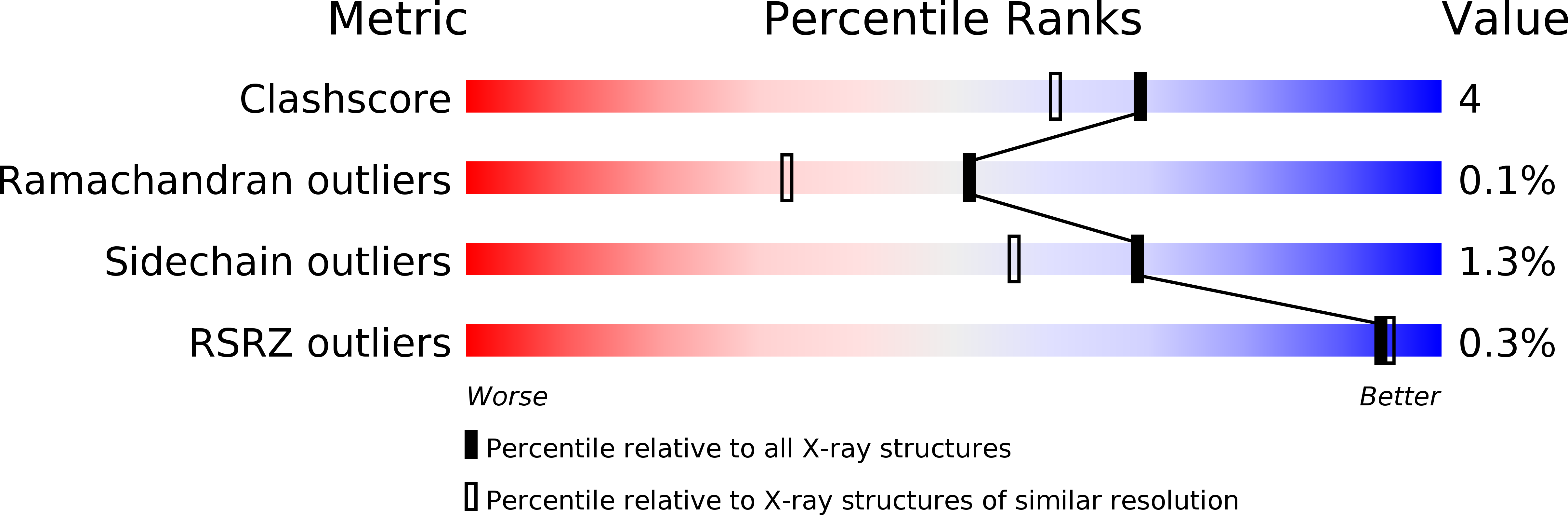
Macromolecular Entities
Structures with similar UniProt ID
Protein Blast
Polymer Type:polypeptide(L)
Molecule:PEROXIREDOXIN-2
Gene (Uniprot):PRDX2
Chain IDs:A, B, C, D, E, F, G, H, I, J
Chain Length:197
Number of Molecules:10
Biological Source:HOMO SAPIENS
Modified Residue
Compound ID Chain ID Parent Comp ID Details 2D Image
CSD A CYS 3-SULFINOALANINE
NCB A ALA N-CARBAMOYL-ALANINE
Primary Citation
Crystal Structure of Decameric 2-Cys Peroxiredoxin from Human Erythrocytes at 1.7 A Resolution.
Structure 8 605 ? (2000)
PMID: 10873855 DOI: 10.1016/S0969-2126(00)00147-7

Abstact

BACKGROUND: The peroxiredoxins (Prxs) are an emerging family of multifunctional enzymes that exhibit peroxidase activity in vitro, and in vivo participate in a range of cellular processes known to be sensitive to reactive oxygen species. Thioredoxin peroxidase B (TPx-B), a 2-Cys type II Prx from erythrocytes, promotes potassium efflux and down-regulates apoptosis and the recruitment of monocytes by endothelial tissue. RESULTS: The crystal structure of human decameric TPx-B purified from erythrocytes has been determined to 1.7 [corrected)] A resolution. The structure is a toroid comprising five dimers linked end-on through predominantly hydrophobic interactions, and is proposed to represent an intermediate in the in vivo reaction cycle. In the crystal structure, Cys51, the site of peroxide reduction, is oxidised to cysteine sulphinic acid. The residue Cys172, lies approximately 10 A away from Cys51 [corrected]. CONCLUSIONS: The oxidation of Cys51 appears to have trapped the structure into a stable decamer, as confirmed by sedimentation analysis. A comparison with two previously reported dimeric Prx structures reveals that the catalytic cycle of 2-Cys Prx requires significant conformational changes that include the unwinding of the active-site helix and the movement of four loops. It is proposed that the stable decamer forms in vivo under conditions of oxidative stress. Similar decameric structures of TPx-B have been observed by electron microscopy, which show the protein associated with the erythrocyte membrane.

Legend

Protein

Chemical

Disease

Primary Citation of related structures
Feedback Form
Name
Email
Institute
Feedback