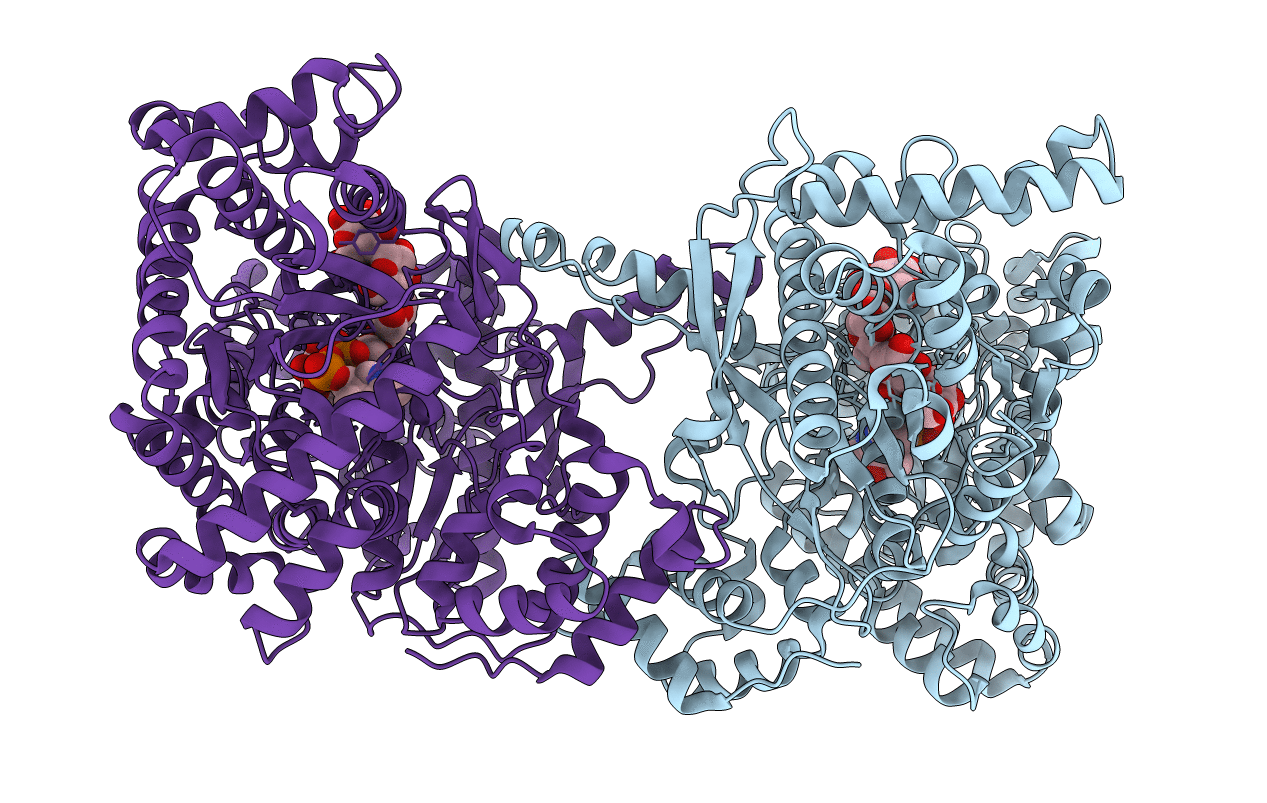
1QM5 image
Deposition Date 1999-09-20
Release Date 2000-02-03
Last Version Date 2024-05-08
Entry Detail
PDB ID:
1QM5
Keywords:
Title:
Phosphorylase recognition and phosphorylysis of its oligosaccharide substrate: answers to a long outstanding question
Biological Source:
Source Organism:
ESCHERICHIA COLI (Taxon ID: 562)
Host Organism:
Method Details:
Experimental Method:
Resolution:
2.00 Å
R-Value Free:
0.26
R-Value Work:
0.22
R-Value Observed:
0.22
Space Group:
P 1 21 1

Macromolecular Entities
Structures with similar UniProt ID
Protein Blast
Polymer Type:polypeptide(L)
Molecule:MALTODEXTRIN PHOSPHORYLASE
Gene (Uniprot):malP
Chain IDs:A, B
Chain Length:796
Number of Molecules:2
Biological Source:ESCHERICHIA COLI
Primary Citation
Phosphorylase Recognition and Phosphorolysis of its Oligosaccharide Substrate: Answers to a Long Outstanding Question
Embo J. 18 4619 ? (1999)
PMID: 10469642 DOI: 10.1093/EMBOJ/18.17.4619

Abstact

Phosphorylases are key enzymes of carbohydrate metabolism. Structural studies have provided explanations for almost all features of control and substrate recognition of phosphorylase but one question remains unanswered. How does phosphorylase recognize and cleave an oligosaccharide substrate? To answer this question we turned to the Escherichia coli maltodextrin phosphorylase (MalP), a non-regulatory phosphorylase that shares similar kinetic and catalytic properties with the mammalian glycogen phosphorylase. The crystal structures of three MalP-oligosaccharide complexes are reported: the binary complex of MalP with the natural substrate, maltopentaose (G5); the binary complex with the thio-oligosaccharide, 4-S-alpha-D-glucopyranosyl-4-thiomaltotetraose (GSG4), both at 2.9 A resolution; and the 2.1 A resolution ternary complex of MalP with thio-oligosaccharide and phosphate (GSG4-P). The results show a pentasaccharide bound across the catalytic site of MalP with sugars occupying sub-sites -1 to +4. Binding of GSG4 is identical to the natural pentasaccharide, indicating that the inactive thio compound is a close mimic of the natural substrate. The ternary MalP-GSG4-P complex shows the phosphate group poised to attack the glycosidic bond and promote phosphorolysis. In all three complexes the pentasaccharide exhibits an altered conformation across sub-sites -1 and +1, the site of catalysis, from the preferred conformation for alpha(1-4)-linked glucosyl polymers.

Legend

Protein

Chemical

Disease

Primary Citation of related structures
Feedback Form
Name
Email
Institute
Feedback