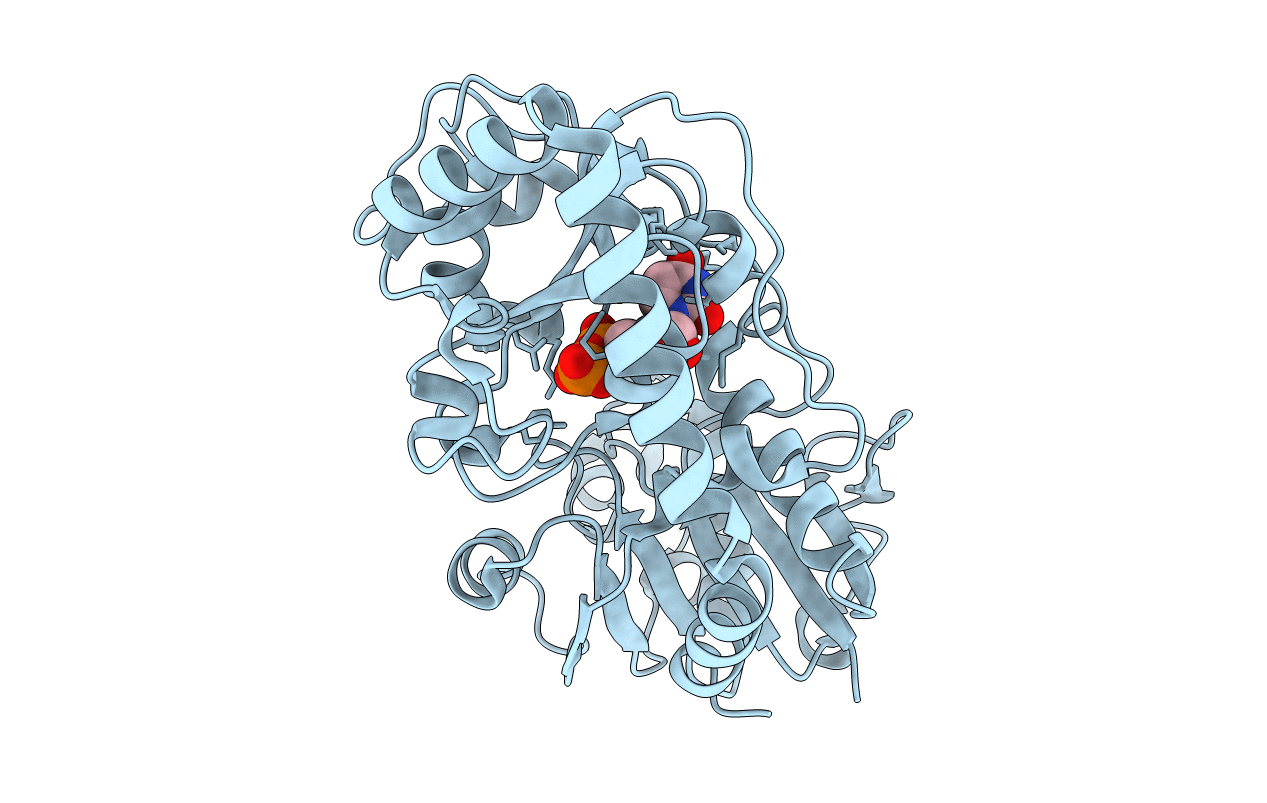
1QKJ image
Deposition Date 1999-07-22
Release Date 1999-07-28
Last Version Date 2023-12-13
Entry Detail
PDB ID:
1QKJ
Title:
T4 Phage B-Glucosyltransferase, Substrate Binding and Proposed Catalytic Mechanism
Biological Source:
Source Organism:
Host Organism:
Method Details:
Experimental Method:
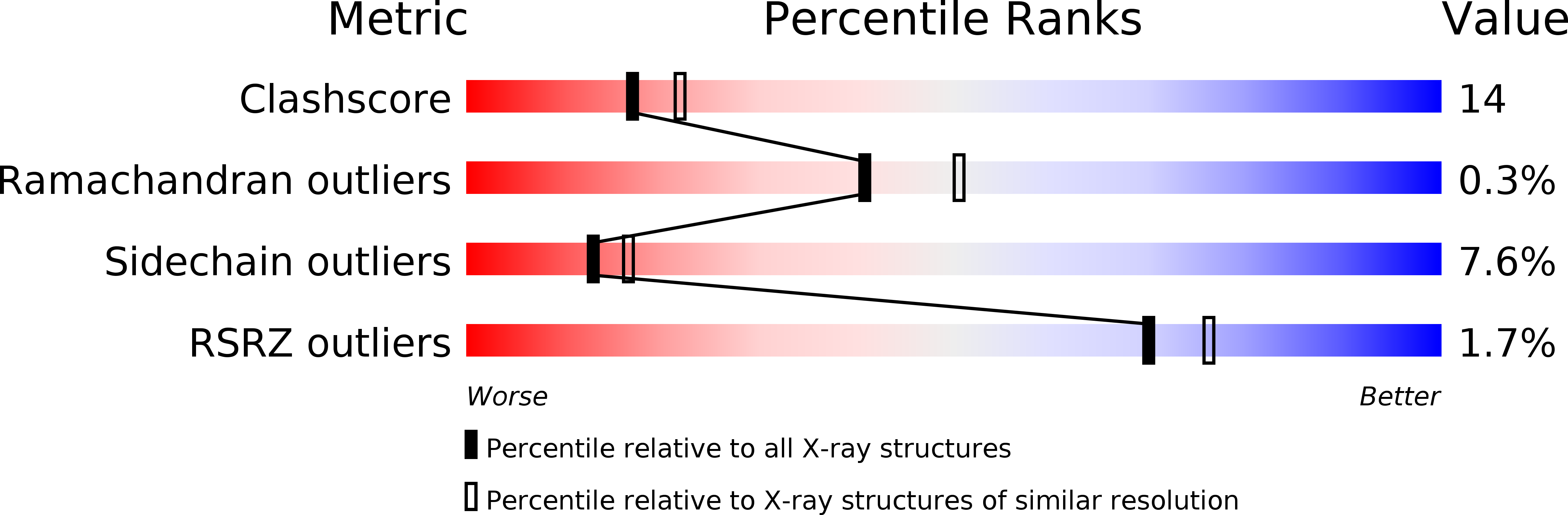
Resolution:
2.30 Å
R-Value Free:
0.29
R-Value Work:
0.19
R-Value Observed:
0.19
Space Group:
P 21 21 21
Macromolecular Entities
Structures with similar UniProt ID
Protein Blast
Polymer Type:polypeptide(L)
Molecule:BETA-GLUCOSYLTRANSFERASE
Gene (Uniprot):bgt
Chain IDs:A
Chain Length:351
Number of Molecules:1
Biological Source:BACTERIOPHAGE T4
Ligand Molecules
Primary Citation
T4 Phage Beta-Glucosyltransferase: Substrate Binding and Proposed Catalytic Mechanism
J.Mol.Biol. 292 717 730 (1999)
PMID: 10497034 DOI: 10.1006/JMBI.1999.3094

Abstact

beta-Glucosyltransferase (BGT) is a DNA-modifying enzyme encoded by bacteriophage T4 which catalyses the transfer of glucose (Glc) from uridine diphosphoglucose (UDP-Glc) to 5-hydroxymethylcytosine (5-HMC) in double-stranded DNA. The glucosylation of T4 phage DNA is part of a phage DNA protection system aimed at host nucleases. We previously reported the first three-dimensional structure of BGT determined from crystals grown in ammonium sulphate containing UDP-Glc. In this previous structure, we did not observe electron density for the Glc moiety of UDP-Glc nor for two large surface loop regions (residues 68-76 and 109-122). Here we report two further BGT co-crystal structures, in the presence of UDP product (form I) and donor substrate UDP-Glc (form II), respectively. Form I crystals are grown in ammonium sulphate and the structure has been determined to 1.88 A resolution (R -factor 19.1 %). Form II crystals are grown in polyethyleneglycol 4000 and the structure has been solved to 2.3 A resolution (R -factor 19.8 %). The form I structure is isomorphous to our previous BGT UDP-Glc structure. The form II structure, however, has allowed us to model the two missing surface loop regions and thus provides the first complete structural description of BGT. In this low-salt crystal form, we see no electron density for the Glc moiety from UDP-Glc similar to previous observations. Biochemical data however, shows that BGT can cleave UDP-Glc in the absence of DNA acceptor, which probably accounts for the absence of Glc in our UDP-Glc substrate structures. The complete BGT structure now provides a basis for detailed modelling of a BGT HMC-DNA ternary complex. By using the structural similarity between the catalytic core of glycogen phosphorylase (GP) and BGT, we have modelled the position of the Glc moiety in UDP-Glc. From these two models, we propose a catalytic mechanism for BGT and identify residues involved in both DNA binding and in stabilizing a "flipped-out" 5-HMC nucleotide.

Legend

Protein

Chemical

Disease

Primary Citation of related structures
Feedback Form
Name
Email
Institute
Feedback