1QK0 image
Deposition Date 1999-07-08
Release Date 1999-09-18
Last Version Date 2024-10-23
Entry Detail
PDB ID:
1QK0
Keywords:
Title:
CEL6A WITH A NON-HYDROLYSABLE CELLOTETRAOSE
Biological Source:
Source Organism:
Host Organism:
Method Details:
Experimental Method:
Resolution:
2.10 Å
R-Value Free:
0.22
R-Value Work:
0.18
R-Value Observed:
0.18
Space Group:
P 1 21 1
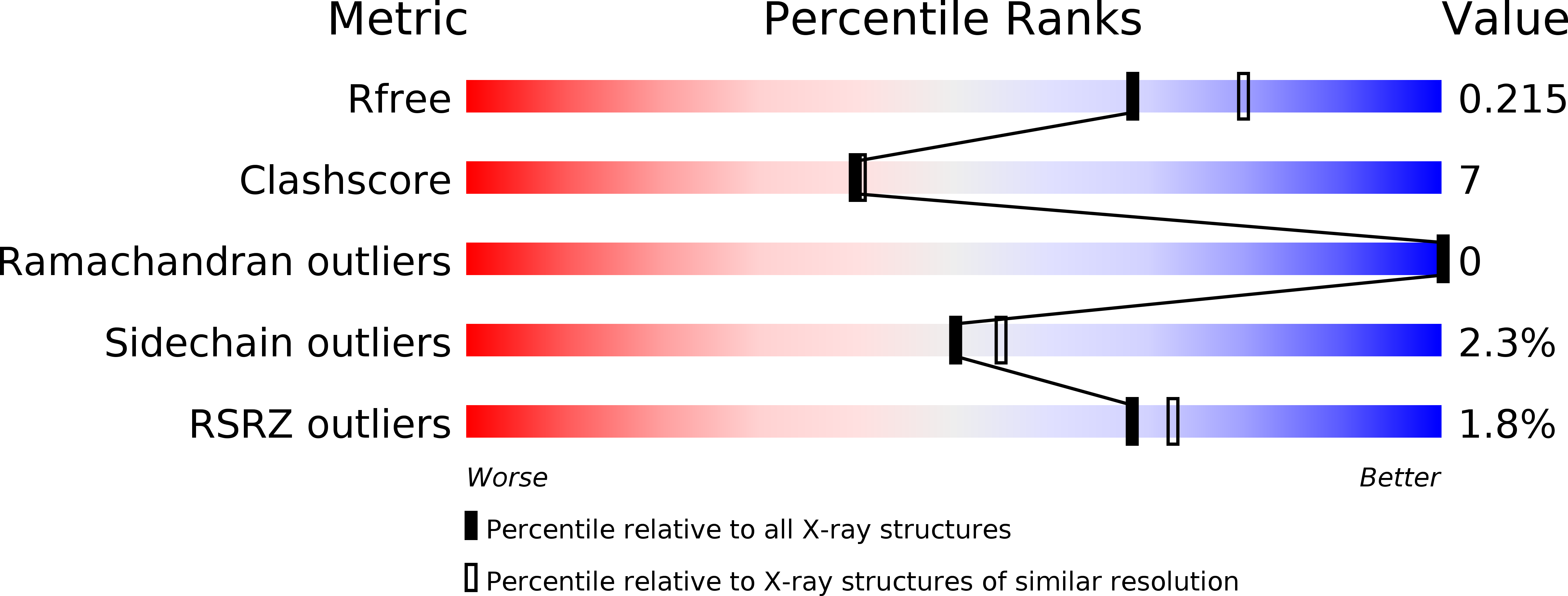
Macromolecular Entities
Structures with similar UniProt ID
Protein Blast
Polymer Type:polypeptide(L)
Molecule:CELLOBIOHYDROLASE CEL6A (FORMERLY CALLED CBH II)
Gene (Uniprot):cbh2
Chain IDs:A, B
Chain Length:363
Number of Molecules:2
Biological Source:TRICHODERMA REESEI
Modified Residue
Compound ID Chain ID Parent Comp ID Details 2D Image
ASN A ASN GLYCOSYLATION SITE
SER A SER GLYCOSYLATION SITE
THR A THR GLYCOSYLATION SITE
Primary Citation
Crystallographic Evidence for Substrate Ring Distortion and Protein Conformational Changes During Catalysis in Cellobiohydrolase Cel6A from Trichoderma Reesei
Structure 7 1035 ? (1999)
PMID: 10508787 DOI: 10.1016/S0969-2126(99)80171-3

Abstact

BACKGROUND: Cel6A is one of the two cellobiohydrolases produced by Trichoderma reesei. The catalytic core has a structure that is a variation of the classic TIM barrel. The active site is located inside a tunnel, the roof of which is formed mainly by a pair of loops. RESULTS: We describe three new ligand complexes. One is the structure of the wild-type enzyme in complex with a nonhydrolysable cello-oligosaccharide, methyl 4-S-beta-cellobiosyl-4-thio-beta-cellobioside (Glc)(2)-S-(Glc)(2), which differs from a cellotetraose in the nature of the central glycosidic linkage where a sulphur atom replaces an oxygen atom. The second structure is a mutant, Y169F, in complex with the same ligand, and the third is the wild-type enzyme in complex with m-iodobenzyl beta-D-glucopyranosyl-beta(1,4)-D-xylopyranoside (IBXG). CONCLUSIONS: The (Glc)(2)-S-(Glc)(2) ligand binds in the -2 to +2 sites in both the wild-type and mutant enzymes. The glucosyl unit in the -1 site is distorted from the usual chair conformation in both structures. The IBXG ligand binds in the -2 to +1 sites, with the xylosyl unit in the -1 site where it adopts the energetically favourable chair conformation. The -1 site glucosyl of the (Glc)(2)-S-(Glc)(2) ligand is unable to take on this conformation because of steric clashes with the protein. The crystallographic results show that one of the tunnel-forming loops in Cel6A is sensitive to modifications at the active site, and is able to take on a number of different conformations. One of the conformational changes disrupts a set of interactions at the active site that we propose is an integral part of the reaction mechanism.

Legend

Protein

Chemical

Disease

Primary Citation of related structures
Feedback Form
Name
Email
Institute
Feedback