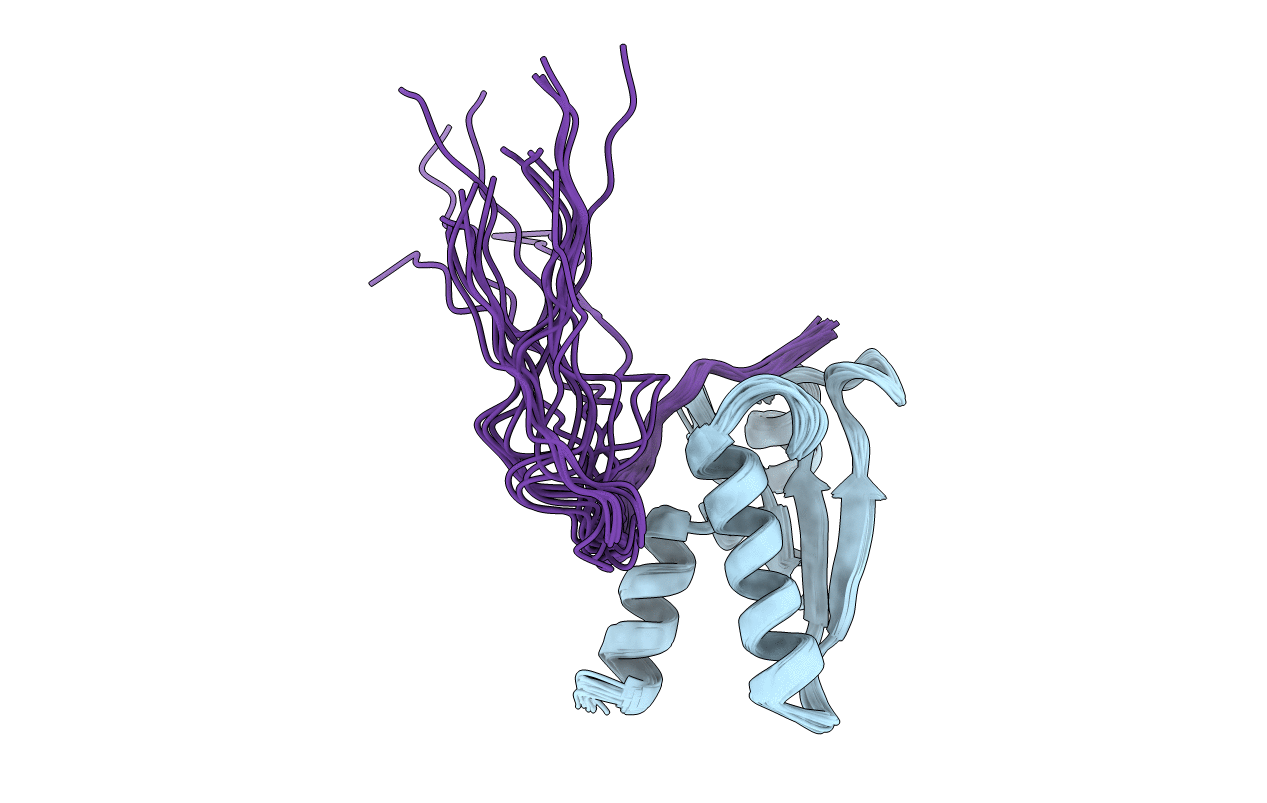
1QFN image
Deposition Date 1999-04-12
Release Date 2000-01-01
Last Version Date 2024-11-13
Entry Detail
PDB ID:
1QFN
Title:
GLUTAREDOXIN-1-RIBONUCLEOTIDE REDUCTASE B1 MIXED DISULFIDE BOND
Biological Source:
Source Organism:
Escherichia coli (Taxon ID: 562)
Host Organism:
Method Details:
Experimental Method:
Conformers Calculated:
50
Conformers Submitted:
20
Selection Criteria:
LEAST TARGET FUNCTION
Macromolecular Entities
Structures with similar UniProt ID
Protein Blast
Polymer Type:polypeptide(L)
Molecule:PROTEIN (GLUTAREDOXIN 1)
Gene (Uniprot):grxA
Mutagens:C14S
Chain IDs:A
Chain Length:85
Number of Molecules:1
Biological Source:Escherichia coli
Structures with similar UniProt ID
Protein Blast
Polymer Type:polypeptide(L)
Molecule:PROTEIN (RIBONUCLEOSIDE-DIPHOSPHATE REDUCTASE 1)
Gene (Uniprot):nrdA
Mutagens:C754S
Chain IDs:B
Chain Length:25
Number of Molecules:1
Biological Source:Escherichia coli
Ligand Molecules
Primary Citation
Binding specificity and mechanistic insight into glutaredoxin-catalyzed protein disulfide reduction.
J.Mol.Biol. 292 151 161 (1999)
PMID: 10493864 DOI: 10.1006/jmbi.1999.3067

Abstact

The reduction equivalents necessary for the ribonucleotide reductase (RNR)-catalyzed production of deoxyribonucleotides are provided by glutaredoxin (Grx) or thioredoxin (Trx). The initial location for transfer of reducing equivalents to RNR is located at the C terminus of the B1 subunit and involves the reduction of a disulfide between Cys754 and Cys759. We have used a 25-mer peptide corresponding to residues 737-761 of RNR B1 (C754-->S) to synthesize a stable mixed disulfide with Escherichia coli Grx-1 (C14-->S) resembling the structure of an intermediate in the reaction. The high-resolution solution structure of the mixed disulfide has been obtained by NMR with an RMSD of 0.56 A for all the backbone atoms of the protein and the well-defined portion of the peptide. The binding interactions responsible for specificity have been identified demonstrating the importance of electrostatic interactions in this system and providing a rationale for the specificity of the Grx-RNR interaction. The disulfide is buried in this complex, implying a solely intra-molecular mechanism of reduction in contrast to the previously determined structure of the glutathione complex where the disulfide was exposed; mutagenesis studies have shown the relevance of intermolecular reduction processes. Substantial conformational changes in the helices of the protein are associated with peptide binding which have significant mechanistic implications for protein disulfide reduction by glutaredoxins.

Legend

Protein

Chemical

Disease

Primary Citation of related structures
Feedback Form
Name
Email
Institute
Feedback