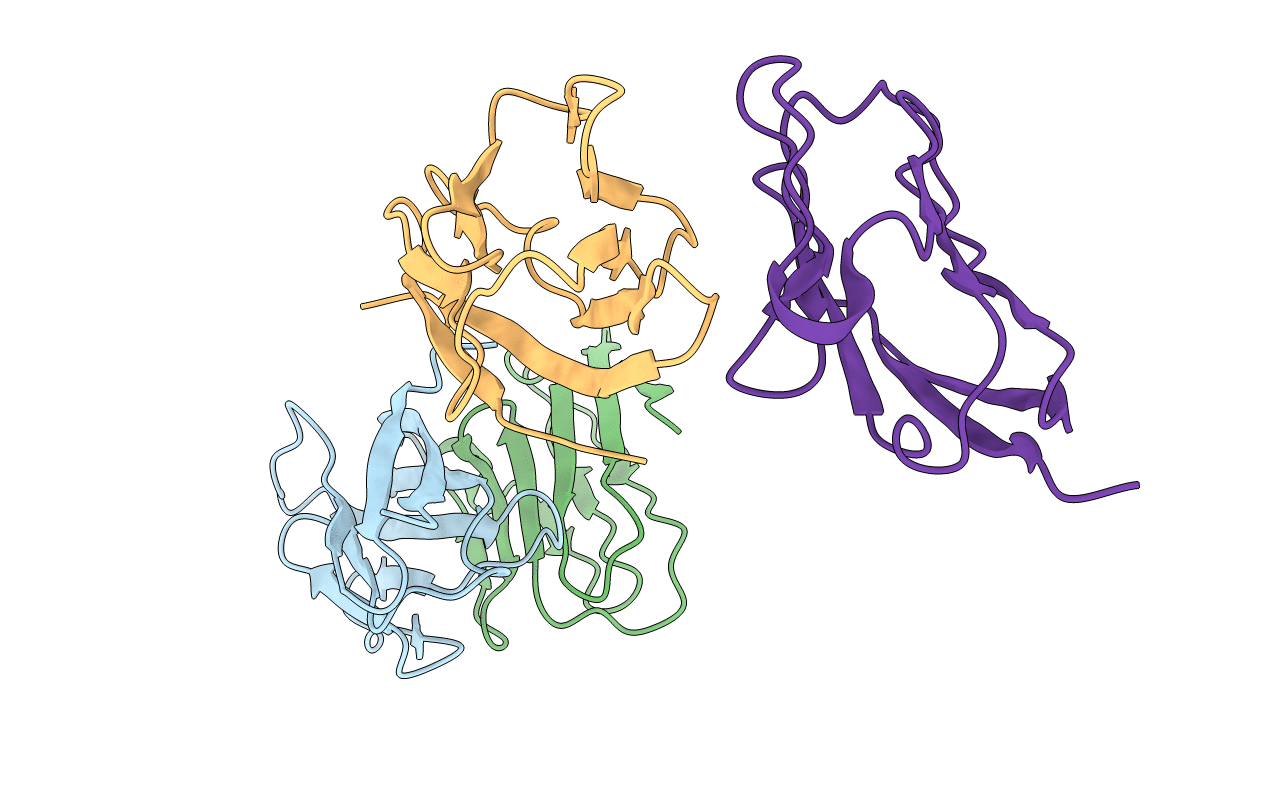
1QA9 image
Deposition Date 1999-04-13
Release Date 1999-04-29
Last Version Date 2024-02-14
Entry Detail
PDB ID:
1QA9
Keywords:
Title:
Structure of a Heterophilic Adhesion Complex Between the Human CD2 and CD58(LFA-3) Counter-Receptors
Biological Source:
Source Organism:
Homo sapiens (Taxon ID: 9606)
Host Organism:
Method Details:
Experimental Method:
Resolution:
3.20 Å
R-Value Free:
0.28
R-Value Work:
0.22
Space Group:
C 1 2 1

Macromolecular Entities
Structures with similar UniProt ID
Protein Blast
Polymer Type:polypeptide(L)
Molecule:HUMAN CD2 PROTEIN
Mutagens:K61E, F63L, T67A
Chain IDs:A, C
Chain Length:102
Number of Molecules:2
Biological Source:Homo sapiens
Structures with similar UniProt ID
Protein Blast
Polymer Type:polypeptide(L)
Molecule:HUMAN CD58 PROTEIN
Mutagens:F1S, V9K, V21Q, V58K, T85S, L93G
Chain IDs:B, D
Chain Length:95
Number of Molecules:2
Biological Source:Homo sapiens
Ligand Molecules
Primary Citation
Structure of a heterophilic adhesion complex between the human CD2 and CD58 (LFA-3) counterreceptors.
Cell(Cambridge,Mass.) 97 791 803 (1999)
PMID: 10380930 DOI: 10.1016/S0092-8674(00)80790-4

Abstact

Interaction between CD2 and its counterreceptor, CD58 (LFA-3), on opposing cells optimizes immune recognition, facilitating contacts between helper T lymphocytes and antigen-presenting cells as well as between cytolytic effectors and target cells. Here, we report the crystal structure of the heterophilic adhesion complex between the amino-terminal domains of human CD2 and CD58. A strikingly asymmetric, orthogonal, face-to-face interaction involving the major beta sheets of the respective immunoglobulin-like domains with poor shape complementarity is revealed. In the virtual absence of hydrophobic forces, interdigitating charged amino acid side chains form hydrogen bonds and salt links at the interface (approximately 1200 A2), imparting a high degree of specificity albeit with low affinity (K(D) of approximately microM). These features explain CD2-CD58 dynamic binding, offering insights into interactions of related immunoglobulin superfamily receptors.

Legend

Protein

Chemical

Disease

Primary Citation of related structures
Feedback Form
Name
Email
Institute
Feedback