1Q7S image
Deposition Date 2003-08-19
Release Date 2003-12-16
Last Version Date 2024-02-14
Entry Detail
PDB ID:
1Q7S
Keywords:
Title:
Crystal structure of bit1
Biological Source:
Source Organism:
Homo sapiens (Taxon ID: 9606)
Host Organism:
Method Details:
Experimental Method:
Resolution:
2.00 Å
R-Value Free:
0.23
R-Value Work:
0.21
R-Value Observed:
0.21
Space Group:
P 43 21 2
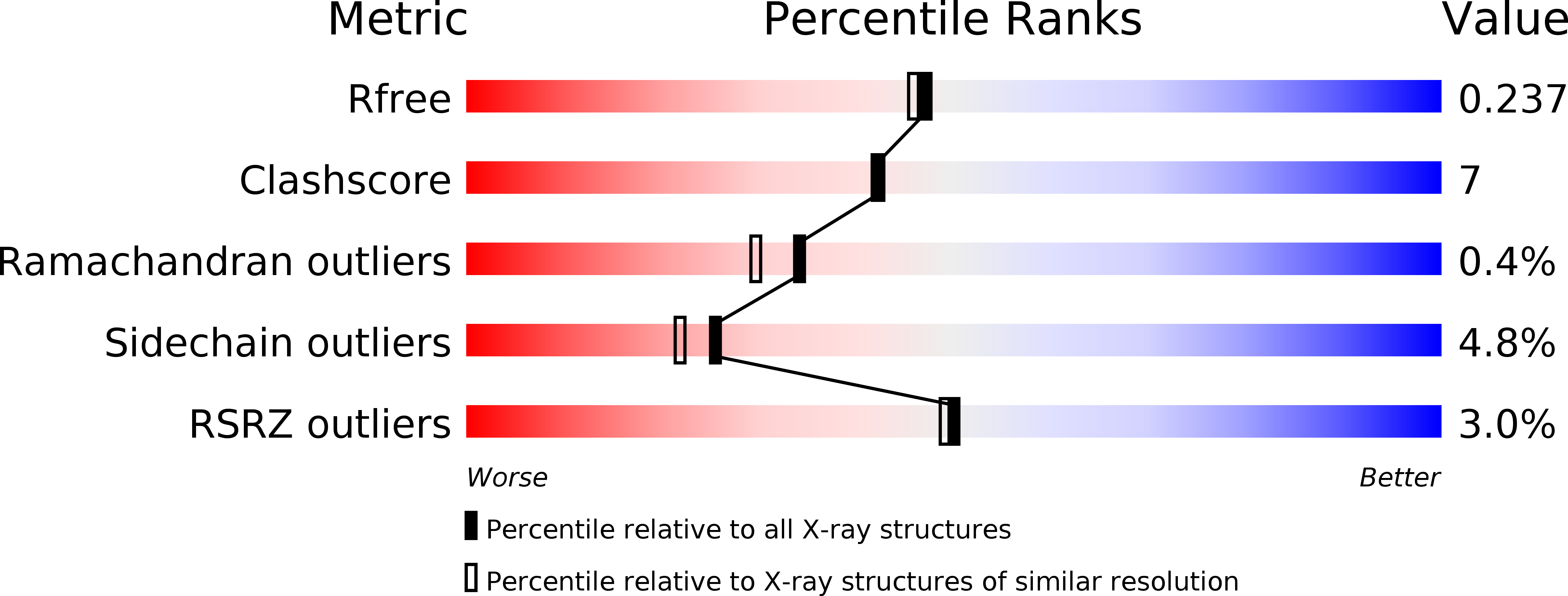
Macromolecular Entities
Structures with similar UniProt ID
Protein Blast
Polymer Type:polypeptide(L)
Molecule:bit1
Gene (Uniprot):PTRH2
Chain IDs:A, B
Chain Length:117
Number of Molecules:2
Biological Source:Homo sapiens
Primary Citation
Crystal structure of a human peptidyl-tRNA hydrolase reveals a new fold and suggests basis for a bifunctional activity.
J.Biol.Chem. 279 8111 8115 (2004)
PMID: 14660562 DOI: 10.1074/jbc.M311449200

Abstact

Peptidyl-tRNA hydrolase (Pth) activity releases tRNA from the premature translation termination product peptidyl-tRNA. Two different enzymes have been reported to encode such activity, Pth present in bacteria and eukaryotes and Pth2 present in archaea and eukaryotes. Here we report the crystallographic structure of the Homo sapiens Pth2 at a 2.0-A resolution as well as its catalytic properties. In contrast to the structure of Escherichia coli Pth, H. sapiens Pth2 has an alpha/beta fold with a four-stranded antiparallel beta-sheet in its core surrounded by two alpha-helices on each side. This arrangement of secondary structure elements generates a fold not previously reported. Its catalytic efficiency is comparable with that reported for the archaeal Sulfolobus solfataricus Pth2 and higher than that of the bacterial E. coli Pth. Several lines of evidence target the active site to two close loops with highly conserved residues. This active site architecture is unrelated to that of E. coli Pth. In addition, intermolecular contacts in the crystal asymmetric unit cell suggest a likely surface for protein-protein interactions related to the Pth2-mediated apoptosis.

Legend

Protein

Chemical

Disease

Primary Citation of related structures
Feedback Form
Name
Email
Institute
Feedback