1Q5J image
Deposition Date 2003-08-07
Release Date 2004-01-06
Last Version Date 2024-10-30
Entry Detail
PDB ID:
1Q5J
Title:
Crystal structure of bacteriorhodopsin mutant P91A crystallized from bicelles
Biological Source:
Source Organism(s):
Expression System(s):
Method Details:
Experimental Method:
Resolution:
2.10 Å
R-Value Free:
0.26
R-Value Work:
0.21
R-Value Observed:
0.21
Space Group:
P 1 21 1
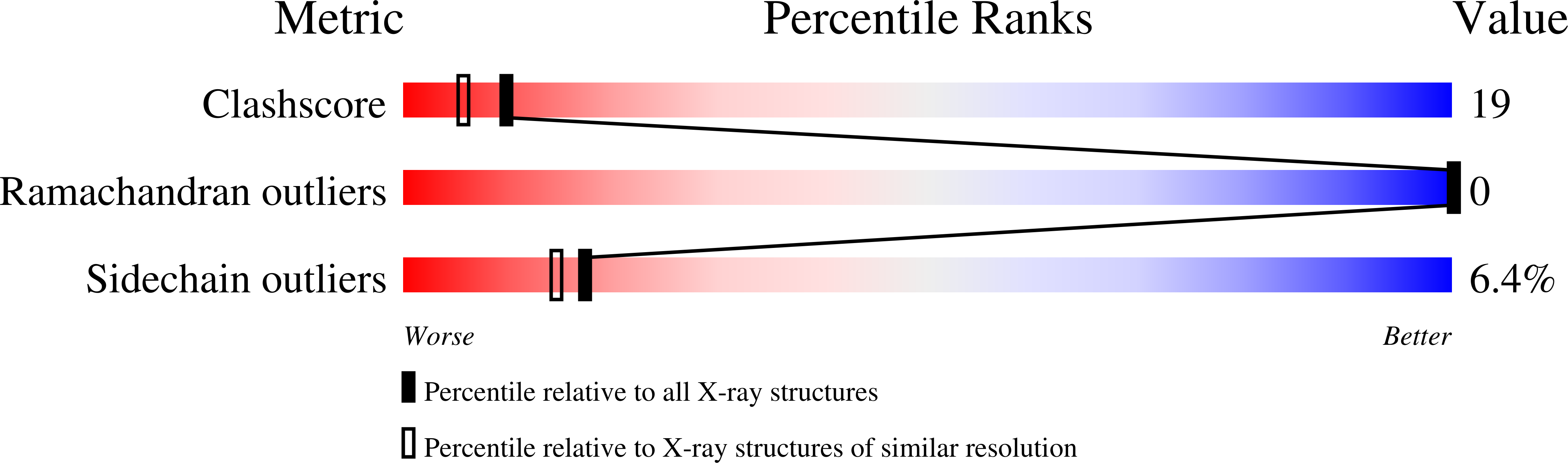
Macromolecular Entities
Structures with similar UniProt ID
Protein Blast
Polymer Type:polypeptide(L)
Molecule:Bacteriorhodopsin
Gene (Uniprot):bop
Mutagens:P91A
Chain IDs:A, B
Chain Length:249
Number of Molecules:2
Biological Source:Halobacterium salinarum
Ligand Molecules
Primary Citation
The evolution of transmembrane helix kinks and the structural diversity of G protein-coupled receptors.
Proc.Natl.Acad.Sci.USA 101 959 963 (2004)
PMID: 14732697 DOI: 10.1073/pnas.0306077101

Abstact

One of the hallmarks of membrane protein structure is the high frequency of transmembrane helix kinks, which commonly occur at proline residues. Because the proline side chain usually precludes normal helix geometry, it is reasonable to expect that proline residues generate these kinks. We observe, however, that the three prolines in bacteriorhodopsin transmembrane helices can be changed to alanine with little structural consequences. This finding leads to a conundrum: if proline is not required for helix bending, why are prolines commonly present at bends in transmembrane helices? We propose an evolutionary hypothesis in which a mutation to proline initially induces the kink. The resulting packing defects are later repaired by further mutation, thereby locking the kink in the structure. Thus, most prolines in extant proteins can be removed without major structural consequences. We further propose that nonproline kinks are places where vestigial prolines were later removed during evolution. Consistent with this hypothesis, at 14 of 17 nonproline kinks in membrane proteins of known structure, we find prolines in homologous sequences. Our analysis allows us to predict kink positions with >90% reliability. Kink prediction indicates that different G protein-coupled receptor proteins have different kink patterns and therefore different structures.

Legend

Protein

Chemical

Disease

Primary Citation of related structures
Feedback Form
Name
Email
Institute
Feedback