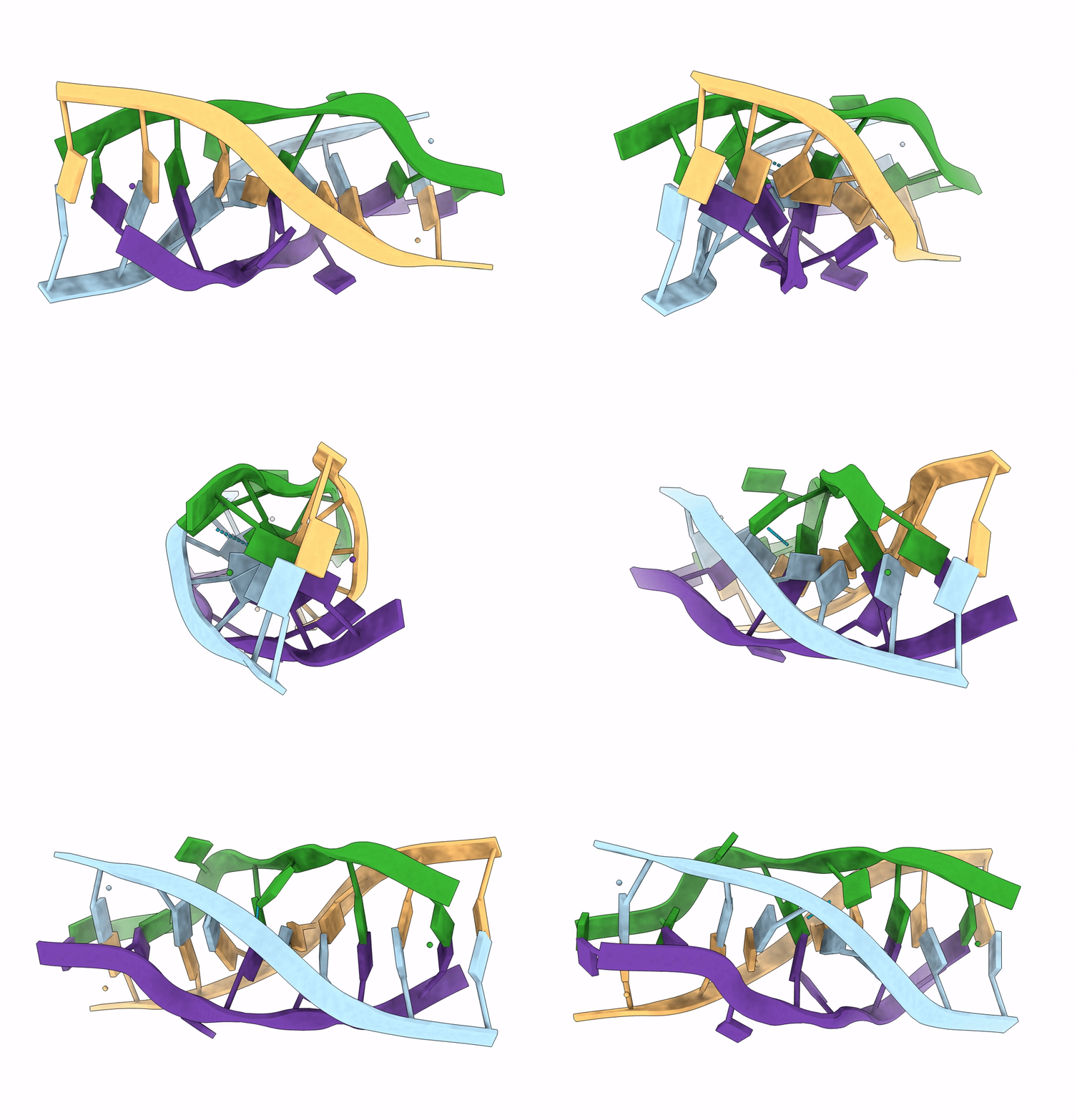
1Q2T image
Deposition Date 2003-07-26
Release Date 2003-09-23
Last Version Date 2024-05-22
Entry Detail
PDB ID:
1Q2T
Keywords:
Title:
Solution structure of d(5mCCTCTCC)4
Biological Source:
Source Organism:
Method Details:
Experimental Method:
Conformers Calculated:
10
Conformers Submitted:
1
Selection Criteria:
back calculated data agree with experimental NOESY spectrum
Macromolecular Entities
Polymer Type:polydeoxyribonucleotide
Molecule:5'-D(*(MCY)P*CP*TP*CP*TP*CP*C)-3'
Chain IDs:A, B, C, D
Chain Length:7
Number of Molecules:4
Biological Source:
Modified Residue
Compound ID Chain ID Parent Comp ID Details 2D Image
MCY A DC 5-METHYL-2'-DEOXYCYTIDINE
Ligand Molecules
Primary Citation
T.T pair intercalation and duplex inter-conversion within i-motif tetramers
J.Mol.Biol. 333 125 139 (2003)
PMID: 14516748 DOI: 10.1016/S0022-2836(03)00945-8

Abstact

The i-motif is a four-stranded structure built by intercalation in head-to-tail orientation of two parallel duplexes associated by hemi-protonated C.C(+) pairs. Using NMR methods, we investigated the structure, the base-pair opening kinetics and the internal motions of three i-motif tetramers: [d(5mCCTCnTCC)](4) (n=1, 2, 3). These tetramers cannot accommodate the intercalation of two T.T pairs in face-to-face orientation. They are built by intercalation of two symmetrical duplexes whose contacting T3/TM thymidine bases (M=5, 6, 7) are either base-paired or unstacked. The arrangement of the unstacked/paired thymidine bases of the two T/T groups results in the formation of two different conformations. One, fully symmetric, whose thymidine bases T3 and TM are unstacked and base-paired respectively. The other is the asymmetric assembly of two duplexes: one where both thymidine bases are unstacked and the other with two T.T pairs. The proportion of the symmetric conformer increases from a value beyond the detection threshold for n=1, to 19% for n=2 and up to more than 95% for n=3. The exchange cross-peaks connecting together the intercalated duplexes of [d(5mCCTCTCC)](4) and [d(5mCCTCCTCC)](4) reveal a structural interconversion induced by the simultaneous opening/closing of the contacting T3/TM thymidine bases. In [d(5mCCTCCTCC)](4) the motion of the T3/T6 groups triggers the interconversion of the symmetric and asymmetric conformations. In [d(5mCCTCTCC)](4) the intercalated duplexes exchange their structures in an apparently concerted motion, suggesting the simultaneous opening/closing of two distant T3/T5* and T5/T3* switching groups. The spectrum of [d(5mCCTCCCTCC)](4) is fully symmetric and, for this reason, its spectrum gives no indication for duplex interconversion. Nevertheless, the imino proton exchange kinetics argues for a switching motion of the T3/T7 group. Duplex interconversion is not detectable in that case, due to the tetramer symmetry. The origin of the structural conflict hindering the intercalation of two T.T pairs into the i-motif is discussed.

Legend

Protein

Chemical

Disease

Primary Citation of related structures
Feedback Form
Name
Email
Institute
Feedback