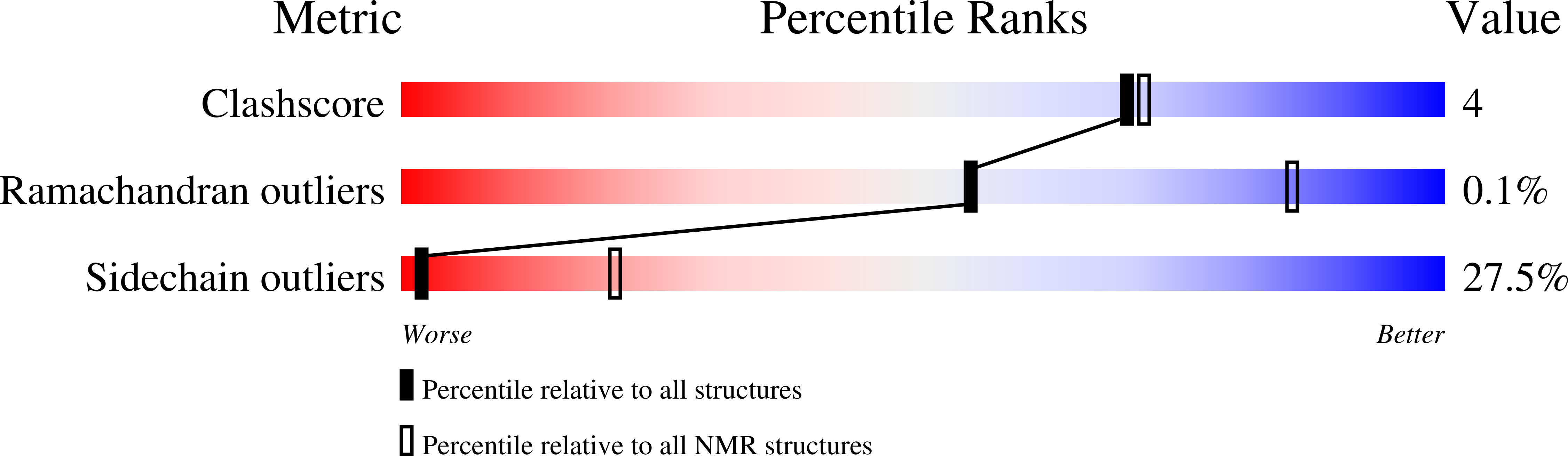
1Q1O image
Deposition Date 2003-07-22
Release Date 2003-10-14
Last Version Date 2024-05-29
Entry Detail
PDB ID:
1Q1O
Title:
Solution Structure of the PB1 Domain of Cdc24p (Long Form)
Biological Source:
Source Organism:
Method Details:
Experimental Method:
Conformers Calculated:
100
Conformers Submitted:
20
Selection Criteria:
structures with the lowest energy
Macromolecular Entities
Structures with similar UniProt ID
Protein Blast
Polymer Type:polypeptide(L)
Molecule:Cell division control protein 24
Gene (Uniprot):CDC24
Chain IDs:A
Chain Length:98
Number of Molecules:1
Biological Source:Saccharomyces cerevisiae
Ligand Molecules
Primary Citation
The PB1 domain and the PC motif-containing region are structurally similar protein binding modules
EMBO J. 22 4888 4897 (2003)
PMID: 14517229 DOI: 10.1093/emboj/cdg475

Abstact

The PC motif is evolutionarily conserved together with the PB1 domain, a binding partner of the PC motif-containing protein. For interaction with the PB1 domain, the PC motif-containing region (PCCR) comprising the PC motif and its flanking regions is required. Because the PB1 domain and the PCCR are novel binding modules found in a variety of signaling proteins, their structural and functional characterization is crucial. Bem1p and Cdc24p interact through the PB1-PCCR interaction and regulate cell polarization in budding yeast. Here, we determined a tertiary structure of the PCCR of Cdc24p by NMR. The tertiary structure of the PCCR is similar to that of the PB1 domain of Bem1p, which is classified into a ubiquitin fold. The PC motif portion takes a compact betabetaalpha-fold, presented on the ubiquitin scaffold. Mutational studies indicate that the PB1-PCCR interaction is mainly electrostatic. Based on the structural information, we group the PB1 domains and the PCCRs into a novel family, named the PB1 family. Thus, the PB1 family proteins form a specific dimer with each other.

Legend

Protein

Chemical

Disease

Primary Citation of related structures
Feedback Form
Name
Email
Institute
Feedback