1PZ9 image
Deposition Date 2003-07-10
Release Date 2004-04-13
Last Version Date 2024-11-20
Entry Detail
PDB ID:
1PZ9
Title:
Modulation of agrin function by alternative splicing and Ca2+ binding
Biological Source:
Source Organism:
Gallus gallus (Taxon ID: 9031)
Host Organism:
Method Details:
Experimental Method:
Resolution:
2.80 Å
R-Value Free:
0.27
R-Value Work:
0.23
R-Value Observed:
0.23
Space Group:
C 1 2 1
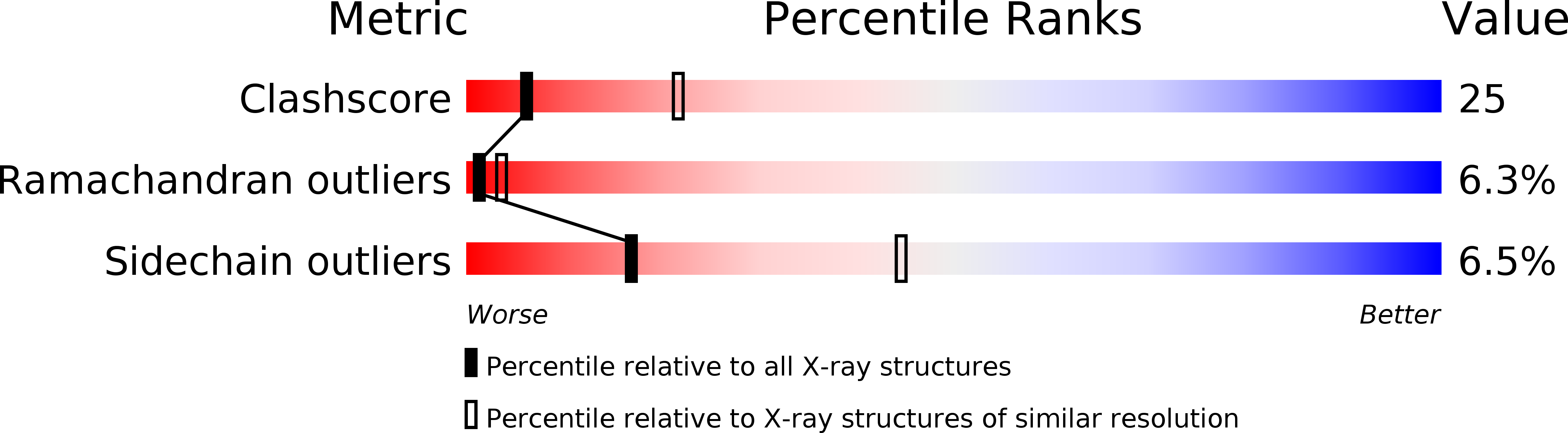
Macromolecular Entities
Structures with similar UniProt ID
Protein Blast
Polymer Type:polypeptide(L)
Molecule:Agrin
Gene (Uniprot):AGRN
Chain IDs:A, B
Chain Length:201
Number of Molecules:2
Biological Source:Gallus gallus
Primary Citation
Modulation of agrin function by alternative splicing and Ca2+ binding.
STRUCTURE 12 503 515 (2004)
PMID: 15016366 DOI: 10.1016/j.str.2004.02.001

Abstact

The aggregation of acetylcholine receptors on postsynaptic membranes is a key step in neuromuscular junction development. This process depends on alternatively spliced forms of the proteoglycan agrin with "B-inserts" of 8, 11, or 19 residues in the protein's globular C-terminal domain, G3. Structures of the neural B8 and B11 forms of agrin-G3 were determined by X-ray crystallography. The structure of G3-B0, which lacks inserts, was determined by NMR. The agrin-G3 domain adopts a beta jellyroll fold. The B insert site is flanked by four loops on one edge of the beta sandwich. The loops form a surface that corresponds to a versatile interaction interface in the family of structurally related LNS proteins. NMR and X-ray data indicate that this interaction interface is flexible in agrin-G3 and that flexibility is reduced by Ca(2+) binding. The plasticity of the interaction interface could enable different splice forms of agrin to select between multiple binding partners.

Legend

Protein

Chemical

Disease

Primary Citation of related structures
Feedback Form
Name
Email
Institute
Feedback