1PVZ image
Deposition Date 2003-06-29
Release Date 2004-05-18
Last Version Date 2024-11-13
Entry Detail
PDB ID:
1PVZ
Keywords:
Title:
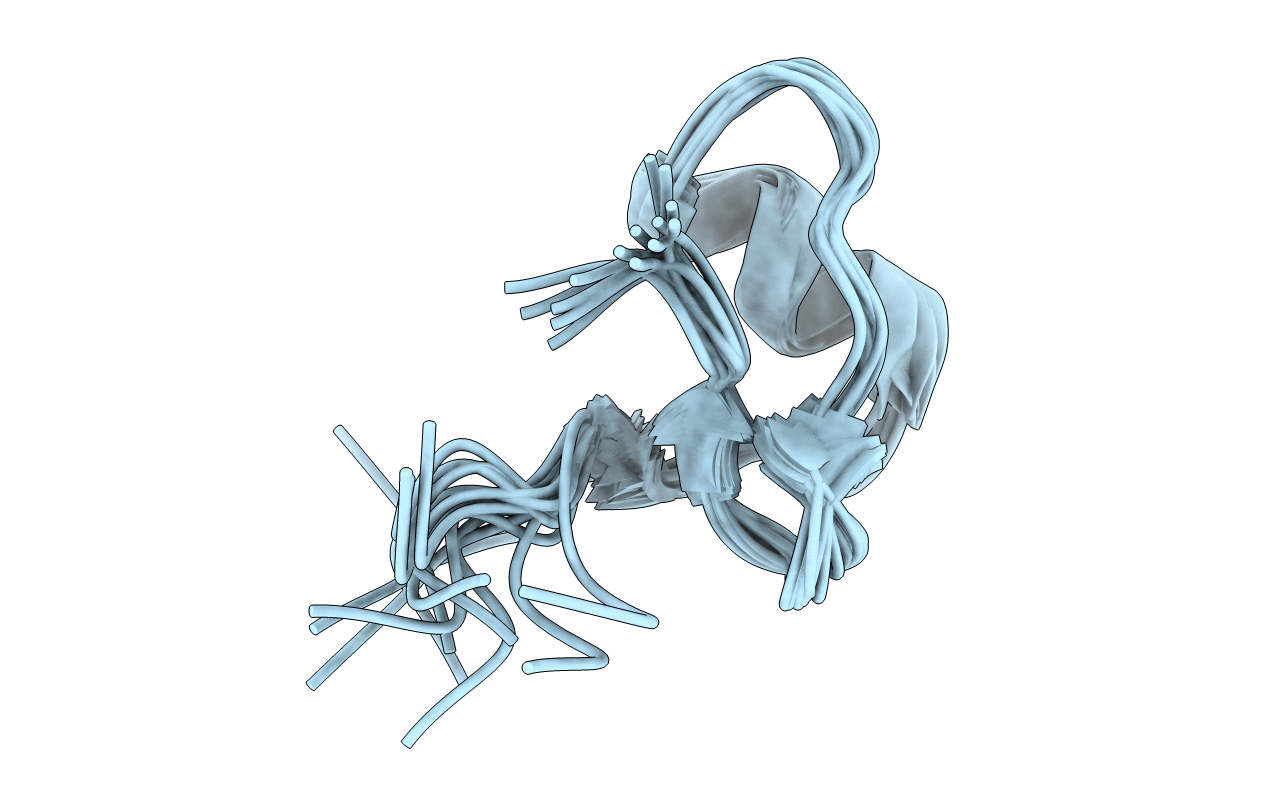
Solution Structure of BmP07, A Novel Potassium Channel Blocker from Scorpion Buthus martensi Karsch, 15 structures
Biological Source:
Source Organism:
Method Details:
Experimental Method:
Conformers Calculated:
200
Conformers Submitted:
15
Selection Criteria:
structures with the lowest energy

Macromolecular Entities
Structures with similar UniProt ID
Protein Blast
Polymer Type:polypeptide(L)
Molecule:K+ toxin-like peptide
Chain IDs:A
Chain Length:31
Number of Molecules:1
Biological Source:Mesobuthus martensii
Ligand Molecules
Primary Citation
Solution structure of BmKK2, a new potassium channel blocker from the venom of chinese scorpion Buthus martensi Karsch
PROTEINS 55 835 845 (2004)
PMID: 15146482 DOI: 10.1002/prot.20117

Abstact

A natural K+ channel blocker, BmKK2 (a member of scorpion toxin subfamily alpha-KTx 14), which is composed of 31 amino acid residues and purified from the venom of the Chinese scorpion Buthus martensi Karsch, was characterized using whole-cell patch-clamp recording in rat hippocampal neurons. The three dimensional structure of BmKK2 was determined with two-dimensional NMR spectroscopy and molecular modelling techniques. In solution this toxin adopted a common alpha/beta-motif, but showed distinct local conformation in the loop between alpha-helix and beta-sheet in comparison with typical short-chain scorpion toxins (e.g., CTX and NTX). Also, the alpha helix is shorter and the beta-sheet element is smaller (each strand consisted only two residues). The unusual structural feature of BmKK2 was attributed to the shorter loop between the alpha-helix and beta-sheet and the presence of two consecutive Pro residues at position 21 and 22 in the loop. Moreover, two models of BmKK2/hKv1.3 channel and BmKK2/rSK2 channel complexes were simulated with docking calculations. The results demonstrated the existence of a alpha-mode binding between the toxin and the channels. The model of BmKK2/rSK2 channel complex exhibited favorable contacts both in electrostatic and hydrophobic, including a network of five hydrogen bonds and bigger interface containing seven pairs of inter-residue interactions. In contrast, the model of BmKK2/hKv1.3 channel complex, containing only three pairs of inter-residue interactions, exhibited poor contacts and smaller interface. The results well explained its lower activity towards Kv channel, and predicted that it may prefer a type of SK channel with a narrower entryway as its specific receptor.

Legend

Protein

Chemical

Disease

Primary Citation of related structures
Feedback Form
Name
Email
Institute
Feedback