1PQP image
Deposition Date 2003-06-18
Release Date 2004-08-10
Last Version Date 2025-11-12
Entry Detail
PDB ID:
1PQP
Keywords:
Title:
Crystal Structure of the C136S Mutant of Aspartate Semialdehyde Dehydrogenase from Haemophilus influenzae Bound with Aspartate Semialdehyde and Phosphate
Biological Source:
Source Organism(s):
Expression System(s):
Method Details:
Experimental Method:
Resolution:
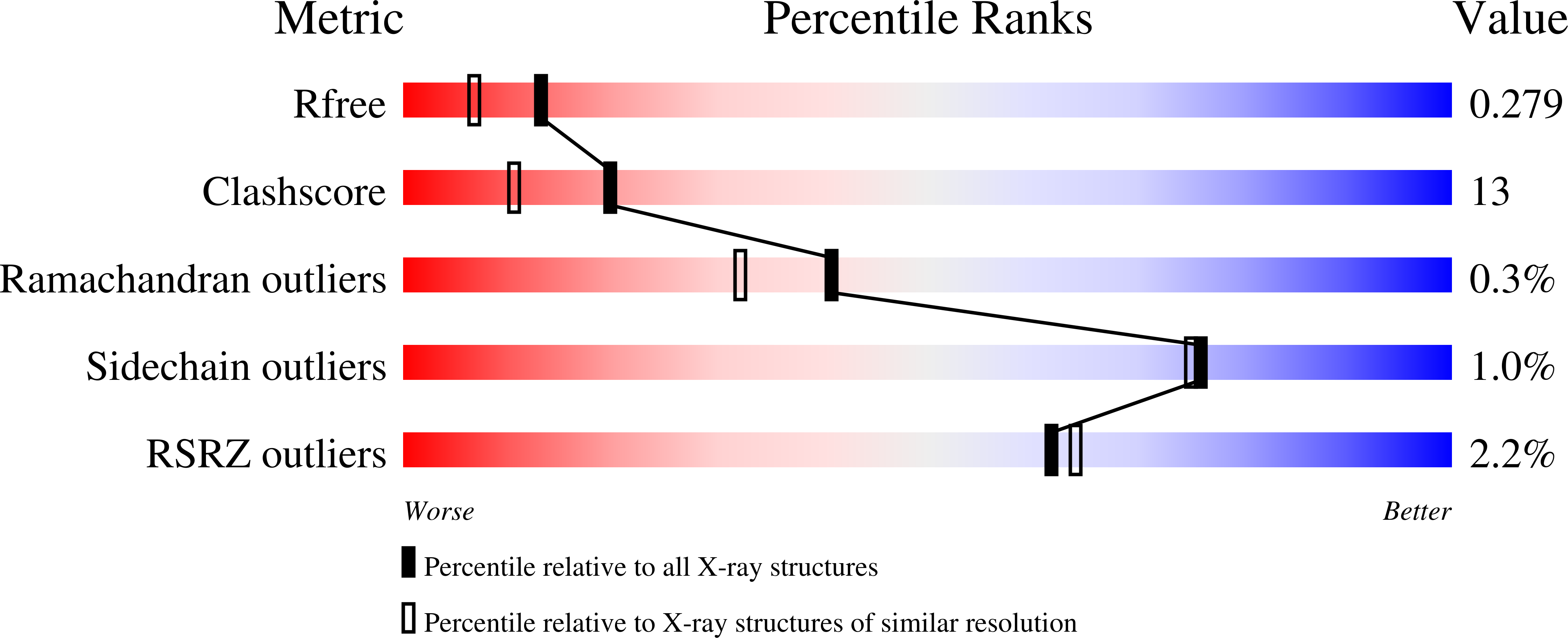
2.06 Å
R-Value Free:
0.28
R-Value Work:
0.22
R-Value Observed:
0.22
Space Group:
P 21 21 2
Macromolecular Entities
Structures with similar UniProt ID
Protein Blast
Polymer Type:polypeptide(L)
Molecule:Aspartate-semialdehyde dehydrogenase
Gene (Uniprot):asd
Mutagens:C136S
Chain IDs:A
Chain Length:371
Number of Molecules:1
Biological Source:Haemophilus influenzae Rd
Primary Citation
Critical catalytic functional groups in the mechanism of aspartate-beta-semialdehyde dehydrogenase.
Acta Crystallogr.,Sect.D 60 1808 1815 (2004)
PMID: 15388927 DOI: 10.1107/S0907444904020104

Abstact

Aspartate-beta-semialdehyde dehydrogenase (ASADH) catalyzes the reductive dephosphorylation of beta-aspartyl phosphate to L-aspartate-beta-semialdehyde in the aspartate biosynthetic pathway. This pathway is not found in humans or other eukaryotic organisms, yet is required for the production of threonine, isoleucine, methionine and lysine in most microorganisms. The mechanism of this enzyme has been examined through the structures of two active-site mutants of ASADH from Haemophilus influenzae. Replacement of the enzyme active-site cysteine with serine (C136S) leads to a dramatic loss of catalytic activity caused by the expected decrease in nucleophilicity, but also by a change in the orientation of the serine hydroxyl group relative to the cysteine thiolate. In contrast, in the H277N active-site mutant the introduced amide is oriented in virtually the same position as that of the histidine imidazole ring. However, a shift in the position of the bound reaction intermediate to accommodate this shorter asparagine side chain, coupled with the inability of this introduced amide to serve as a proton acceptor, results in a 100-fold decrease in the catalytic efficiency of H277N relative to the native enzyme. These mutant enzymes have the same overall fold and high structural identity to native ASADH. However, small perturbations in the positioning of essential catalytic groups or reactive intermediates have dramatic effects on catalytic efficiency.

Legend

Protein

Chemical

Disease

Primary Citation of related structures
Feedback Form
Name
Email
Institute
Feedback