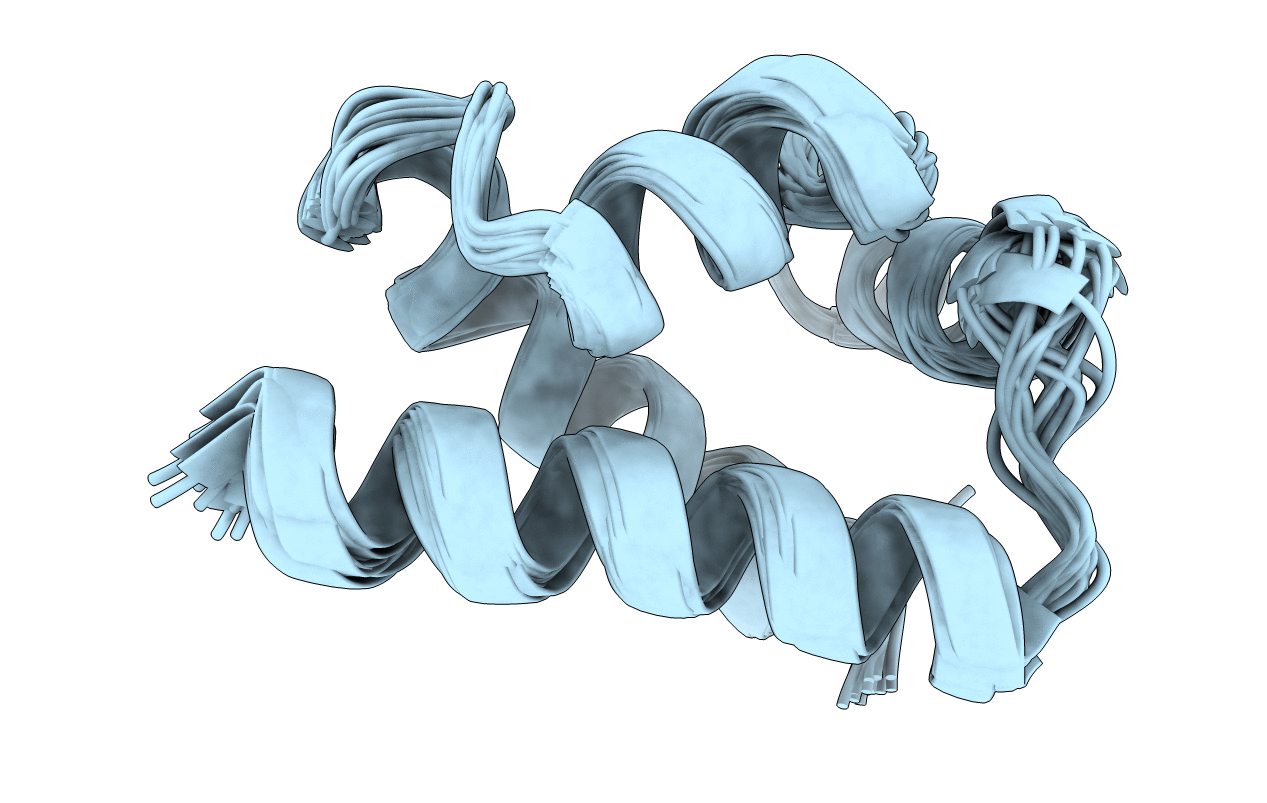
1POU image
Deposition Date 1993-06-14
Release Date 1994-10-15
Last Version Date 2024-05-22
Entry Detail
PDB ID:
1POU
Title:
THE SOLUTION STRUCTURE OF THE OCT-1 POU-SPECIFIC DOMAIN REVEALS A STRIKING SIMILARITY TO THE BACTERIOPHAGE LAMBDA REPRESSOR DNA-BINDING DOMAIN
Biological Source:
Source Organism:
Homo sapiens (Taxon ID: 9606)
Method Details:
Experimental Method:
Conformers Submitted:
20

Macromolecular Entities
Structures with similar UniProt ID
Protein Blast
Polymer Type:polypeptide(L)
Molecule:OCT-1
Gene (Uniprot):POU2F1
Chain IDs:A
Chain Length:71
Number of Molecules:1
Biological Source:Homo sapiens
Ligand Molecules
Primary Citation
The solution structure of the Oct-1 POU-specific domain reveals a striking similarity to the bacteriophage lambda repressor DNA-binding domain.
Cell(Cambridge,Mass.) 73 193 205 (1993)
PMID: 8462099 DOI: 10.1016/0092-8674(93)90171-L

Abstact

The POU-specific (POUs) domain, in association with a POU-type homeodomain, forms the bipartite DNA-binding POU domain. The solution structure of the Oct-1 POUs domain has been determined by multidimensional nuclear magnetic resonance spectroscopy and consists of four alpha helices surrounding a conserved hydrophobic core. The POUs domain is structurally similar to the DNA-binding domains of the bacteriophage lambda and 434 repressors and 434 Cro. These domains exhibit superimposable helix-turn-helix (HTH) motifs, except that in the POUs domain, the first helix and the linker to the second helix of the motif are extended. The conserved structural features have been used to propose a plausible model for DNA binding by the POUs domain. A human dwarfism mutation that affects positive control in the related POU domain protein Pit-1 maps to the same region of the HTH motif as do positive control mutations in lambda repressor.

Legend

Protein

Chemical

Disease

Primary Citation of related structures
Feedback Form
Name
Email
Institute
Feedback