1PGY image
Deposition Date 2003-05-28
Release Date 2004-03-23
Last Version Date 2024-05-22
Entry Detail
PDB ID:
1PGY
Keywords:
Title:
Solution structure of the UBA domain in Saccharomyces cerevisiae protein, Swa2p
Biological Source:
Source Organism:
Method Details:
Experimental Method:
Conformers Calculated:
20
Conformers Submitted:
20
Selection Criteria:
all calculated structures submitted
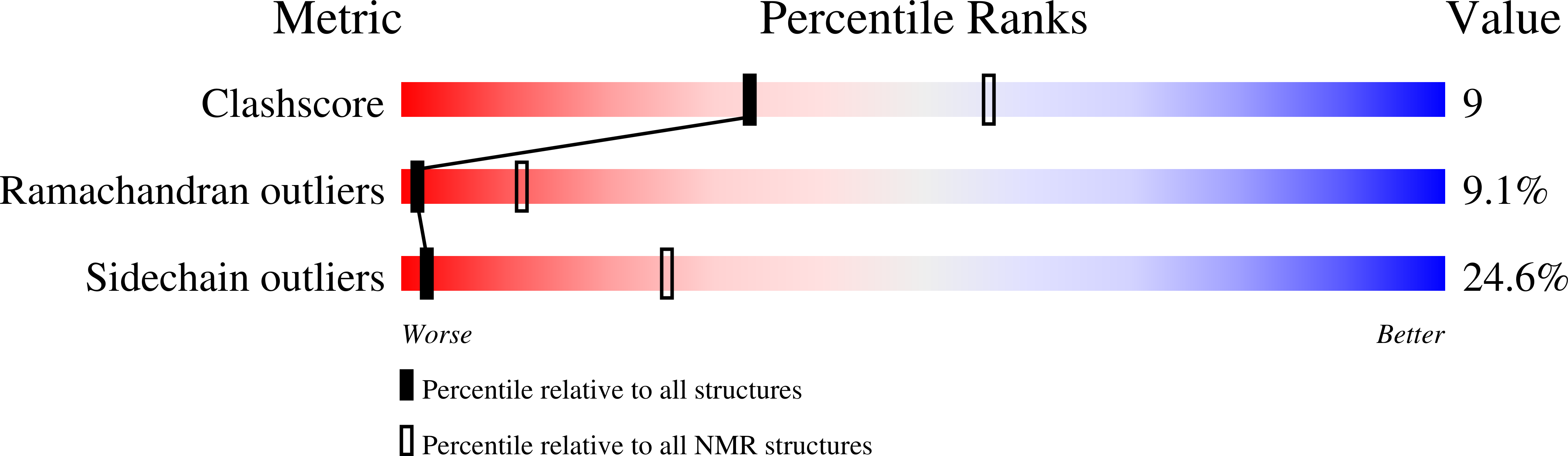
Macromolecular Entities
Structures with similar UniProt ID
Protein Blast
Polymer Type:polypeptide(L)
Molecule:Swa2p
Gene (Uniprot):SWA2
Chain IDs:A
Chain Length:47
Number of Molecules:1
Biological Source:Saccharomyces cerevisiae
Ligand Molecules
Primary Citation
Solution structure of the ubiquitin-binding domain in Swa2p from Saccharomyces cerevisiae.
PROTEINS: STRUCT.,FUNCT.,GENET. 54 784 793 (2004)
PMID: 14997574 DOI: 10.1002/prot.10636

Abstact

The SWA2/AUX1 gene has been proposed to encode the Saccharomyces cerevisiae ortholog of mammalian auxilin. Swa2p is required for clathrin assembly/dissassembly in vivo, thereby implicating it in intracellular protein and lipid trafficking. While investigating the 287-residue N-terminal region of Swa2p, we found a single stably folded domain between residues 140 and 180. Using binding assays and structural analysis, we established this to be a ubiquitin-associated (UBA) domain, unidentified by bioinformatics of the yeast genome. We determined the solution structure of this Swa2p domain and found a characteristic three-helix UBA fold. Comparisons of structures of known UBA folds reveal that the position of the third helix is quite variable. This helix in Swa2p UBA contains a bulkier tyrosine in place of smaller residues found in other UBAs and cannot pack as close to the second helix. The molecular surface of Swa2p UBA has a mostly negative potential, with a single hydrophobic surface patch found also in the UBA domains of human protein, HHR23A. The presence of a UBA domain implicates Swa2p in novel roles involving ubiquitin and ubiquitinated substrates. We propose that Swa2p is a multifunctional protein capable of recognizing several proteins through its protein-protein recognition domains.

Legend

Protein

Chemical

Disease

Primary Citation of related structures
Feedback Form
Name
Email
Institute
Feedback