1P7N image
Deposition Date 2003-05-02
Release Date 2003-12-23
Last Version Date 2023-08-16
Entry Detail
PDB ID:
1P7N
Keywords:
Title:
Dimeric Rous Sarcoma virus Capsid protein structure with an upstream 25-amino acid residue extension of C-terminal of Gag p10 protein
Biological Source:
Source Organism(s):
Expression System(s):
Method Details:
Experimental Method:
Resolution:
2.60 Å
R-Value Free:
0.29
R-Value Work:
0.26
R-Value Observed:
0.26
Space Group:
P 41 21 2
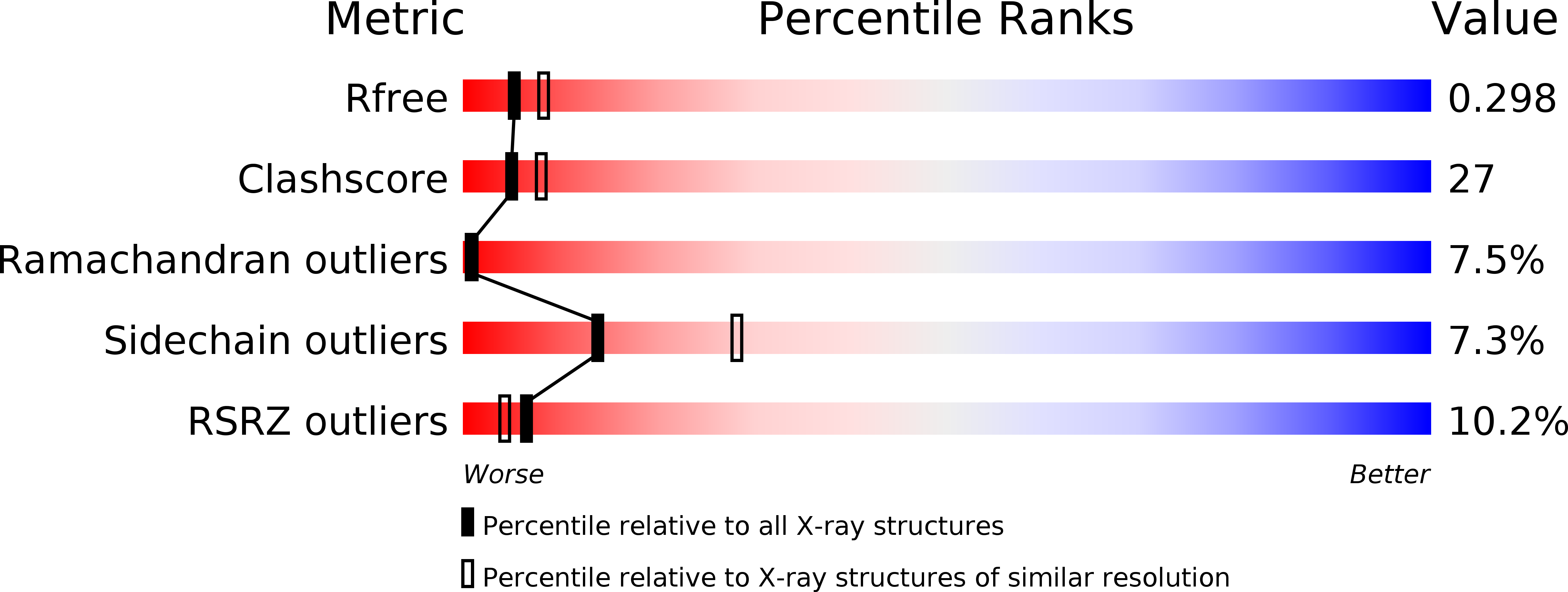
Macromolecular Entities
Structures with similar UniProt ID
Protein Blast
Polymer Type:polypeptide(L)
Molecule:GAG POLYPROTEIN CAPSID PROTEIN P27
Gene (Uniprot):gag
Chain IDs:A
Chain Length:176
Number of Molecules:1
Biological Source:Rous sarcoma virus
Ligand Molecules
Primary Citation
Dimeric rous sarcoma virus capsid protein structure relevant to immature gag assembly
J.Mol.Biol. 335 275 282 (2004)
PMID: 14659756 DOI: 10.1016/j.jmb.2003.10.034

Abstact

The structure of the N-terminal domain (NTD) of Rous sarcoma virus (RSV) capsid protein (CA), with an upstream 25 amino acid residue extension corresponding to the C-terminal portion of the Gag p10 protein, has been determined by X-ray crystallography. Purified Gag proteins of retroviruses can assemble in vitro into virus-like particles closely resembling in vivo-assembled immature virus particles, but without a membrane. When the 25 amino acid residues upstream of CA are deleted, Gag assembles into tubular particles. The same phenotype is observed in vivo. Thus, these residues act as a "shape determinant" promoting spherical assembly, when they are present, or tubular assembly, when they are absent. We show that, unlike the NTD on its own, the extended NTD protein has no beta-hairpin loop at the N terminus of CA and that the molecule forms a dimer in which the amino-terminal extension forms the interface between monomers. Since dimerization of Gag has been inferred to be a critical step in assembly of spherical, immature Gag particles, the dimer interface may represent a structural feature that is essential in retrovirus assembly.

Legend

Protein

Chemical

Disease

Primary Citation of related structures
Feedback Form
Name
Email
Institute
Feedback