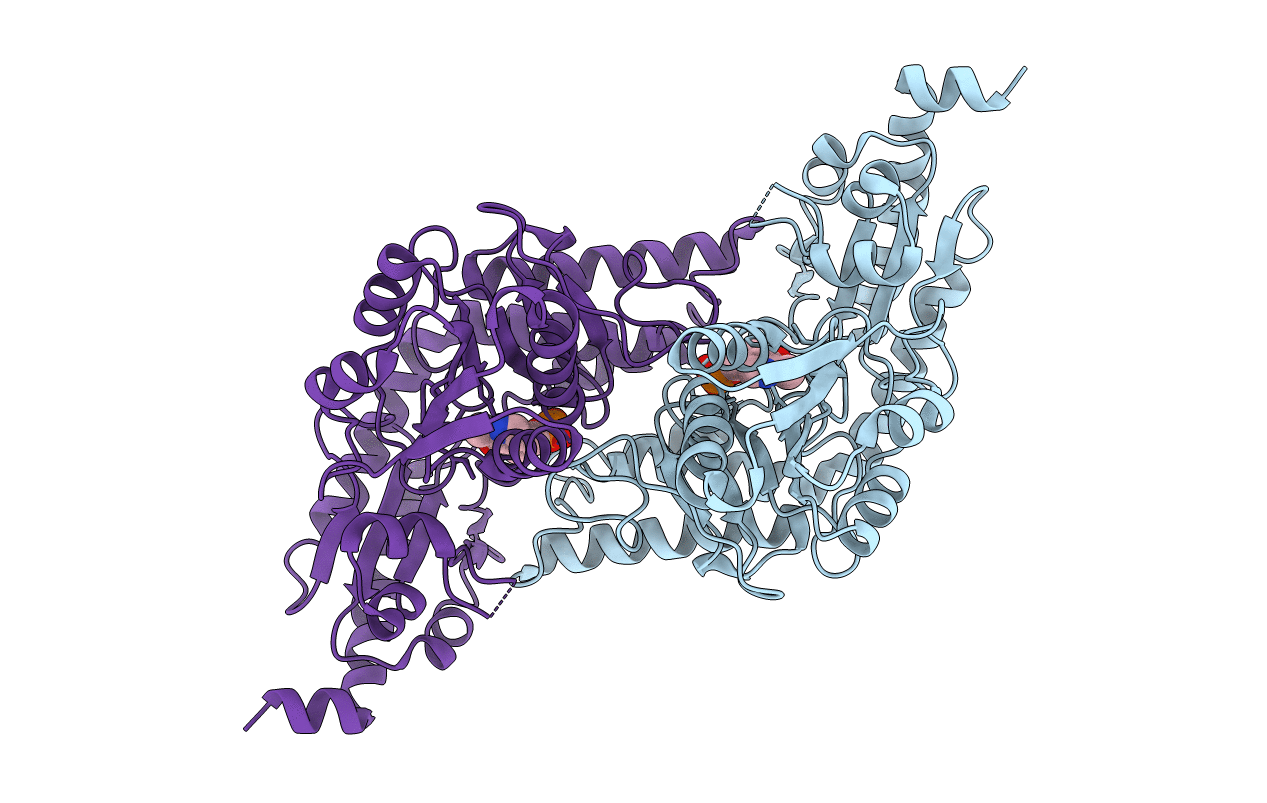
1P3W image
Deposition Date 2003-04-18
Release Date 2003-07-22
Last Version Date 2024-04-03
Entry Detail
PDB ID:
1P3W
Keywords:
Title:
X-ray crystal structure of E. coli IscS
Biological Source:
Source Organism:
Escherichia coli (Taxon ID: 562)
Host Organism:
Method Details:
Experimental Method:
Resolution:
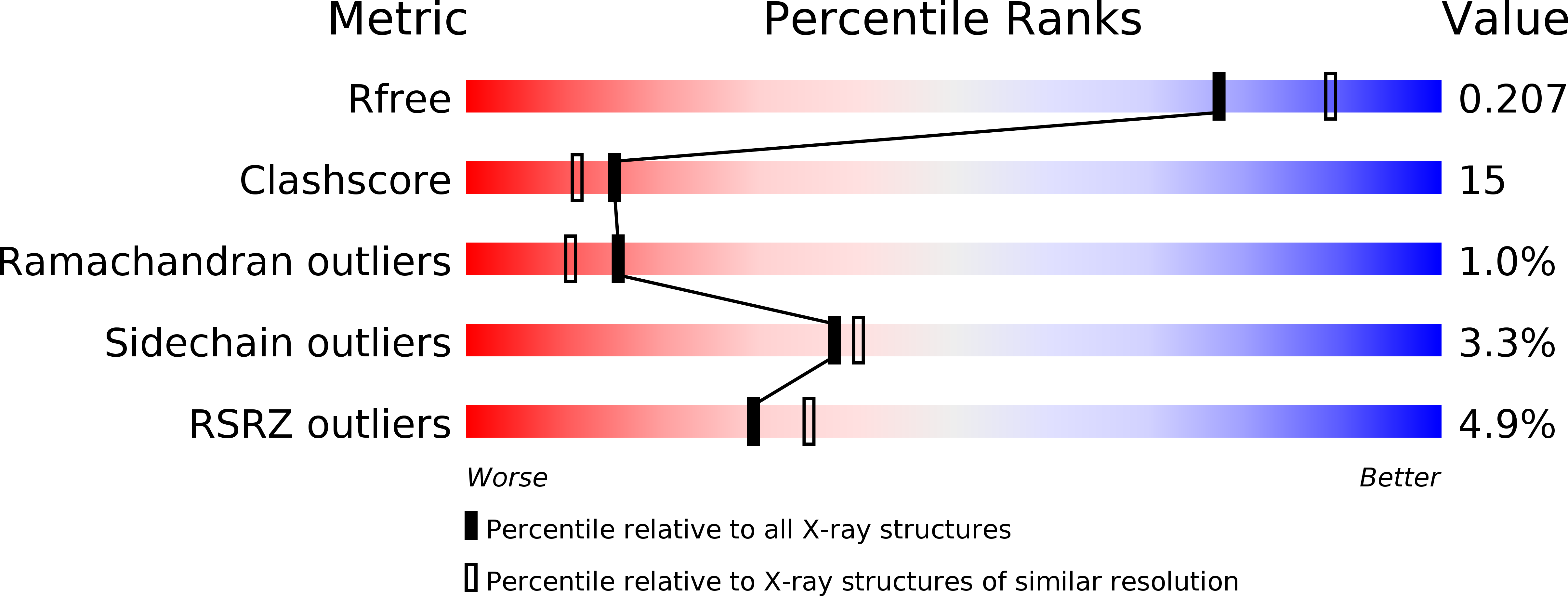
2.10 Å
R-Value Free:
0.23
R-Value Work:
0.20
R-Value Observed:
0.20
Space Group:
P 21 21 21
Macromolecular Entities
Structures with similar UniProt ID
Protein Blast
Polymer Type:polypeptide(L)
Molecule:Cysteine desulfurase
Gene (Uniprot):iscS
Chain IDs:A (auth: B), B (auth: A)
Chain Length:404
Number of Molecules:2
Biological Source:Escherichia coli
Ligand Molecules
Primary Citation
Crystal Structure of IscS, a Cysteine Desulfurase from Escherichia coli
J.Mol.Biol. 330 1049 1059 (2003)
PMID: 12860127 DOI: 10.1016/S0022-2836(03)00690-9

Abstact

IscS is a widely distributed cysteine desulfurase that catalyzes the pyridoxal phosphate-dependent desulfuration of L-cysteine and plays a central role in the delivery of sulfur to a variety of metabolic pathways. We report the crystal structure of Escherichia coli IscS to a resolution of 2.1A. The crystals belong to the space group P2(1)2(1)2(1) and have unit cell dimensions a=73.70A, b=101.97A, c=108.62A (alpha=beta=gamma=90 degrees ). Molecular replacement with the Thermotoga maritima NifS model was used to determine phasing, and the IscS model was refined to an R=20.6% (R(free)=23.6%) with two molecules per asymmetric unit. The structure of E.coli IscS is similar to that of T.maritima NifS with nearly identical secondary structure and an overall backbone r.m.s. difference of 1.4A. However, in contrast to NifS a peptide segment containing the catalytic cysteine residue (Cys328) is partially ordered in the IscS structure. This segment of IscS (residues 323-335) forms a surface loop directed away from the active site pocket. Cys328 is positioned greater than 17A from the pyridoxal phosphate cofactor, suggesting that a large conformational change must occur during catalysis in order for Cys328 to participate in nucleophilic attack of a pyridoxal phosphate-bound cysteine substrate. Modeling suggests that rotation of this loop may allow movement of Cys328 to within approximately 3A of the pyridoxal phosphate cofactor.

Legend

Protein

Chemical

Disease

Primary Citation of related structures
Feedback Form
Name
Email
Institute
Feedback