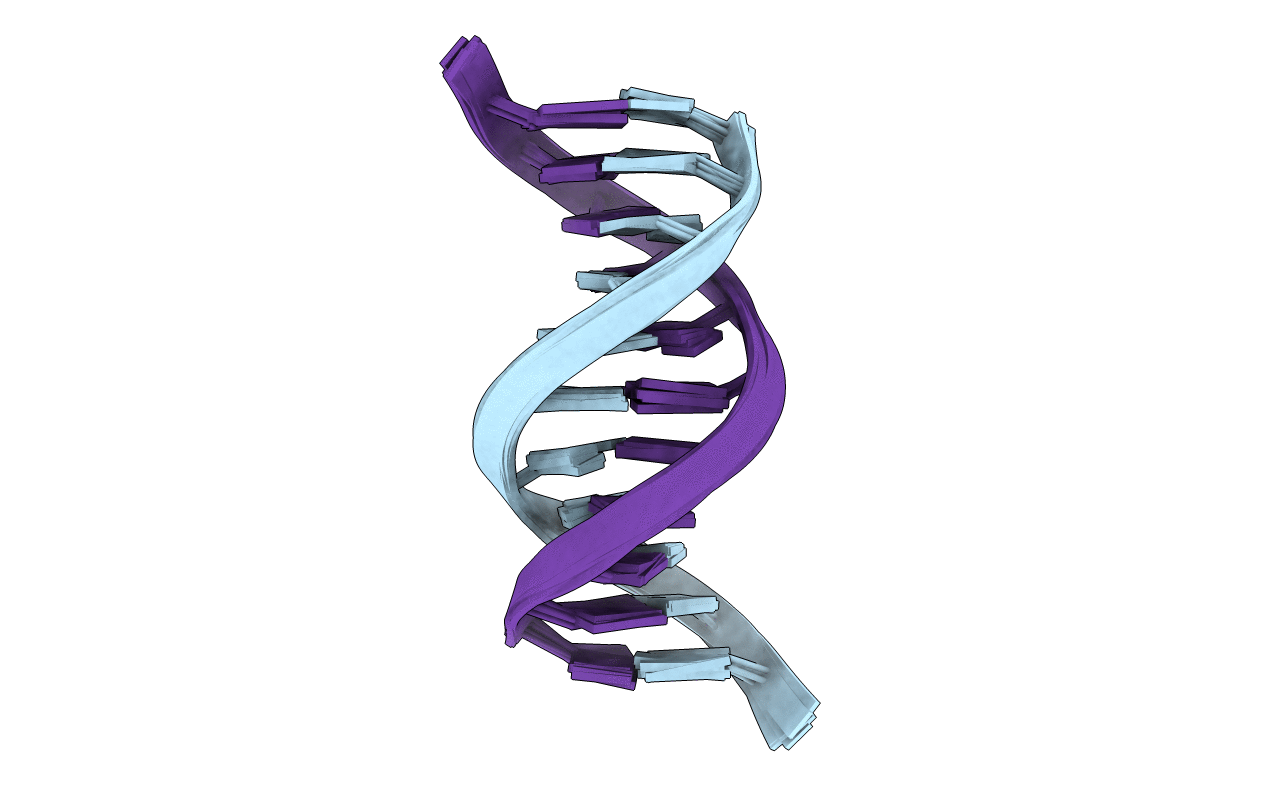
1ONM image
Deposition Date 2003-02-28
Release Date 2003-11-04
Last Version Date 2024-05-22
Entry Detail
PDB ID:
1ONM
Keywords:
Title:
Solution Structure of a DNA duplex containing A:G mismatch. d(GCTTCAGTCGT):d(ACGACGGAAGC)
Biological Source:
Source Organism:
Method Details:
Experimental Method:
Conformers Calculated:
10
Conformers Submitted:
10
Selection Criteria:
all calculated structures submitted

Macromolecular Entities
Polymer Type:polydeoxyribonucleotide
Molecule:5'-D(*GP*CP*TP*TP*CP*AP*GP*TP*CP*GP*T)-3'
Chain IDs:A
Chain Length:11
Number of Molecules:1
Biological Source:
Polymer Type:polydeoxyribonucleotide
Molecule:5'-D(*AP*CP*GP*AP*CP*GP*GP*AP*AP*GP*C)-3'
Chain IDs:B
Chain Length:11
Number of Molecules:1
Biological Source:
Ligand Molecules
Primary Citation
Initiation of repair of A/G mismatches is modulated by sequence context
DNA REPAIR 2 863 878 (2003)
PMID: 12893083 DOI: 10.1016/S1568-7864(03)00067-3

Abstact

The efficiency of DNA glycosylases to initiate base excision repair (BER) has been demonstrated to be modulated by the precise sequence context in which the lesion or mismatch is located. In the case of DNA containing an A/G mismatch, in which the recognition and excision of adenine from the mismatch is mediated by the Escherichia coli MutY enzyme, not only does the local sequence context affect the strength of base stacking interactions, but it also modulates the syn/anti conformation around the glycosyl bond of the bases in the mispair. Utilizing prior NMR data to identify DNA sequence contexts that adopt either an anti/anti or a syn/anti configuration at an A/G mismatch, we tested the hypothesis that the initial equilibrium of the mismatched base orientations would modulate the overall efficiency of glycosyl bond scission. By systematically varying the sequence context around a central A/G mismatch within a 30-mer duplex DNA, significant kinetic differences were observed that were consistent with this hypothesis. Since the relative efficiency of the kinetics fell into only two groupings, a NMR study was conducted on a DNA sequence context of unknown syn/anti conformation. These data established that the relative syn/anti conformation did not correlate with the excision efficiency, as well as there being a lack of correlation between kinetics and thermal stability of these DNAs.

Legend

Protein

Chemical

Disease

Primary Citation of related structures
Feedback Form
Name
Email
Institute
Feedback