1OMR image
Deposition Date 2003-02-26
Release Date 2003-11-25
Last Version Date 2023-10-25
Entry Detail
PDB ID:
1OMR
Title:
non-myristoylated wild-type bovine recoverin with calcium bound to EF-hand 3
Biological Source:
Source Organism:
Bos taurus (Taxon ID: 9913)
Host Organism:
Method Details:
Experimental Method:
Resolution:
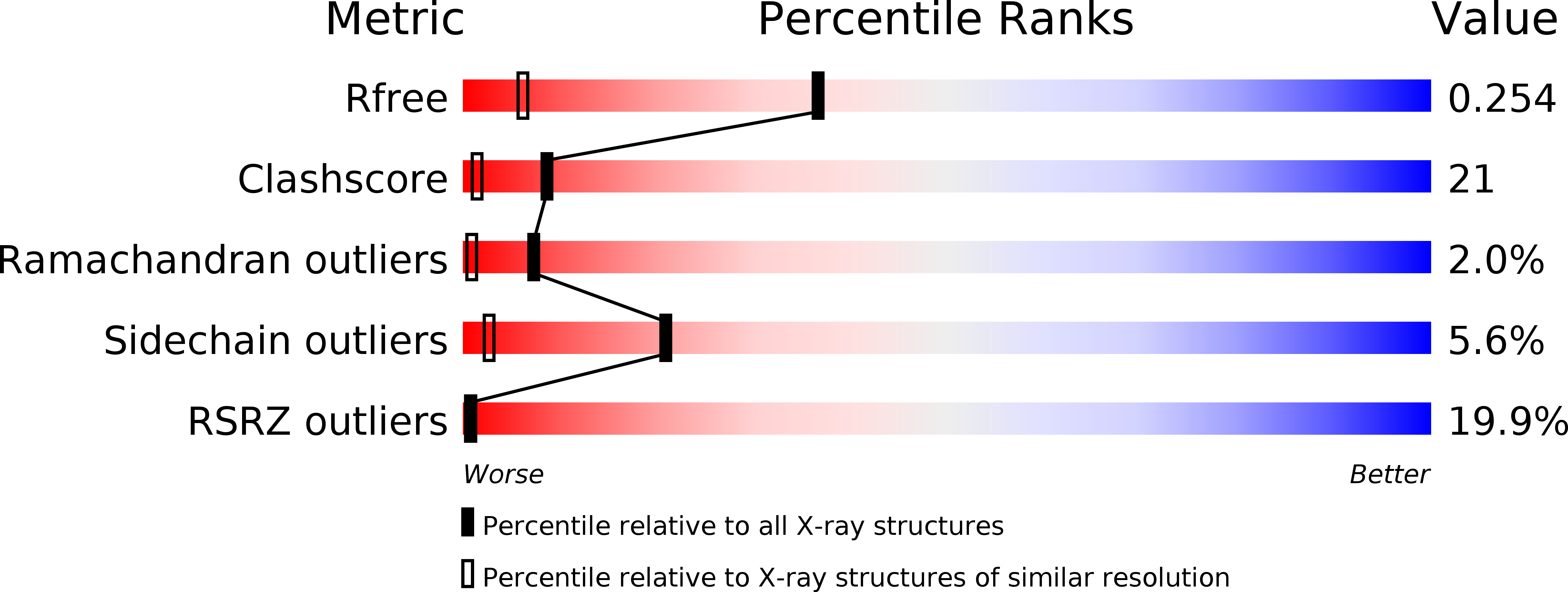
1.50 Å
R-Value Free:
0.25
R-Value Work:
0.24
R-Value Observed:
0.24
Space Group:
I 4
Macromolecular Entities
Structures with similar UniProt ID
Protein Blast
Polymer Type:polypeptide(L)
Molecule:recoverin
Gene (Uniprot):RCVRN
Chain IDs:A
Chain Length:201
Number of Molecules:1
Biological Source:Bos taurus
Ligand Molecules
Primary Citation
Impact of N-terminal myristoylation on the Ca2+-dependent conformational transition in recoverin
J.Biol.Chem. 278 22972 22979 (2003)
PMID: 12686556 DOI: 10.1074/jbc.M300447200

Abstact

Recoverin is a Ca2+-regulated signal transduction modulator found in vertebrate retina that has been shown to undergo dramatic conformational changes upon Ca2+ binding to its two functional EF-hand motifs. To elucidate the differential impact of the N-terminal myristoylation as well as occupation of the two Ca2+ binding sites on recoverin structure and function, we have investigated a non-myristoylated E85Q mutant exhibiting virtually no Ca2+ binding to EF-2. Crystal structures of the mutant protein as well as the non-myristoylated wild-type have been determined. Although the non-myristoylated E85Q mutant does not display any functional activity, its three-dimensional structure in the presence of Ca2+ resembles the myristoylated wild-type with two Ca2+ but is quite dissimilar from the myristoylated E85Q mutant. We conclude that the N-terminal myristoyl modification significantly stabilizes the conformation of the Ca2+-free protein (i.e. the T conformation) during the stepwise transition toward the fully Ca2+-occupied state. On the basis of these observations, a refined model for the role of the myristoyl group as an intrinsic allosteric modulator is proposed.

Legend

Protein

Chemical

Disease

Primary Citation of related structures
Feedback Form
Name
Email
Institute
Feedback