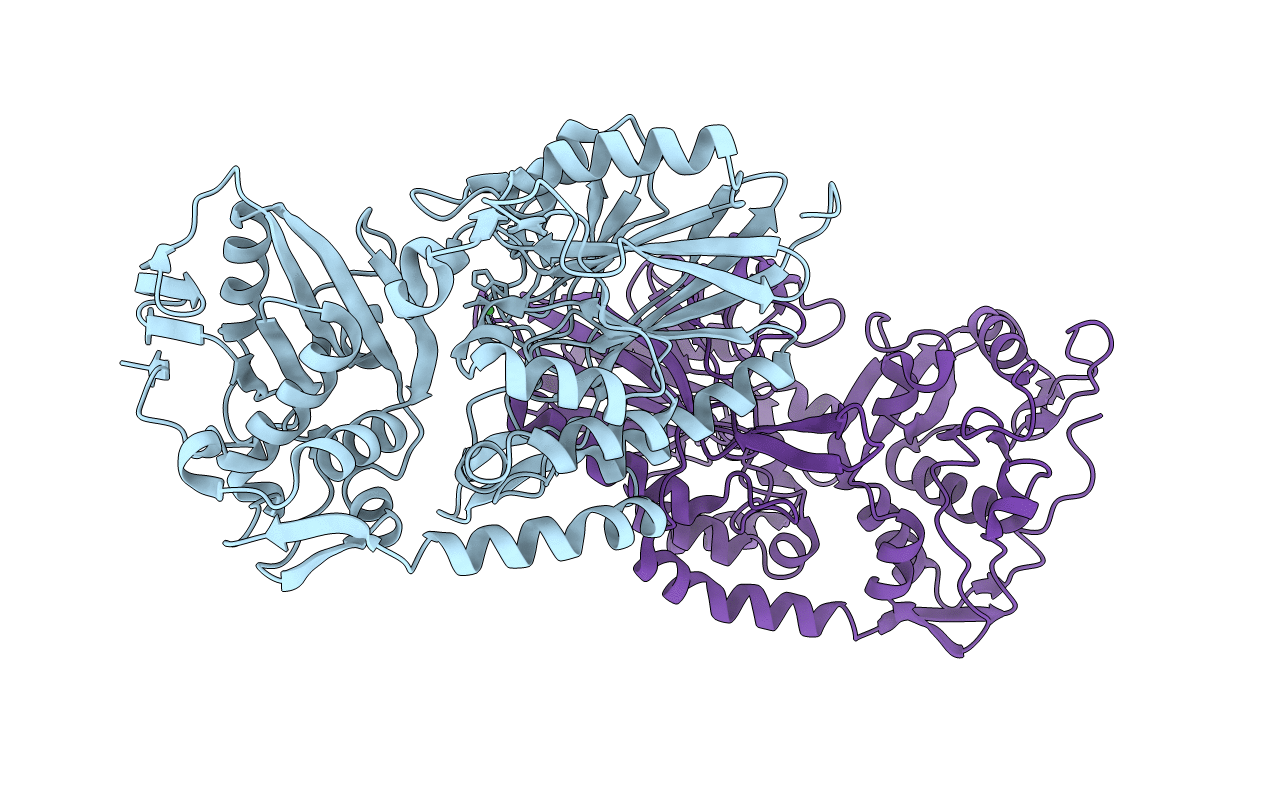
1OID image
Deposition Date 2003-06-13
Release Date 2004-06-10
Last Version Date 2024-11-06
Entry Detail
PDB ID:
1OID
Keywords:
Title:
5'-Nucleotidase (E. coli) with an Engineered Disulfide Bridge (S228C, P513C)
Biological Source:
Source Organism:
ESCHERICHIA COLI (Taxon ID: 562)
Host Organism:
Method Details:
Experimental Method:
Resolution:
2.10 Å
R-Value Free:
0.21
R-Value Work:
0.16
R-Value Observed:
0.16
Space Group:
P 1 21 1

Macromolecular Entities
Structures with similar UniProt ID
Protein Blast
Polymer Type:polypeptide(L)
Molecule:PROTEIN USHA
Gene (Uniprot):ushA
Mutagens:YES
Chain IDs:A, B
Chain Length:532
Number of Molecules:2
Biological Source:ESCHERICHIA COLI
Ligand Molecules
Primary Citation
Trapping a 96 Degree Domain Rotation in Two Distinct Conformations by Engineered Disulfide Bridges
Protein Sci. 13 1811 ? (2004)
PMID: 15215524 DOI: 10.1110/PS.04629604

Abstact

Engineering disulfide bridges is a common technique to lock a protein movement in a defined conformational state. We have designed two double mutants of Escherichia coli 5'-nucleotidase to trap the enzyme in both an open (S228C, P513C) and a closed (P90C, L424C) conformation by the formation of disulfide bridges. The mutant proteins have been expressed, purified, and crystallized, to structurally characterize the designed variants. The S228C, P513C is a double mutant crystallized in two different crystal forms with three independent conformers, which differ from each other by a rotation of up to 12 degrees of the C-terminal domain with respect to the N-terminal domain. This finding, as well as an analysis of the domain motion in the crystal, indicates that the enzyme still exhibits considerable residual domain flexibility. In the double mutant that was designed to trap the enzyme in the closed conformation, the structure analysis reveals an unexpected intermediate conformation along the 96 degrees rotation trajectory between the open and closed enzyme forms. A comparison of the five independent conformers analyzed in this study shows that the domain movement of the variant enzymes is characterized by a sliding movement of the residues of the domain interface along the interface, which is in contrast to a classical closure motion where the residues of the domain interface move perpendicular to the interface.

Legend

Protein

Chemical

Disease

Primary Citation of related structures
Feedback Form
Name
Email
Institute
Feedback