1NXD image
Deposition Date 2003-02-10
Release Date 2004-03-30
Last Version Date 2024-12-25
Entry Detail
PDB ID:
1NXD
Title:
Crystal structure of MnMn Concanavalin A
Biological Source:
Source Organism:
Method Details:
Experimental Method:
Resolution:
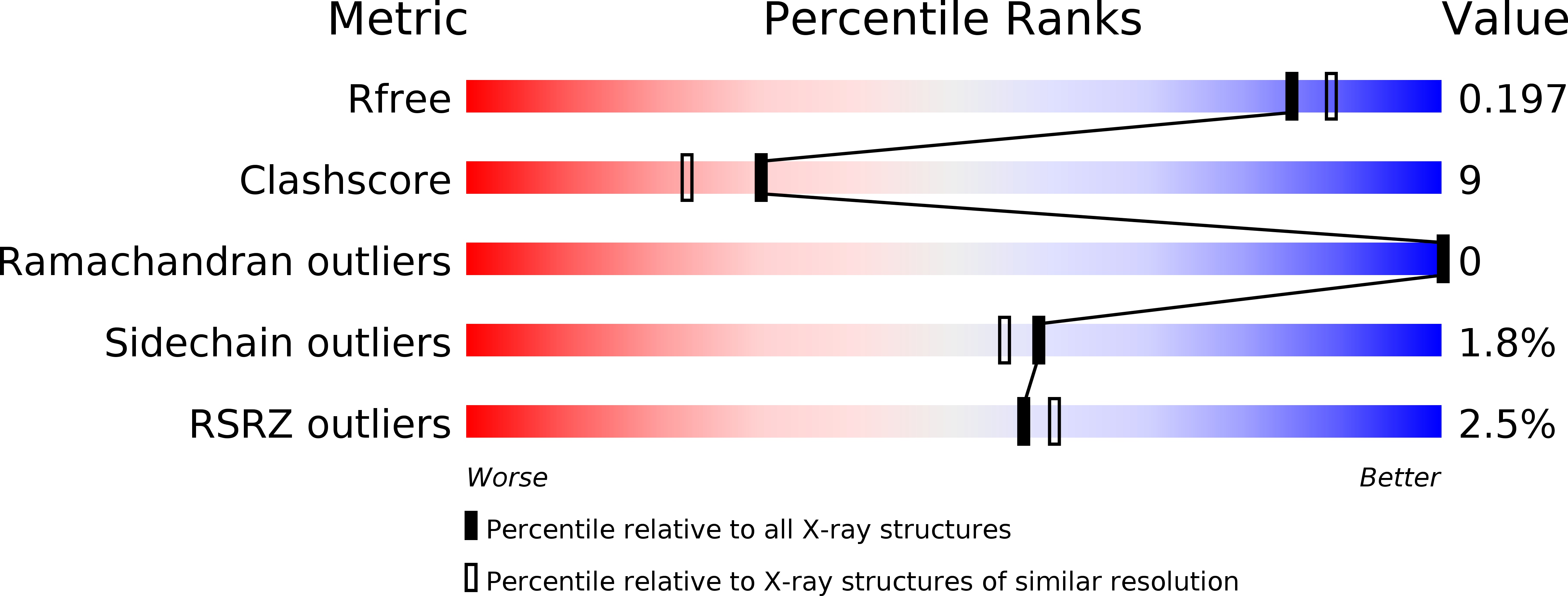
1.90 Å
R-Value Free:
0.20
R-Value Work:
0.18
Space Group:
C 2 2 21
Macromolecular Entities
Structures with similar UniProt ID
Protein Blast
Polymer Type:polypeptide(L)
Molecule:concanavalin A
Chain IDs:A (auth: 1), B (auth: 2), C (auth: 3), D (auth: 4)
Chain Length:237
Number of Molecules:4
Biological Source:Canavalia ensiformis
Primary Citation
Structure of concanavalin A at pH 8: bound solvent and crystal contacts.
Acta Crystallogr.,Sect.D 60 1048 1056 (2004)
PMID: 15159564 DOI: 10.1107/S0907444904007000

Abstact

Concanavalin A has been crystallized in the presence of the ligand (6-S-beta-D-galactopyranosyl-6-thio)-cyclomaltoheptaose. The crystals are isomorphous to those reported for ConA complexed with peptides at low resolution (3.00-2.75 angstroms). The structure was solved at 1.9 angstroms, with free R and R values of 0.201 and 0.184, respectively. As expected, no molecules of the ligand were bound to the protein. Soaking in the cryobuffer left its fingerprint as 25 molecules of glycerol in the bound solvent, most of them at specific positions. The fact that a glycerol molecule is located in the sugar-binding pocket of each of the four subunits in the asymmetric unit and another is located in two of the peptide-binding sites suggests a recognition phenomenon rather than a displacement of water molecules by glycerol. Crystal contact analysis shows that a relation exists between the residues that form hydrogen bonds to other asymmetric units and the space group: contact Asp58-Ser62 is a universal feature of ConA crystals, while Ser66-His121, Asn69-Asn118 and Tyr100-His205 contacts are general features of the C222(1) crystal form.

Legend

Protein

Chemical

Disease

Primary Citation of related structures
Feedback Form
Name
Email
Institute
Feedback