1NOG image
Deposition Date 2003-01-16
Release Date 2003-07-29
Last Version Date 2024-02-14
Entry Detail
PDB ID:
1NOG
Title:
Crystal Structure of Conserved Protein 0546 from Thermoplasma Acidophilum
Biological Source:
Source Organism:
Method Details:
Experimental Method:
Resolution:
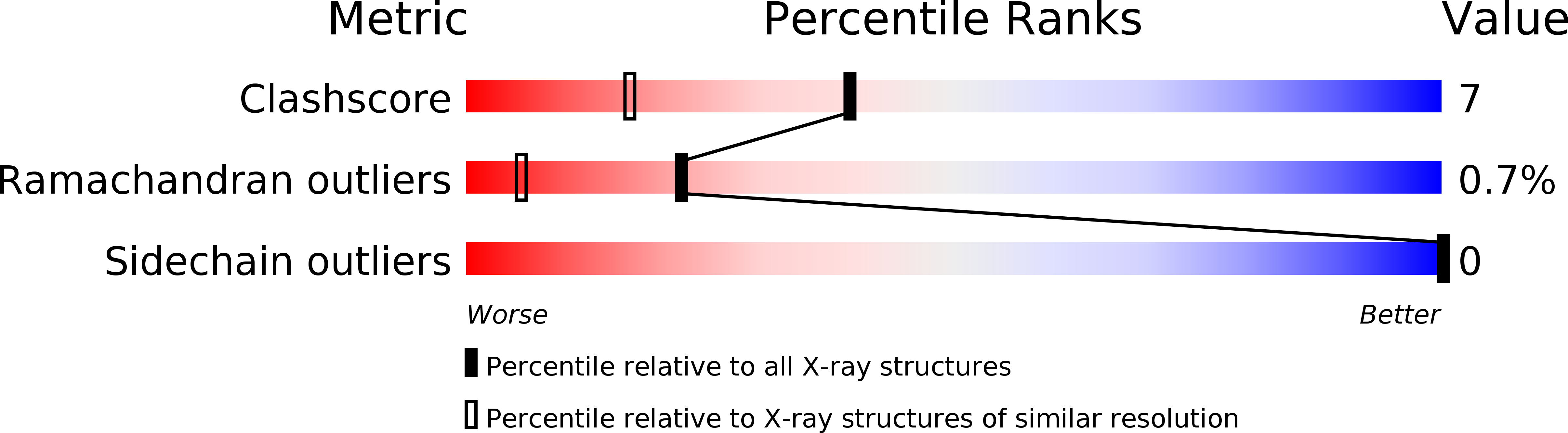
1.55 Å
R-Value Free:
0.21
R-Value Work:
0.19
R-Value Observed:
0.19
Space Group:
P 2 3
Macromolecular Entities
Structures with similar UniProt ID
Protein Blast
Polymer Type:polypeptide(L)
Molecule:conserved hypothetical protein TA0546
Gene (Uniprot):Ta1434
Chain IDs:A
Chain Length:177
Number of Molecules:1
Biological Source:Thermoplasma acidophilum
Primary Citation
The structural basis for methylmalonic aciduria. The crystal structure of archaeal ATP:cobalamin adenosyltransferase.
J.Biol.Chem. 279 23646 23653 (2004)
PMID: 15044458 DOI: 10.1074/jbc.M401395200

Abstact

ATP:cobalamin adenosyltransferase MMAB was recently identified as the gene responsible for a disorder of cobalamin metabolism in humans (cblB complementation group). The crystal structure of the MMAB sequence homologue from Thermoplasma acidophilum (TA1434; GenBank identification number gi|16082403) was determined to a resolution of 1.5 A. TA1434 was confirmed to be an ATP:cobalamin adenosyltransferase, which depended absolutely on divalent metal ions (Mg2+ > Mn2+ > Co2+) and only used ATP or dATP as adenosyl donors. The apparent Km of TA1434 was 110 microM (kcat = 0.23 s(-1)) for ATP, 140 microM (kcat = 0.11 s(-1)) for dATP, and 3 microM (kcat = 0.18 s(-1)) for cobalamin. TA1434 is a trimer in solution and in the crystal structure, with each subunit composed of a five-helix bundle. The location of disease-related point mutations and other residues conserved among the homologues of TA1434 suggest that the active site lies at the junctions between the subunits. Mutations in TA1434 that correspond to the disease-related mutations resulted in proteins that were inactive for ATP:cobalamin adenosyltransferase activity in vitro, confirming that these mutations define the molecular basis of the human disease.

Legend

Protein

Chemical

Disease

Primary Citation of related structures
Feedback Form
Name
Email
Institute
Feedback