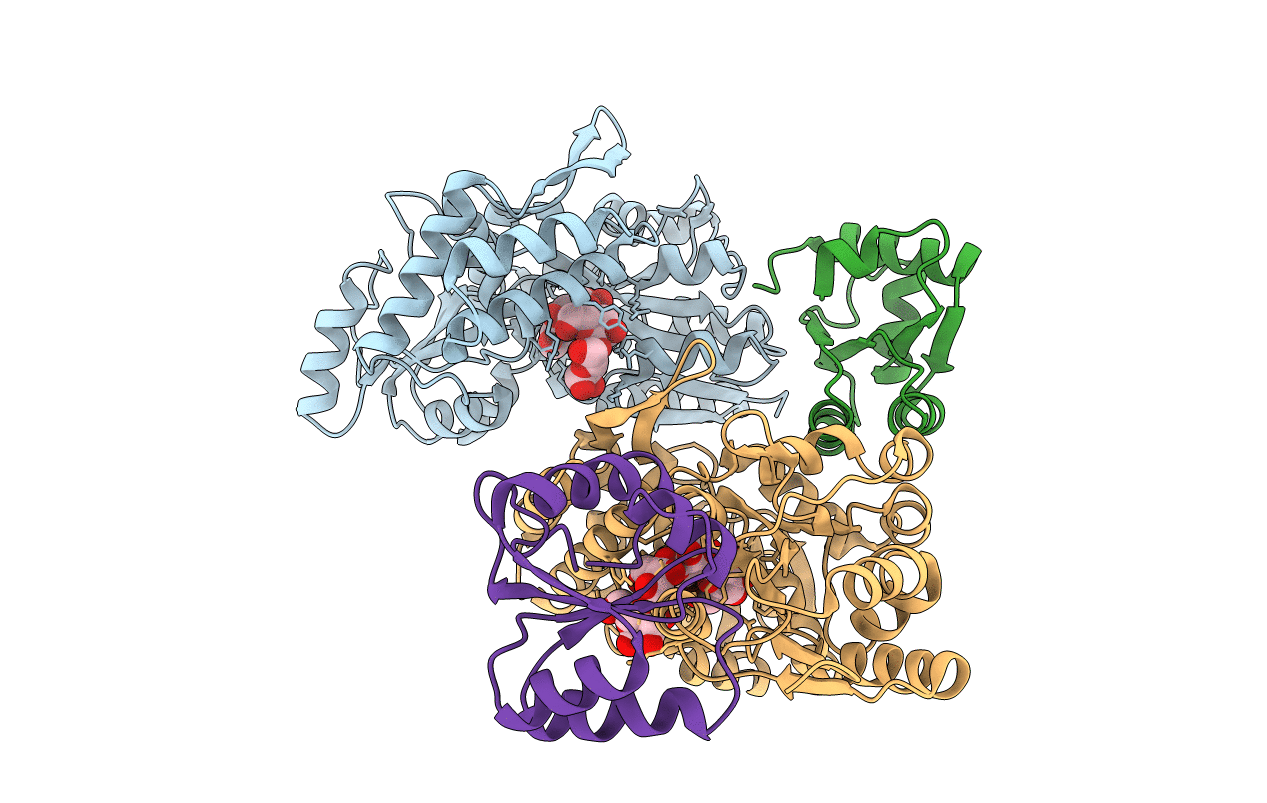
1NMU image
Deposition Date 2003-01-10
Release Date 2003-02-18
Last Version Date 2024-05-22
Entry Detail
PDB ID:
1NMU
Title:
MBP-L30
Biological Source:
Source Organism:
Host Organism:
Method Details:
Experimental Method:
Resolution:
2.31 Å
R-Value Free:
0.25
R-Value Work:
0.21
R-Value Observed:
0.22
Space Group:
P 21 21 21

Macromolecular Entities
Structures with similar UniProt ID
Protein Blast
Polymer Type:polypeptide(L)
Molecule:maltose-binding periplasmic protein
Chain IDs:A, C
Chain Length:382
Number of Molecules:2
Biological Source:Escherichia coli
Structures with similar UniProt ID
Protein Blast
Polymer Type:polypeptide(L)
Molecule:60S ribosomal protein L30
Gene (Uniprot):RPL30
Chain IDs:B, D
Chain Length:104
Number of Molecules:2
Biological Source:Saccharomyces cerevisiae
Peptide-like Molecules
PRD_900010
Primary Citation
Inherent Protein Structural Flexibility at the RNA-binding Interface of L30e
J.Mol.Biol. 326 999 1004 (2003)
PMID: 12589748 DOI: 10.1016/S0022-2836(02)01476-6

Abstact

The Saccharomyces cerevisiae ribosomal protein L30 autoregulates its own expression by binding to a purine-rich internal loop in its pre-mRNA and mRNA. NMR studies of L30 and its RNA complex showed that both the internal loop of the RNA as well as a region of the protein become substantially more ordered upon binding. A crystal structure of a maltose binding protein (MBP)-L30 fusion protein with two copies in the asymmetric unit has been determined. The flexible RNA-binding region in the L30 copies has two distinct conformations, one resembles the RNA bound form solved by NMR and the other is unique. Structure prediction algorithms also had difficulty accurately predicting this region, which is consistent with conformational flexibility seen in the NMR and X-ray crystallography studies. Inherent conformational flexibility may be a hallmark of regions involved in intermolecular interactions.

Legend

Protein

Chemical

Disease

Primary Citation of related structures
Feedback Form
Name
Email
Institute
Feedback