1NLU image
Deposition Date 2003-01-07
Release Date 2004-01-20
Last Version Date 2025-03-26
Entry Detail
PDB ID:
1NLU
Title:
Pseudomonas sedolisin (serine-carboxyl proteinase) complexed with two molecules of pseudo-iodotyrostatin
Biological Source:
Source Organism:
Pseudomonas sp. (Taxon ID: 306)
Host Organism:
Method Details:
Experimental Method:
Resolution:
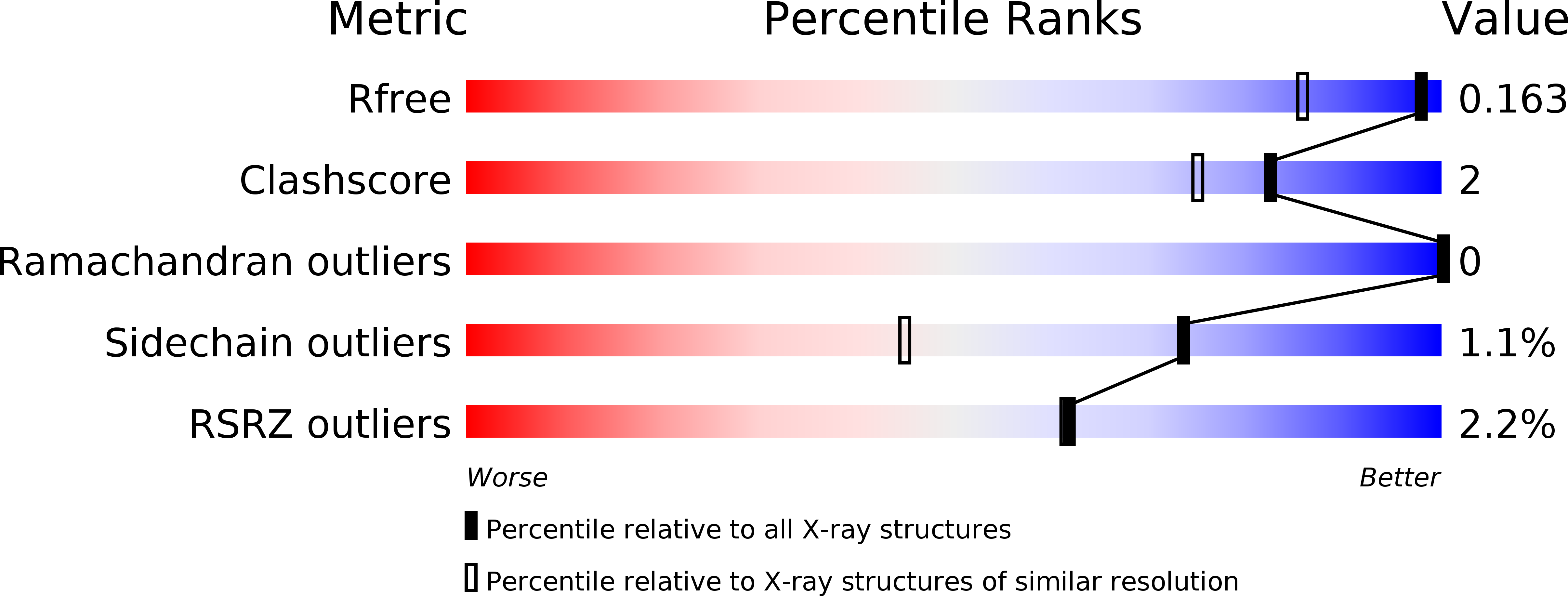
1.30 Å
R-Value Free:
0.19
R-Value Work:
0.16
Space Group:
P 62
Macromolecular Entities
Structures with similar UniProt ID
Protein Blast
Polymer Type:polypeptide(L)
Molecule:SEDOLISIN
Gene (Uniprot):pcp
Chain IDs:A
Chain Length:370
Number of Molecules:1
Biological Source:Pseudomonas sp.
Polymer Type:polypeptide(L)
Molecule:PSEUDO-IODOTYROSTATIN
Chain IDs:B, C
Chain Length:3
Number of Molecules:2
Biological Source:
Modified Residue
Compound ID Chain ID Parent Comp ID Details 2D Image
PHI B PHE IODO-PHENYLALANINE
TYB B TYR TYROSINAL
Ligand Molecules
Peptide-like Molecules
PRD_000754
Primary Citation
Two inhibitor molecules bound in the active site of Pseudomonas sedolisin: a model for the bi-product complex following cleavage of a peptide substrate.
Biochem.Biophys.Res.Commun. 314 638 645 (2004)
PMID: 14733955 DOI: 10.1016/j.bbrc.2003.12.130

Abstact

High-resolution crystallographic analysis of a complex of the serine-carboxyl proteinase sedolisin with pseudo-iodotyrostatin revealed two molecules of this inhibitor bound in the active site of the enzyme, marking subsites from S3 to S3('). The mode of binding represents two products of the proteolytic reaction. Substrate specificity of sedolisin was investigated using peptide libraries and a new peptide substrate for sedolisin, MCA-Lys-Pro-Pro-Leu-Glu#Tyr-Arg-Leu-Gly-Lys(DNP)-Gly, was synthesized based on the results of the enzymatic and crystallographic studies and was shown to be efficiently cleaved by the enzyme. The kinetic parameters for the substrate, measured by the increase in fluorescence upon relief of quenching, were: k(cat)=73+/-5 s(-1), K(m)=0.12+/-0.011 microM, and k(cat)/K(m)=608+/-85 s(-1)microM(-1).

Legend

Protein

Chemical

Disease

Primary Citation of related structures
Feedback Form
Name
Email
Institute
Feedback