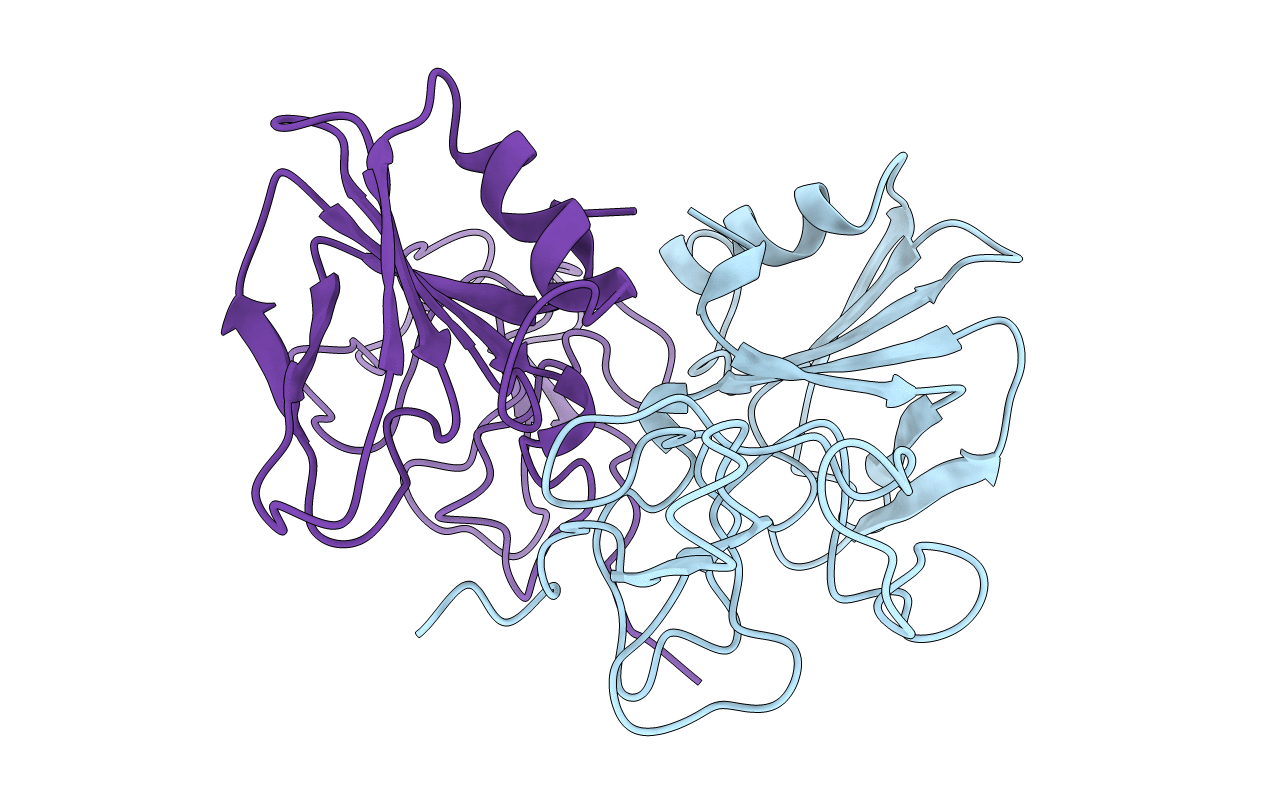
1NK1 image
Deposition Date 1998-08-20
Release Date 1999-01-13
Last Version Date 2024-11-06
Entry Detail
PDB ID:
1NK1
Title:
NK1 FRAGMENT OF HUMAN HEPATOCYTE GROWTH FACTOR/SCATTER FACTOR (HGF/SF) AT 2.5 ANGSTROM RESOLUTION
Biological Source:
Source Organism:
Homo sapiens (Taxon ID: 9606)
Host Organism:
Method Details:
Experimental Method:
Resolution:
2.50 Å
R-Value Free:
0.31
R-Value Work:
0.24
R-Value Observed:
0.24
Space Group:
P 1 21 1
Macromolecular Entities
Structures with similar UniProt ID
Protein Blast
Polymer Type:polypeptide(L)
Molecule:PROTEIN (HEPATOCYTE GROWTH FACTOR PRECURSOR)
Gene (Uniprot):HGF
Mutagens:A29V
Chain IDs:A, B
Chain Length:183
Number of Molecules:2
Biological Source:Homo sapiens
Primary Citation
Crystal structure of the NK1 fragment of HGF/SF suggests a novel mode for growth factor dimerization and receptor binding.
Nat.Struct.Biol. 6 72 79 (1999)
PMID: 9886295 DOI: 10.1038/4947

Abstact

Although ligand-induced receptor dimerization is a common prerequisite for receptor activation, the mode by which different growth factors bind their receptors and cause them to dimerize varies considerably. Here we report the crystal structure at 2.5 A resolution of NK1, a receptor-binding fragment and a natural splice variant of hepatocyte growth factor/scatter factor (HGF/SF). NK1 assembles as a homodimer in the asymmetric unit, revealing a novel mode of growth factor dimerization produced by close packing of the N domain of one subunit and the kringle domain of the other, thus bringing the two linkers in close proximity. The structure suggests the presence of a binding site for heparan sulfate chains and a mechanism by which the NK1 dimer may engage two receptor molecules through clusters of amino acids located on each protomer and on opposite surfaces of the homodimer. We also report that short (14-mer) heparin fragments effectively dimerize NK1 in solution, implying that heparan sulfate chains may stabilize the NK1 dimer. These results provide a basis for the agonistic activity of NK1 and have implications for the mechanism of receptor binding of HGF/SF.

Legend

Protein

Chemical

Disease

Primary Citation of related structures
Feedback Form
Name
Email
Institute
Feedback