1NJO image
Deposition Date 2003-01-02
Release Date 2003-02-11
Last Version Date 2023-08-16
Entry Detail
PDB ID:
1NJO
Keywords:
Title:
The crystal structure of the 50S Large ribosomal subunit from Deinococcus radiodurans complexed with a short substrate analog ACCPuromycin (ACCP)
Biological Source:
Source Organism:
Method Details:
Experimental Method:
Resolution:
3.70 Å
R-Value Free:
0.29
R-Value Work:
0.28
R-Value Observed:
0.28
Space Group:
I 2 2 2
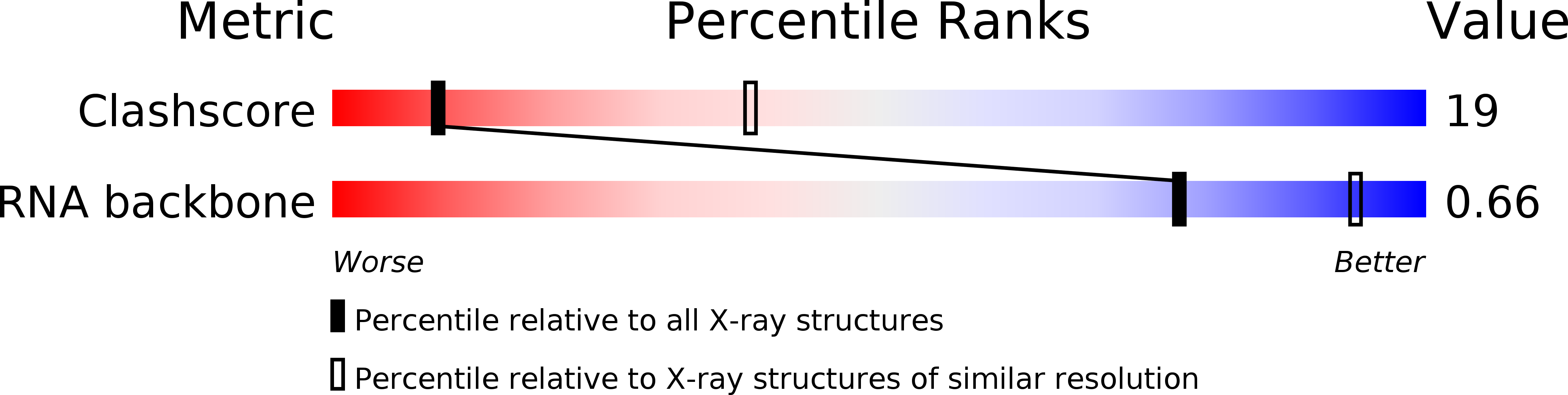
Macromolecular Entities
Polymer Type:polyribonucleotide
Molecule:23S ribosomal RNA
Chain IDs:A (auth: 0)
Chain Length:2880
Number of Molecules:1
Biological Source:Deinococcus radiodurans
Polymer Type:polyribonucleotide
Molecule:RNA ACC(Puromycin)
Chain IDs:B (auth: 5)
Chain Length:4
Number of Molecules:1
Biological Source:
Modified Residue
Compound ID Chain ID Parent Comp ID Details 2D Image
PPU B A PUROMYCIN-5'-MONOPHOSPHATE
Ligand Molecules
Primary Citation
Structural basis of the ribosomal machinery for Peptide bond formation, translocation, and nascent chain progression
Mol.Cell 11 91 102 (2003)
PMID: 12535524 DOI: 10.1016/S1097-2765(03)00009-1

Abstact

Crystal structures of tRNA mimics complexed with the large ribosomal subunit of Deinococcus radiodurans indicate that remote interactions determine the precise orientation of tRNA in the peptidyl-transferase center (PTC). The PTC tolerates various orientations of puromycin derivatives and its flexibility allows the conformational rearrangements required for peptide-bond formation. Sparsomycin binds to A2602 and alters the PTC conformation. H69, the intersubunit-bridge connecting the PTC and decoding site, may also participate in tRNA placement and translocation. A spiral rotation of the 3' end of the A-site tRNA around a 2-fold axis of symmetry identified within the PTC suggests a unified ribosomal machinery for peptide-bond formation, A-to-P-site translocation, and entrance of nascent proteins into the exit tunnel. Similar 2-fold related regions, detected in all known structures of large ribosomal subunits, indicate the universality of this mechanism.

Legend

Protein

Chemical

Disease

Primary Citation of related structures
Feedback Form
Name
Email
Institute
Feedback